Page 1 of 2
All that remains
Posted: Tue Jul 28, 2015 11:24 pm
by Gob
Scientists say they have identified the remains of four men who were among the early leaders of Virginia's Jamestown settlement.
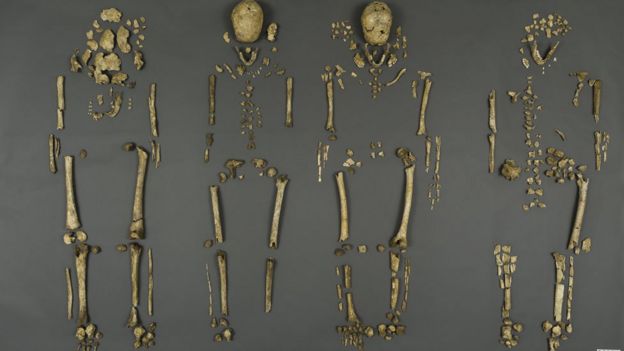
Jamestown was the first successful British colony that gave rise to modern day America.
The bodies were exhumed in November 2013 in the church where Pocahontas married Captain John Rolfe in 1614.
It took two years of detective work and the latest scientific techniques to identify the badly-preserved bones.
It's now known the remains belong to important figures who lived in Jamestown between 1607 and 1610, when the colony almost collapsed.
"This was a time of food shortages, Indian attacks and disease," says James Horn, president of Jamestown Rediscovery. "These men helped established the colony and bring to life the challenges faced by the first settlers."
"We have two men from the first expedition of 1607 and two men from the second expedition that saved Jamestown and English America in 1610. So it's highly significant in terms of understanding the success of Jamestown and its survival as an English colony in the New World."
The bodies were found in the church's chancel, indicating they were people of great status in the community.
Using physical evidence at the site, analysis of the bones and extensive historical research, scientists narrowed the search down to these four men.
Re: All that remains
Posted: Wed Jul 29, 2015 8:30 pm
by oldr_n_wsr
Should they be digging these bones up?
Is someone going to dig up our bones in 400 years?
I can see getting a sample to date the bones and such, but digging all the bones up and reassembling them out of the tomb seems a little to much.
Re: All that remains
Posted: Thu Dec 03, 2015 4:41 am
by BoSoxGal
You'll be dead then, you won't care.

Re: All that remains
Posted: Thu Dec 03, 2015 8:51 am
by Lord Jim
I wish somebody would explain that to the Indian tribes...
Re: All that remains
Posted: Thu Dec 03, 2015 1:37 pm
by TPFKA@W
This is why I intend to be cremated. No bones about it.
Re: All that remains
Posted: Thu Dec 03, 2015 1:45 pm
by Guinevere
Lord Jim wrote:I wish somebody would explain that to the Indian tribes...
Pretty sure the dead aren't the ones complaining. Would it be OK to dig up your parents? Your grandparents? The sainted confederate great great great?
Re: All that remains
Posted: Thu Dec 03, 2015 1:52 pm
by Lord Jim
No it wouldn't...
And I don't approve of what was done in Jamestown either. Do you?
Re: All that remains
Posted: Thu Dec 03, 2015 3:16 pm
by Big RR
Jim--personally it wouldn't bother me at all if someone did that to my ancestors--they're dead bodies, not the people; however, I recognize not everyone feels that way. However, to the extent these people (or their heirs) went to the effort and cost of establishing some space dedicated to the perpetual storage of their remains, I do think it is wrong that the bones are dug up in violation of this trust--the same for the Native American burial grounds.
Re: All that remains
Posted: Thu Dec 03, 2015 4:13 pm
by Jarlaxle
Don't care...personally, I'm seriously considering donating my body to a medical school.
Re: All that remains
Posted: Thu Dec 03, 2015 4:16 pm
by MajGenl.Meade
Except that only is of much value if you die young. They don't want old flabby bodies (at least, my parents both signed up for that and both were rejected). I've heard of others.
Re: All that remains
Posted: Thu Dec 03, 2015 4:19 pm
by TPFKA@W
Well we have rummaged around King Tut's tomb and placed things on display. I doubt that was the original intent of the tomb.
At what point do we draw the line and say it is too early to dig up bones?
Where does the right to privacy end and the right to be educated about the past begin?
Re: All that remains
Posted: Thu Dec 03, 2015 4:52 pm
by Big RR
That's a good question; I propose a millennium.
Re: All that remains
Posted: Thu Dec 03, 2015 5:04 pm
by Guinevere
I agree, its a difficult balance between history/science and respect. I don't think there can be a hard and fast rule --- shouldn't it depend on the circumstances? What's magical about a millennium, except its a large number. Does it matter today if Napoleon died of natural causes or was poisoned? Does it matter how our early settlers ate? Does it matter what kind of trinkets we can find in King Tut's tomb?
I don't know, truly.
Re: All that remains
Posted: Thu Dec 03, 2015 5:31 pm
by rubato
It is an important part of Native American culture to show respect by their actions in the present to their ancestors. Even distant ones. We are obligated to respect their wishes just as we would be obliged to show respect to the families of the dead in how we moved a modern cemetery, if dam construction or something else made it necessary.
I was raised to believe that a dead body is inert matter with no real connection to the person who used to inhabit that body. If they want to dig me up in the future for some scientific purpose they can be my guest. When they are through marvelling at the perfection of my proportions and graceful shape of my limbs they can have at it and grind me up into bone meal for the flowerbeds. Or they can put me in a crypt and worship my remains for all eternity. It's all the same to me.
IIR they sought and received the consent of the known descendants of Richard III when they dug him up recently. [note] ( I just looked it up and there was substantial dispute between the putative descendants and other authorities netting the lawyers about 250,000 pounds and the claimants nothing. )
yrs,
rubato
Re: All that remains
Posted: Thu Dec 03, 2015 5:35 pm
by MajGenl.Meade
Yes, I think rubato has it. It's a question of belief and custom to the people who matter
Re: All that remains
Posted: Thu Dec 03, 2015 6:00 pm
by Jarlaxle
TPFKA@W wrote:Well we have rummaged around King Tut's tomb and placed things on display. I doubt that was the original intent of the tomb.
At what point do we draw the line and say it is too early to dig up bones?
Where does the right to privacy end and the right to be educated about the past begin?
Wasn't Tut's tomb (like most) pillaged long ago by the very priests that entombed him?
Re: All that remains
Posted: Thu Dec 03, 2015 6:02 pm
by Big RR
Guin--
shouldn't it depend on the circumstances? What's magical about a millennium, except its a large number.
Yes, I proposed a millennium exactly because it is a large number--I'm happy to entertain any other numbers. and of course it depends on the circumstances--which is why an even newly buried body can be exhumed, but it requires a court order based on the circumstances.
I agree with rubato about the beliefs of the persons that should be taken into account, but then I do think there should be a period of time beyond which the beliefs will cease to matter; e.g. we can dig up fossilized remains of Neanderthals because a long time has passed even though we know nothing of their customs and beliefs.
Jarl--as I recall, one of the antechambers was breached long before the modern discovery--not certain by who.
Re: All that remains
Posted: Thu Dec 03, 2015 6:06 pm
by Lord Jim
Wasn't Tut's tomb (like most) pillaged long ago by the very priests that entombed him?
No it wasn't, which is what makes it pretty much unique...
It was discovered intact with all of the original treasures that had been placed in the tomb, as well as Tut's body...
Re: All that remains
Posted: Thu Dec 03, 2015 6:11 pm
by MajGenl.Meade
Re: All that remains
Posted: Thu Dec 03, 2015 6:28 pm
by Big RR
Lord Jim wrote:Wasn't Tut's tomb (like most) pillaged long ago by the very priests that entombed him?
No it wasn't, which is what makes it pretty much unique...
It was discovered intact with all of the original treasures that had been placed in the tomb, as well as Tut's body...
Sorry Jim
http://www.touregypt.net/featurestories/tutrobbery.html
As I recall, if It had not been touched in the past, Carnaveron (sp?) would have gotten a bigger share, but he did not because of the past pillaging. the surprising thing, however, is that many rooms, including the one holding his remains, were not touched which is why so many treasures were found.
