Lord Jim wrote:This is an interesting study, but it has some serious contradictions and flaws.
I'm going to analyze the numbers on homicide , (this study analyses both homicide and suicide , and then lumps them together to reach it's conclusion; the first major flaw) since they are obviously two completely different kinds of events, with two completely different sets of factors involved. (Suicide should be discussed separately.)
First, the contradiction, as relates to homicide. Here's the studies conclusion:
In our study, the risk of dying from a firearm-related homicide or suicide [as I said, the study's conclusion lumps these together]was greater in homes with guns
From the same study:
an estimated 40 percent of adults in the United States report keeping a gun in the home for recreational or protective purposes
According to the study's footnote, that the number comes from a Justice Department survey conducted in 2001. I can't find the original report, but I suspect the researchers may be misstating that somewhat, (substituting "adults" for "households") based on the results of this 2005 Gallup poll:
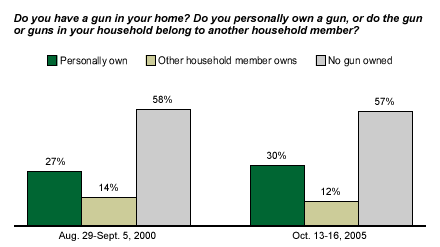
How many Americans personally own guns, and what do they use them for? A recent Gallup Poll* shows that 3 in 10 Americans personally own a gun; most gun owners say they use their guns to protect themselves against crime, for hunting, and for target shooting. Gun ownership varies by different groups in the country, with men more likely to be gun owners than women, Southerners and Midwesterners more likely than Easterners or Westerners, Republicans more so than Democrats, and older rather than younger Americans.
Gun Ownership
The poll, conducted Oct. 13-16, finds that 4 in 10 Americans report they have a gun in their homes, including 30% who say they personally own a gun and 12% who say another member of their household owns it. These results show essentially no change since this question was last asked in 2000. At that time, 27% of Americans said they personally owned a gun and 14% said another household member owned one.
 http://www.gallup.com/poll/20098/gun-ow ... erica.aspx
So, it seems to me the fair thing to do based on that, would be to substitute "households" for "adults" and then accept an estimate of somewhere around 40% or slightly higher as houesholds where a firearm is present.
Now, again, from the Oxford study rube quotes:
Nearly three quarters of suicide victims lived in a home where one or more firearms were present, compared with 42 percent of homicide victims and one third of those who died of other causes
Well, gee whiz....
We have roughly 40% of the households with firearms, and 42% of homicides occurring in households where firearms are present....
According to the Oxford study's
own data, the differentiation between homicides occurring in households with firearms and without, is
statistically insignificant.... not "greater"....
But it's worse than that...(here's one of the serious flaws)
Look at the methodology the Oxford study employs:
We used the death certificates for information on the decedent’s cause and manner of death and proxy-respondent interviews for all other demographic and behavioral information on the decedent. The study sample consisted of deaths that occurred in the home. Included were persons who subsequently died en route to or at a hospital. Deaths were classified by whether they were homicides (n = 490; International Classification of Diseases, Ninth Revision codes E960–E969), suicides (n = 1,049; International Classification of Diseases, Ninth Revision codes E950–E959), or the result of other causes (n = 535). Accidental poisonings or poisonings of undetermined intent, unintentional firearm injuries and firearm injuries of undetermined intent, and other deaths of undetermined cause were excluded from the study sample on the basis that they could be homicides or suicides.
See the problem here? For their statistical purposes, they are classifying
any death caused deliberately by a firearm as a "homicide". This
must be the case because
nowhere on that list of factors they
excluded from their homicide by firearm criteria, does the phrase, "death by someone in the household using a firearm for self defense" appear.
In other words, in order to get to their 42% number, they have included the deaths of home invaders in the number and labeled them "homicides". This represents illegitimate methodology, and provides misleading conclusions, since shooting and killing someone who invades your home is
not legally defined as "homicide".
The conclusion to be drawn from all of this, is that despite the fact that the the authors of this study went to great pains to conduct much of what they did in an apparently scientific manner, they failed to do so in some key and important ways, tainting their conclusions, and strongly suggesting that their results were driven more by an agenda than by objective inquiry.
To summarize, two decisions they made point to this, quite clearly:
1. The decision to lump two completely different kinds of actions, (suicide and homicide) together in order to be able to state their conclusion. (Since they must have realized that stating them separately wouldn't have shown a statistical difference regarding homicide)
2.The decision to lump all deliberate firearms deaths together and label them as "homicides" without regard to whether or not the person who died was a perp or a vic.
I'm really glad rube posted this, because it has given me an opportunity to illustrate something I have talked about before. (most recently in a discussion about second hand smoke)
The way in which something can "look scientific" but if you really drill down you can see how by fudging and blurring key distinctions, results can be massaged to reach the conclusions that the "researchers" wanted to reach in the first place.
This study is a classic case in point.