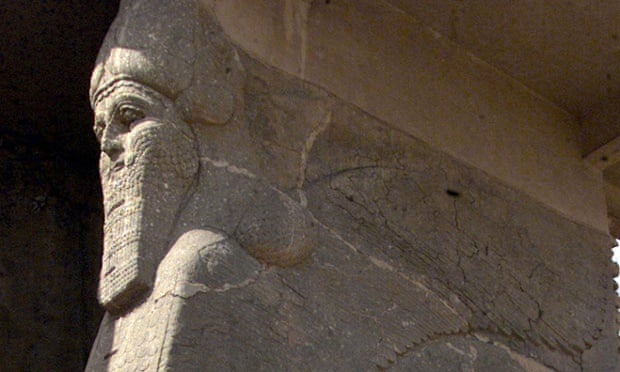
Nimrud gone
Posted: Fri Mar 06, 2015 10:29 pm
Activists, officials and historians have condemned Islamic State (Isis) for the destruction of the ancient Assyrian archaeological site of Nimrud in Iraq, with Unesco describing the act as a war crime.
“They are not destroying our present life, or only taking the villages, churches, and homes, or erasing our future – they want to erase our culture, past and civilisation,” said Habib Afram, the president of the Syriac League of Lebanon, adding that Isis’s actions were reminiscent of the Mongol invasion of the Middle East.
Iraq’s tourism and antiquities ministry said on Thursday that Isis had bulldozed the ancient city, south of Mosul, which was conquered by the militants in a lightning advance last summer.
“Daesh terrorist gangs continue to defy the will of the world and the feelings of humanity,” the ministry said, using the group’s Arabic acronym.
The destruction of the site, which became the capital of the Neo-Assyrian empire, was confirmed by a local tribal source speaking to Reuters.
“I condemn with the strongest force the destruction of the site at Nimrud,” Irina Bokova, the head of Unesco, said in a statement. Bokova said she had spoken with the heads of the UN security council and international criminal court on the issue.
“We cannot remain silent,” Bokova said. “The deliberate destruction of cultural heritage constitutes a war crime. I call on all political and religious leaders in the region to stand up and remind everyone that there is absolutely no political or religious justification for the destruction of humanity’s cultural heritage.”
Nimrud was first excavated in the 1840s by the British explorer Austen Henry Layard, who unearthed the winged bull gatekeeper statues later sent to the British Museum. The site also contains the palace of Ashurnasirpal, the king of Assyria.
Many of the site’s relics are in the British Museum and the Metropolitan Museum in New York, and other reliefs, wall paintings, clay tablets and ivory furniture recovered in the 1950s and 60s are in Iraq’s national museum in Baghdad, said Augusta McMahon, senior lecturer on Mesopotamia and the ancient near east at Cambridge, and who has carried out excavations in Iraq, Syria, Turkey and Yemen.
But the Nimrud site itself still hosts large numbers of reliefs and winged bull statues left in their original locations, and the palace grounds were reconstructed by the Iraqi government in the 1970s and 80s, said McMahon, adding that the winged bull statues in particular were probably targeted by the militants.