"... This shouldn’t come as a surprise. There are basic economic reasons why public social insurance is superior to voluntary charity. The goal here is to protect people against risk: of unemployment, of health emergency, of outliving one’s savings, and so on. For a risk-mitigation scheme to work, there are a few things that are necessary. One is that people actually be covered. This is something you can never have with a private system (unless it’s regulated to the point of being essentially public), since charities get to pick and choose whom they want to help. As Konczal says of private agencies before the Depression,
“They were also concerned they’d lose their ability to stigmatize—or to protect—various populations; by playing a role in determining who wasn’t deserving of assistance, they could shield those they felt worthy of their support.” ... "
No private charity has the goal of eliminating poverty or hunger or homelessness or disease or death or nakedness. They necessarily target a particular group (or a finite group of individuals) with the dual goals of alleviating the acute problem and addressing the issues that caused it, if possible. There are times when they are appropriately "judgmental," which many people in need find unacceptable.
Public "assistance" is provided by what amounts to an industry that figuratively "profits" by the number of "clients" and the amount of aid that is distributed. Next year's budget is based on this year's expenditures. Figure it out. Thus, people are encouraged to sign up for food stamps, to take advantage of their available exended unemployment benefits, to apply for disability stipends, to apply for subsidized housing and so on. Great pains are taken NOT to be judgmental about the need to avail oneself or the life choices that may have resulted in that need (and may be perpetuating the need).
Not surprisingly, the people who avail themselves of the Government "safety net" tend to take the benefits for as long as possible, and those in charge of disbursing the benefits do very little to discourage flaunting the System. it's not for nothing that we have so many more people on Food Stamps now than we did when Our Beloved President was elected.
The appropriate measure for the success of government assistance programs is the number of people who were able to use those benefits as a catalyst to self-sufficiency, and by that measure, our own U.S. Government's so-called "War on Poverty" has been a spectacular failure. It would have been far, far more beneficial to simply load a thousand dump trucks with cash and pay people to shovel it out on the streets in depressed neighborhoods throughout the country. At least then we wouldn't have to pay a million bureaucrats to administer the failed programs.
dgs49 wrote:Not surprisingly, the people who avail themselves of the Government "safety net" tend to take the benefits for as long as possible, and those in charge of disbursing the benefits do very little to discourage flaunting the System.
Try applying for public assistance some time and then come back and tell us how easy the workers make it for you to get benefits.
dgs49 wrote:it's not for nothing that we have so many more people on Food Stamps now than we did when Our Beloved President was elected.
According to this chart, During Bill Clinton's term in office, the food stamp participation level was lowered to less than the amount it was in 1979. Then from Bush II to present the levels have steadily risen.
That means Obama must have started recruiting people for food stamps back in 2001. What an evil person that black guy Obama turned out to be...
An underlying question is this: Would people make the same choices if the social safety net were not in place?
Would there be as many out-of-wedlock births if the mothers (and fathers) of those bastards knew that they alone would be responsible for the financial wellbeing of their offspring? And keep in mind that the universal availability of artificial birth control more or less coincides with the birth of the War on Poverty.
Would people manage their savings and investments more prudently during their working lives if Social Security didn't exist? (For one thing, their incomes would be about 1/7 greater without the SS tax).
Would families still assume that taking care of Mom & Pop was their primary obligation after Mom & Pop were too old to work (as they did before SS)?
Does public reliance on the social safety net make it necessary? If it didn't exist, and people adjusted their life choices accordingly, would private charity be sufficient?
dgs49 wrote:Does public reliance on the social safety net make it necessary? If it didn't exist, and people adjusted their life choices accordingly, would private charity be sufficient?
I guess that depends on what you believe would happen if there was no safety net.
Do you believe that if we were to eliminate Social Security and Public Assistance, more people with elderly parents would suddenly have enough money and the skills and willingness to care for their parents? There wouldn't be any child born that wasn't planned? People who now rely on Public Assistance would suddenly be able to earn a livable wage?
Why do you think those assistance programs were created?
Likewise, if one looks at 401K contributions, the sad fact is a large percentage (most?) workers don't even contribute enough money to take full advantage of their company's match. It's not because they expect to live well on social security, most people realize that is subsistence income at best, but because they either don't have sufficient money to save or choose not to save. either way, I doubt they'd behave differently without social security.
dgs49 wrote:An underlying question is this: Would people make the same choices if the social safety net were not in place?
A hard question to answer...but a good place to start would be to look at your own behavior and personal choices. Would you, yourself, have made any substantially different choices if the social safety net were not in place?
People who are wrong are just as sure they're right as people who are right. The only difference is, they're wrong.
— God@The Tweet of God
Before the days of Social Security, it was PRESUMED that you would care for your elderly parents when they were too old to work. This is one reason why older houses in our cities are so much bigger than they make them today. They assumed they would have more kids (true), and also that there would be a grandparent or a "maiden aunt" living with them. It wasn't a matter of whether you could afford it, it just WAS.
And if rather than a compulsory GOVERNMENT RUN retirement program, what if the New Dealers had decreed that the employer and employee would be compelled to set aside a certain percentage of earnings and invest them into one or more of some limited number of long-term investments? One way or another the money would be taken out of the earnings of the workers. As it was done, it was pretended that the money was going into a "trust fund," and when the smoke cleared away, we were told that the trust fund didn't exist and we were broke. The other way, the money would have been flowed into the economy where - who knows - it might have done some good and even appreciated in value over the years.
Social Security, like all liberal do-gooder programs, was intended to solve the problem of a relatively small percentage of the elderly population who had no retirement provisions and no family to assist. And in the attempt to solve the real problems of 5% of the elderly population, 100% of the population was compelled to enter into a ridiculous and unconstitutional Ponzi scheme, which will in due course bankrupt the Federal Government, thank you very much FDR.
As for my personal choices, I invited my (widower) father to live with my wife and me when he retired, and he did so until he died 12 years later. And we were richer for it. The same offer was made to my father-in-law, and he declined - and lived to regret it.
dgs49 wrote:As for my personal choices, I invited my (widower) father to live with my wife and me when he retired, and he did so until he died 12 years later. And we were richer for it. The same offer was made to my father-in-law, and he declined - and lived to regret it.
And you did so despite the fact that there was a safety net in place. That tends to argue against your premise that people don't do this anymore. (You and your wife are people, aren't you?)
Or are you saying that the only reason your father-in-law declined your offer was the money he was getting from Social Security?
People who are wrong are just as sure they're right as people who are right. The only difference is, they're wrong.
— God@The Tweet of God
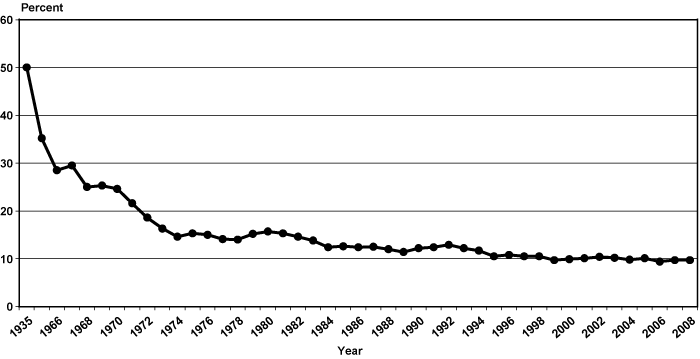
According to dgs 50% is a "small percentage" and this number does not capture the much larger number in near-poverty. Pure fantasy-land thinking.
Chart 4.
Poverty among the elderly, selected years 1935–2008
Line chart linked to data in table format.
SOURCE: Historical Poverty Tables—People, Table 3, Bureau of the Census.
And we hear once again the delusional "ponzi scheme" accusation. Demonstrating the perfect resistance to facts of emotionally-driven beliefs.
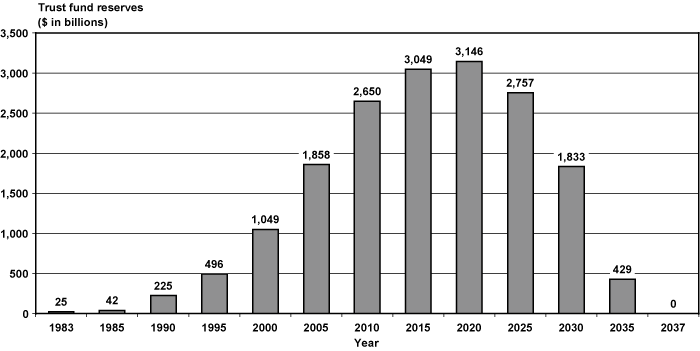
Current data says that the Ponzi scheme will continue to pay off for 28 more years if there are no reforms to it at all and at that time benefits will have to be cut a few percent.