
Achtung baby!
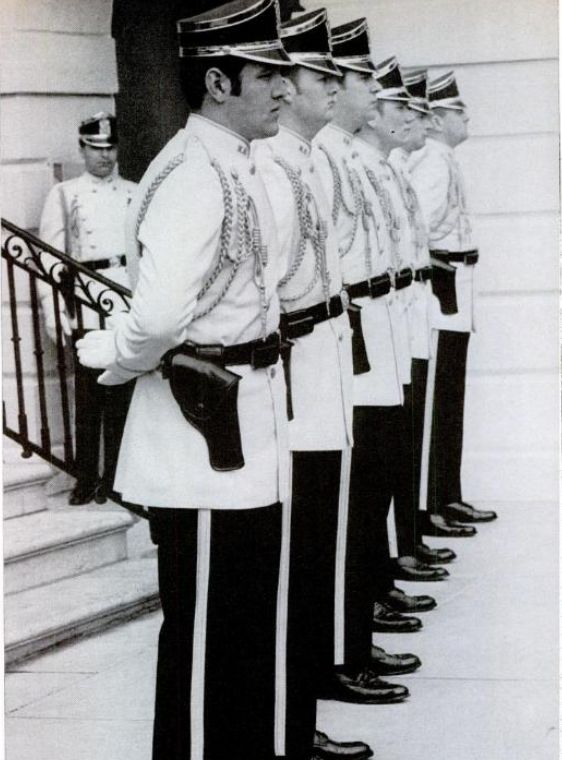

But back to the picture up above--what ever happened to Nixon's palace guard?
http://www.invisiblethemepark.com/2013/ ... istration/In 1970, President Richard Nixon changed the White House Secret Service’s uniforms most dramatically.
According to Richard Reeves’ President Nixon: Alone in the White House, Nixon felt that the present uniforms were “too slovenly.” An upcoming visit by Prime Minister Harold Wilson of Great Britain was a good excuse to upgrade the uniforms.
The uniforms, inspired by ones that Nixon had seen on honor guards in Europe, featured “double-breasted white tunics, starred epaulets, gold piping, draped braid, and high plastic hats decorated with a large White House crest.”
The uniforms were roundly criticized in the press. One columnist said that they looked like old-time movie ushers’ uniforms. Another noted that the uniforms borrowed their style from “decadent European monarchies.”
They lasted 2 weeks.




This version gains plausibility from the fact that "Aglet" is the modern word for the metal or plastic covering on the end of a shoelace.The following is another version:
In the very early days before knights wore metal armor, they wore coats of thick bull hide or sole leather which laced up the back. At it was impossible for them to "button" such a coat, the act had to be performed by their squires, who were required to carry a supply of stout leathern thongs pointed with the "tooth-pick bones" taken from the leg of a buck, or some kind of metal point such as our common shoestring has at this day. The story goes that the squire carried these thongs in a small roll or bundle hanging over his shoulder and from this has gradually developed the idea of an aide or adjutant wearing the aiguillette as the badge of his office.
RayThom wrote:More on the aiguillette and nail. (Scroll down to "206. The origin of the aiguillette.")
https://www.history.navy.mil/research/l ... forms.html
."The Duke of Alva, a Spanish General, having had cause to complain of the conduct of a body of Flemish troops, which had taken flight, ordered that any future misconduct on the part of these troops should be punished by hanging the delinquent, with [sic] regard to rank or grade.
"The Flemings replied that to facilitate the execution of this order, they would hereafter wear on the shoulder a rope and a nail, which they did, but their conduct became so brilliant and exemplary, that this rope was transformed into a braid of passementerie, and became a badge of honor, to be worn by officers of princely households, the pages, and corps d'elite," etc., etc. (Translated from Larousse's Grand Dictionary of the XIX Century)."