Page 1 of 1

Just a coincidence.

Posted: Tue Jul 01, 2014 1:21 pm
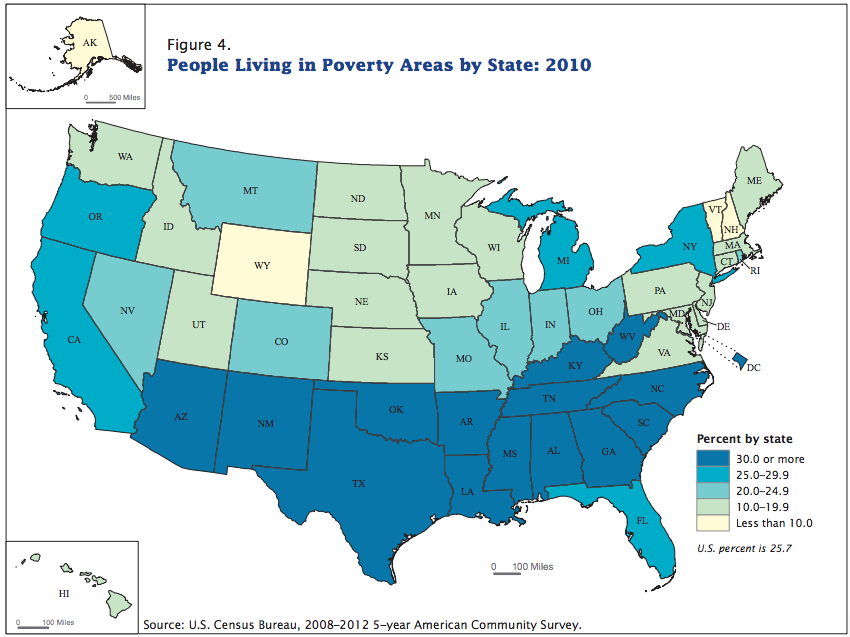
by rubato
Image


yrs,
rubato

Re: Just a coincidence.

Posted: Tue Jul 01, 2014 5:02 pm
by BoSoxGal
Linky? I can't see the full map or the key.

Re: Just a coincidence.

Posted: Tue Jul 01, 2014 6:07 pm
by Lord Jim
I guess for some reason rube wanted to make the "point" that states with the highest percentages of minority population have higher poverty rates, since that's the most obvious correlation that leaps out from that map...

Re: Just a coincidence.

Posted: Tue Jul 01, 2014 10:23 pm
by Econoline
bigskygal wrote:Linky? I can't see the full map or the key.
That's a common problem with images here. The work-around is to right-click on the image, then select "Open image in new tab"...and then click open the new tab. (I have to do that pretty often to see larger images, which tend to get cut off on the right edge.)

Re: Just a coincidence.

Posted: Tue Jul 01, 2014 10:29 pm
by Econoline
Lord Jim wrote:I guess for some reason rube wanted to make the "point" that states with the highest percentages of minority population have higher poverty rates, since that's the most obvious correlation that leaps out from that map...
...or that poor people tend to move to (or stay in) warm states, so that they don't have to pay crippling heating bills?

Re: Just a coincidence.

Posted: Tue Jul 01, 2014 10:33 pm
by Gob
Highest percentage of blue meanies in the south?

Image

Re: Just a coincidence.

Posted: Tue Jul 01, 2014 10:36 pm
by Econoline
:lol: Well, yeah, of course...that goes without saying!

Re: Just a coincidence.

Posted: Tue Jul 01, 2014 11:19 pm
by BoSoxGal
I thought I posted a reply, but I guess it was lost to the interwebs.

First, thanks Econoline for that trick on viewing large images.

Second, I think rather than minority populations, the correlation he's getting at is conservative politics and poverty.

There is a fairly high minority population in Alaska, Hawaii, Montana, etc. but the poverty isn't that high and the politics aren't that same brand of religious conservatism - more libertarian in Alaska and Montana, and I'm guessing Hawaii is liberal (I regret to say, I never pay attention to it).

Re: Just a coincidence.

Posted: Wed Jul 02, 2014 1:19 pm
by rubato

Re: Just a coincidence.

Posted: Wed Jul 02, 2014 1:28 pm
by rubato
JUST a coincidence:


Image


When more people believe that that people in poverty "have it easy" it creates more, and deeper, poverty.


yrs,
rubato

Re: Just a coincidence.

Posted: Wed Jul 02, 2014 3:59 pm
by Sue U
Lord Jim wrote:I guess for some reason rube wanted to make the "point" that states with the highest percentages of minority population have higher poverty rates, since that's the most obvious correlation that leaps out from that map...
That is patently untrue. California, New York, New Jersey, Maryland and Nevada all have higher percentages of minority populations than most of the states in the Deep South poverty belt. In terms of African-Americans alone, Maryland has a higher percentage than all states other than Mississippi, Louisiana and Georgia. Delaware, New York, Illinois and New Jersey all have substantially higher percentages of African-Americans than Texas, Kentucky, Oklahoma and West Virgina.

Re: Just a coincidence.

Posted: Wed Jul 02, 2014 4:52 pm
by Joe Guy
The point rubato made that people are avoiding is obvious. He is letting us know that republicans are responsible for all of the poverty in this country.

Who would have thought rubato would say something like that?

Then again, who would have thought rubato would not say something like that?

Or is it just a coincidence?

Re: Just a coincidence.

Posted: Fri Jul 04, 2014 1:47 am
by Lord Jim
In reviewing this more closely, one should bear in mind that what these maps are measuring is not how many people are really living in poverty, (as defined by the Census Bureau; more on that in a moment) but how many are living it what are called "poverty areas", whether they are actually living under the poverty line or not..

Here's how the website rube references describes a "poverty area":
places where more than 20 percent of the population lives under the poverty line, currently around $23,600 for a two-parent family of four, according to a new report from the Census Bureau.
http://www.vox.com/2014/6/30/5857074/wh ... ncentrated

Under this metric, nationwide, the percentage of people living in "poverty areas" is 25.7%...

A figure some 70% higher than the Census Bureau reports of people who are actually living in "poverty"...

15.1%...

Rube's source admits this, and I have confirmed it independently by another source I will cite later, using the same 2010 Census Bureau numbers:
Around 15 percent of Americans live in poverty,
http://www.vox.com/2014/6/30/5857074/wh ... ncentrated
How many people were poor in 2010?

In 2010, 15.1 percent of all persons lived in poverty.
http://www.npc.umich.edu/poverty/

Now, it seemed to me, that if we were going to use "poverty areas" (which doesn't actually measure the number of people who are actually living in poverty) as some sort of meaningful metric for assessing poverty, some basic questions needed to be answered:

How are these "poverty areas" determined? What geographical and/or demographic criteria are used to the determine the boundaries? How are these "poverty areas" drawn up?

Perhaps there are some data miners around here who are better than Your Humble Corespondent, but while I have been able to determine that "poverty area" is indeed a term of art used by the Census Bureau,

Beyond the repetition of "poverty areas" being described as "places where more than 20 percent of the population lives under the poverty line" I have been able to find absolutely nothing about how such "places" are determined...

Absent any criteria along these lines, in theory the whole of the United States could be determined to be a "poverty area" and we could declare that there is no one at all living in a "poverty area", since the requirement for living in a" poverty area" is to have 20% of the residents living below the poverty line, and in the US as a whole it's only 15.1%....

You see the problem with this...

Absent answers to these questions, this "poverty area" map is pretty much meaningless, in terms of determining the real poverty situation in the US...

Next I'd like to turn to the real issues of poverty in this country, and who if effects, (and rube should really like this, because I'm going to include Census Bureau tables...)

But this post has gone on quite long enough, and I'm going to take the lad and our pooches down to the park, so that will be Part II...

Re: Just a coincidence.

Posted: Fri Jul 04, 2014 4:59 am
by BoSoxGal
I wonder if there is any correlation between heat & humidity and poverty ?

Re: Just a coincidence.

Posted: Fri Jul 04, 2014 6:57 am
by Lord Jim
Part II

Now, let's assume for the moment, that we were looking at "Part II"...

A part where "poverty" looks a lot more like even what the Census Bureau would call it :
cash benefits from government assistance programs are included in a family's income when calculating the official poverty measure, benefits received in-kind such as food stamps, Medicare or Medicaid, employer provided health insurance, housing subsidies, and other social services are excluded. Taxes that families pay and tax credits they receive such as the Earned Income Tax Credit (EITC) do not enter into the official poverty determination.
So on top of the fact that "poverty" is being rated without all these in kind contributions, including the EITC,

There's a whole new definition of poverty....
The poverty rate for all persons masks considerable variation between racial/ethnic subgroups. Poverty rates for blacks and Hispanics greatly exceed the national average. In 2010, 27.4 percent of blacks and 26.6 percent of Hispanics were poor, compared to 9.9 percent of non-Hispanic whites and 12.1 percent of Asians.

Poverty rates are highest for families headed by single women, particularly if they are black or Hispanic. In 2010, 31.6 percent of households headed by single women were poor, while 15.8 percent of households headed by single men and 6.2 percent of married-couple households lived in poverty.][Say what you want about Rick Santorum; he's absolutely right when he talks about two parent families and the avoidance of poverty...the numbers don't lie..)

There are also differences between native-born and foreign-born residents. In 2010, 19.9 percent of foreign-born residents lived in poverty, compared to 14.4 percent of residents born in the United States. Foreign-born, non-citizens had an even higher incidence of poverty, at a rate of 26.7 percent.

http://www.npc.umich.edu/poverty/#4

Re: Just a coincidence.

Posted: Fri Jul 04, 2014 7:22 am
by Lord Jim
In 2010, 31.6 percent of households headed by single women were poor
http://www.npc.umich.edu/poverty/

No doubt about it, that must be Ronald Reagan's fault...

ETA:

And that is precisely the group that benefits the most from the in-kind contributions to income; Section 8 housing, food stamps, and the rest...

Look I'm not a scrooge, I don't begrudge people in those circumstances those benefits, but let's not pretend that those benefits don't exist...

When you calculate the "poverty level" without taking those benefits into consideration, you create a false picture...

Re: Just a coincidence.

Posted: Sat Jul 05, 2014 3:31 pm
by Lord Jim
Poverty rates for blacks and Hispanics greatly exceed the national average. In 2010, 27.4 percent of blacks and 26.6 percent of Hispanics were poor, compared to 9.9 percent of non-Hispanic whites and 12.1 percent of Asians.

Poverty rates are highest for families headed by single women, particularly if they are black or Hispanic. In 2010, 31.6 percent of households headed by single women were poor, while 15.8 percent of households headed by single men and 6.2 percent of married-couple households lived in poverty.

In 2010, 19.9 percent of foreign-born residents lived in poverty, compared to 14.4 percent of residents born in the United States. Foreign-born, non-citizens had an even higher incidence of poverty, at a rate of 26.7 percent.
So, what one would logically expect, is that those states with the highest percentages of those groups with the highest numbers below the poverty line, would be the states with the highest poverty rates overall. That's just logic and basic math, and doesn't have anything to do with how many "poverty areas" there are in a state or how many people live in those "poverty areas".

State A could very easily have a higher percentage of people living below the poverty line then State B and still show up better on the map in the OP, simply because their poor people are more spread out, or because the "poverty areas" have been gerrymandered in some way.

Re: Just a coincidence.

Posted: Sat Jul 05, 2014 3:53 pm
by Lord Jim
Here's a much better map; it actually measures people living below the poverty line; not "poverty areas":

Image

The color coded legend won't copy and paste, (basically the darker the state the worse the rate) so you'll have to go to the link(You can also see a breakdown by county):

http://en.wikipedia.org/wiki/List_of_U. ... verty_rate

You can also see a table with all the states ranked in order at that link. (California is 35th and New York is 38th)

ETA:

For folks who are really interested in this stuff here's a link to another good map:

http://www.povertyusa.org/the-state-of- ... map-state/

This is an interactive map. You can click on a state and drill down on the numbers. (You can also do counties) The numbers are drawn from the CPS; they're slightly different from the other link, (it's an anti-poverty activist site, so the percentages appear to be a little inflated across the board) but they show basically the same differentials.