

Bloomberg / Bush... 2016.




 )
)


"Sir John Pakington taunted him in this way, recalling the passage in the "Representative Government" where he [Mill] said the Conservatives were the stupidest party in the state. Mill replied:
" I never meant to say that the Conservatives are generally stupid. I meant to say that stupid people are generally Conservative. I believe that is so obviously and universally admitted a principle that I hardly think any gentleman will deny it. Suppose any party, in addition to whatever share it may possess of the ability of the community, has nearly the whole of its stupidity, that party must, by the law of its constitution, be the stupidest party; and I do not see why honorable gentlemen should see that position as at all offensive to them, for it ensures their being always an extremely powerful party.... There is so much dense, solid force in sheer stupidity, that any body of able men with that force pressing behind them may ensure victory in many a struggle, and many a victory the Conservative party has gained through that power."
This repartee was generally considered excellent Parliamentary fun. Indeed, we are told, "the House fairly burst into a roar of laughter, men on all sides thoroughly appreciating the humour of the thing". Gladstone was still talking about it a month later. He said it was the most pungent and clever thing that Mill had ever said."


The German Churches and the Nazi State
The population of Germany in 1933 was around 60 million. Almost all Germans were Christian, belonging either to the Roman Catholic (ca. 20 million members) or the Protestant (ca. 40 million members) churches. The Jewish community in Germany in 1933 was less than 1% of the total population of the country.
How did Christians and their churches in Germany respond to the Nazi regime and its laws, particularly to the persecution of the Jews? The racialized anti-Jewish Nazi ideology converged with antisemitism that was historically widespread throughout Europe at the time and had deep roots in Christian history. For all too many Christians, traditional interpretations of religious scriptures seemed to support these prejudices.
The attitudes and actions of German Catholics and Protestants during the Nazi era were shaped not only by their religious beliefs, but by other factors as well, including:
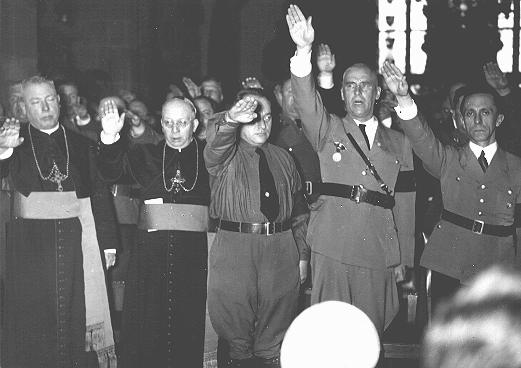
Catholic clergy and Nazi officials, including Joseph Goebbels (far right) and Wilhelm Frick (second from right), give the Nazi salute. Germany, date uncertain.
— Bayerische Staatsbibliothek