Page 1 of 1
Do we really need to make a federal case out of this?
Posted: Tue Dec 27, 2016 1:29 am
by Burning Petard
Its only $25. Fur crying out loud! The Supremes now have on their schedule to consider they should consider the case of a man who does not want to pay a twenty five dollar legal fee.
http://www.nytimes.com/2016/12/26/us/po ... .html?_r=0
Well maybe they do. The fees in Ferguson Missouri had alot to do with the kettle finally boiling over into riots. According to this story, it is happening in lots of places, even liberal Colorado.
On the other hand, I think for a while I am gonna stay away from Ramsey County, Minnesota.
snailgate.
Re: Do we really need to make a federal case out of this?
Posted: Tue Dec 27, 2016 2:03 am
by BoSoxGal
It sucks being too poor to afford a digital subscription to the NYT, Boston Globe or WashPo, but alas, I am.
Any chance of a C/P, or quick explanation of the story behind your OP?
A Federal Case?
Posted: Tue Dec 27, 2016 3:43 am
by RayThom
Similarly, this is big business in Texas to an excess of $5 Billion.
Texas Criminal Court Fees Are a Secret Tax on the Poor
https://www.prisonlegalnews.org/news/20 ... -tax-poor/
Re: Do we really need to make a federal case out of this?
Posted: Tue Dec 27, 2016 5:17 am
by Lord Jim
Kentucky bills people held in its jails for the costs of incarcerating them, even if all charges are later dismissed. In Colorado, five towns raise more than 30 percent of their revenue from traffic tickets and fines. In Ferguson, Mo., “city officials have consistently set maximizing revenue as the priority for Ferguson’s law enforcement activity,” a Justice Department report found last year.
http://www.nytimes.com/2016/12/26/us/po ... .html?_r=0
This kind of legalized theft isn't just in small towns; here in 'frisco the city would go broke if everybody parked legally:
San Francisco Parking Meters: A $130MM Industry
If you’re a car owner in San Francisco, you’ve likely been brought to tears at least once by a dreaded white envelope under your wiper, or towering hourly parking meter rates. If so, you’ve probably wondered: exactly how much money does the city of San Francisco rake in from these revenue streams every year? For many, the cost of parking in this city seems unreasonably high, but how does it compare to other cities?
Here’s the answer: San Francisco has the the most expensive parking tickets in the entire United States.
Parking Citation Fees and Meter Fares
On its website, the San Francisco Municipal Transportation Agency (SFMTA) jokes, “Even parking tickets get a day off now and then.” During just three select days every year — Thanksgiving, Christmas, and New Years' Day — the SFMTA doles out free parking, releasing city dwellers from the burden of enforced meters.
But this “gift” is deceiving; the SFMTA spends the other 362 days a year dutifully handing out parking tickets. Over the years, they’ve gotten quite expensive. In fact, at $74 a pop , the city's standard parking tickets are the most expensive in the country — by nearly $10.
To put this fee into perspective, Boston, which has roughly the same land area and a slightly smaller population, only charges $25, one-third of SF's fine, for a meter violation (see table below for fine rates in other major cities).
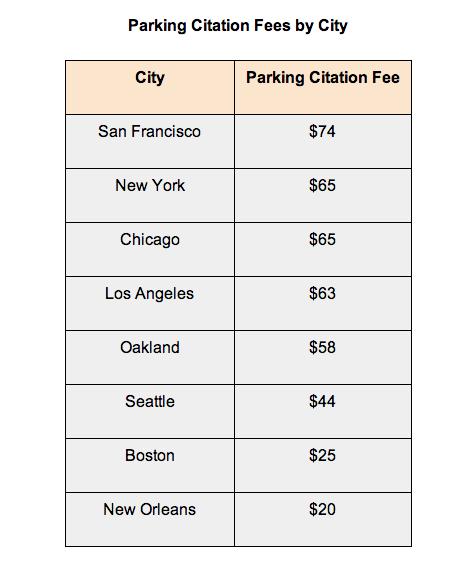
In addition to the standard parking meter ticket, there are
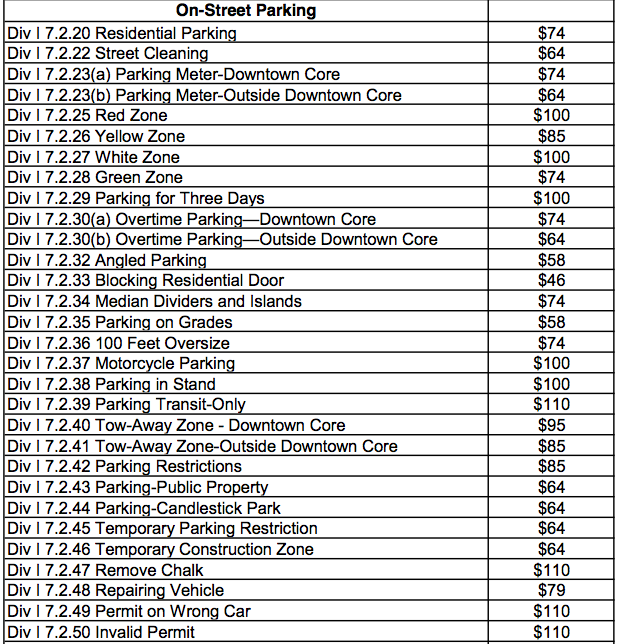
111 different parking citations doled out in the city, ranging from $46 for "blocking a residential door" to $880 for "blocking access to a blue zone." A small sample of these can be found below:
According to Lance Greenfield, a 25-year veteran parking officer, there is only way to avoid these astronomical rates: "Pay for your meter. It's a lot less expensive [than a citation], especially if you're just doing something really quickly."
However, San Francisco’s parking meters — all 29,058 of them — aren’t much cheaper.
SF park , a subsidiary project of the SFMTA that experiments with demand-responsive meter pricing, states:
“Meter pricing can range from between 25 cents an hour to a maximum of $6 an hour, depending on demand. Parking meters on blocks within walking distance of the ballpark are priced between $5 and $7 an hour for events”
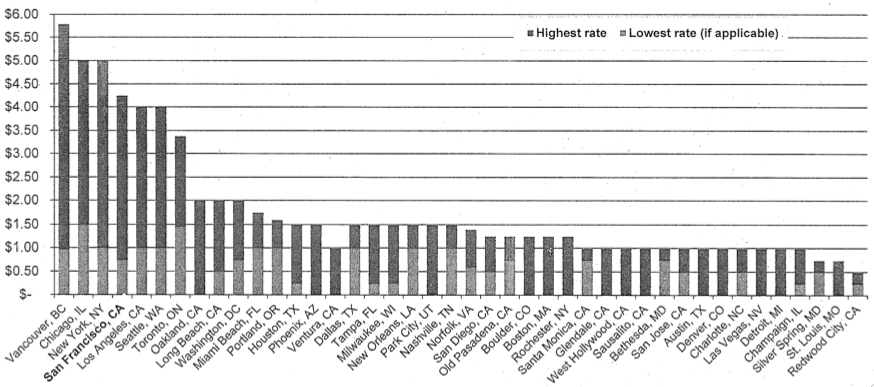
SF Park also conducted a comprehensive meter study (below) that revealed
San Francisco has the fourth highest downtown parking meter rates — at $4.25 per hour — in North America, trailing only Vancouver (BC), Chicago, and New York City.
In 2013, San Francisco even began charging for meters on Sunday , a day on which meters had traditionally been free since the first one was installed on Polk Street in 1947.
[public outrage over this was so severe that free parking on Sundays has been re-instituted since this article was written.] This decision alone gained the city an estimated $2.6 million per year in additional revenue.
The SFMTA reported $47,119,999 in annual revenue from meter fees in 2012. Excluding the three unmonitored days per year, and 52 Sundays (enforcement was not yet in place in 2012), that's about $152,000 collectively, or $5.23 per meter, per day.
The SFMTA reported $87,263,867 in annual revenue from paid citations in 2012. This works out to an average of $281,500 per day.
https://priceonomics.com/san-francisco- ... -industry/
Re: Do we really need to make a federal case out of this?
Posted: Tue Dec 27, 2016 6:15 am
by Econoline
BoSoxGal wrote:It sucks being too poor to afford a digital subscription to the NYT, Boston Globe or WashPo, but alas, I am.
Any chance of a C/P, or quick explanation of the story behind your OP?
I can't afford to subscribe either, but with (free) registration one gets 10 free articles a month, and I've only used 5 of mine so far...
Charged a Fee for Getting Arrested, Whether Guilty or Not
By ADAM LIPTAK
| DEC. 26, 2016
WASHINGTON — Corey Statham had $46 in his pockets when he was arrested in Ramsey County, Minn., and charged with disorderly conduct. He was released two days later, and the charges were dismissed.
But the county kept $25 of Mr. Statham’s money as a “booking fee.” It returned the remaining $21 on a debit card subject to an array of fees. In the end, it cost Mr. Statham $7.25 to withdraw what was left of his money.
The Supreme Court will soon consider whether to hear Mr. Statham’s challenge to Ramsey County’s fund-raising efforts, which are part of a national trend to extract fees and fines from people who find themselves enmeshed in the criminal justice system.
Kentucky bills people held in its jails for the costs of incarcerating them, even if all charges are later dismissed. In Colorado, five towns raise more than 30 percent of their revenue from traffic tickets and fines. In Ferguson, Mo., “city officials have consistently set maximizing revenue as the priority for Ferguson’s law enforcement activity,” a Justice Department report found last year.
An unusual coalition of civil rights organizations, criminal defense lawyers and conservative and libertarian groups have challenged these sorts of policies, saying they confiscate private property without constitutional protections and lock poor people into a cycle of fines, debts and jail.
The Supreme Court has already agreed to hear a separate challenge to a Colorado law that makes it hard for criminal defendants whose convictions were overturned to obtain refunds of fines and restitution, often amounting to thousands of dollars. That case, Nelson v. Colorado, will be argued on Jan. 9.
The Colorado law requires people who want their money back to file a separate lawsuit and prove their innocence by clear and convincing evidence.
The sums at issue are smaller in Ramsey County, which includes St. Paul. But they are taken from people who have merely been arrested. Some of them will never be charged with a crime. Others, like Mr. Statham, will have the charges against them dismissed. Still others will be tried but acquitted.
It is all the same to the county, which does not return the $25 booking fee even if the arrest does not lead to a conviction. Instead, it requires people like Mr. Statham to submit evidence to prove they are entitled to get their money back.
When the case was argued last year before the United States Court of Appeals for the Eighth Circuit in St. Paul, a lawyer for the county acknowledged that its process was in tension with the presumption of innocence.
Michael A. Carvin, a lawyer who will represent Corey Statham, has argued previous cases before the Supreme Court over the Affordable Care Act and fees charged by public unions. Credit Doug Mills/The New York Times
“There is some legwork involved,” the lawyer, Jason M. Hiveley said, but noted that it is possible for blameless people to get their $25 back. “They can do it as soon as they have the evidence that they haven’t been found guilty.”
The legwork proved too much for Mr. Statham. He never got his $25 back.
He did get a debit card for the remaining $21. But there was no practical way to extract his cash without paying some kind of fee. Among them: $1.50 a week for “maintenance” of the unwanted card, starting after 36 hours; $2.75 for using an A.T.M. to withdraw money; $3 for transferring the balance to a bank account; and $1.50 for checking the balance.
In its appeals court brief, the county said the debit cards were provided “for the convenience of the inmates,” who might find it hard to cash a check.
Mr. Statham is represented by Michael A. Carvin, a prominent conservative lawyer who has argued Supreme Court cases challenging the Affordable Care Act and fees charged by public unions.
Mr. Carvin said the county’s motives were not rooted in solicitude for the people it had arrested. “Revenue-starved local governments are increasingly turning toward fees like Ramsey County’s in order to bridge their budgetary gaps,” he wrote in a Supreme Court brief. “But the unilateral decision of a single police officer cannot possibly justify summarily confiscating money.”
“Providing a profit motive to make arrests,” he said, “gives officers an incentive to make improper arrests.”
Ramsey County did not bother to submit a response in the Supreme Court. “We have not filed a brief in opposition to the petition, nor do we plan to,” Mr. Hiveley said in a Dec. 8 email. The county, he said, would take its chances before the justices without presenting its side of the story.
Six days later, the Supreme Court ordered the county to file a brief in the case, Mickelson v. County of Ramsey. It is due Jan. 13.
Through his lawyers, Mr. Statham declined a request for an interview. He lost in the lower courts, which said his right to due process had not been violated by the $25 booking charge or the debit card fees, which were both, the trial judge said, “relatively modest.”
It is true that $25 is not a lot of money — unless you are poor. It represents almost half a day’s work at the federal minimum wage, a federal judge wrote in a dissent in another case on booking fees, and it is nearly the average amount the government allots to help feed an adult for a week under the federal food-stamp program.
In its appeals court brief, the county took a different view of the economic imperatives. “Municipal services,” the brief said, “come at a cost.”
Re: Do we really need to make a federal case out of this?
Posted: Tue Dec 27, 2016 12:01 pm
by Jarlaxle
Pure shakedown, no different from how Whitey Bulger operated.
Re: Do we really need to make a federal case out of this?
Posted: Wed Dec 28, 2016 4:13 am
by ex-khobar Andy
Town of Cedar Lake, Indiana. 28th February 2014, driving on Kentucky plates. I was marginally over the 30 mph limit (my guess 35); and was stopped and told I was doing 55, which conveniently put me into the next bracket. Fined $112 IIRC, and was told by my local friend that out of state plates on the last day of the month is just like a target on your back. Revenue generation, pure and simple.
The prior ticket I had was probably 20 years earlier. The Town of West Sparta has about 200 yards of the NYS Thruway cutting a corner of the township. I was doing 67 in a 60 limit, so I have no beef with the cop who pulled me over. But that 600 feet of Thruway is a financial boon to the town. For some reason I thought I would fight it, so I turned up at the appointed hour at the town hall. To get there I had to go through the town itself which I had always bypassed on the interstate. I had never seen such poverty, especially within 100 miles or so of some relatively well off areas. By the time I got to the town hall I had already resolved not to fight it because it was clear they needed the money more than I did. There were two old boys there counting the tickets - the mayor and his buddy. There must have been a couple of hundred tickets on the desk there, and if they all paid $60 that was $12,000. Once they realized that I had no interest in fighting it and paid up they got quite talkative. They had two cops and one car that just patrolled their little golden piece of the Thruway, and that generated some large percentage of town income.
Re: Do we really need to make a federal case out of this?
Posted: Wed Dec 28, 2016 3:13 pm
by Big RR
I understand your charitable feelings, but sadly that is what tickets have become--not a way of keeping the roads safe but a way of generating income for the town/state. And then people wonder why the municipal courts are the way they are, or why people have little respect for the law.
Re: Do we really need to make a federal case out of this?
Posted: Wed Dec 28, 2016 3:20 pm
by Guinevere
I'm not sure that's true, BigRR --- my town doesn't heavily enforce things like parking tickets at the meters because it doesn't generate enough revenue to pay for the extra time required to actually enforce. We do hire seasonal police in the summer season because we are so overrun with beach people, and because we do enforce the restricted parking --- but thats mostly because the locals would storm town hall if that wasn't the case.
Has anyone checked to see what police are being paid lately? Base + all sorts of extras + overtime + details = regular six figure salaries for many officers. If you can't raise taxes, how are you going to pay for it?
And finally, there is a huge distinction between parking tickets (which are regulatory violations, not crimes that implicate the 5th amendment) and fines and fees paid based on an alleged criminal conduct (where you liberty could be at stake) where due process is required, but the fines/fees are assessed without any process and payment is required even if charges are dismissed/no longer pressed. I'm glad the issue has been raised and SCOTUS is taking the case.
Re: Do we really need to make a federal case out of this?
Posted: Wed Dec 28, 2016 3:28 pm
by Guinevere
Andy, local cops enforcing speeding laws on the NYS Thruway? That would never happen in Massachusetts. I don't think 390 (the road through West Sparta) is the NYS Thruway system -- that's mostly 87/90. it connects to 390, but I believe 390 is simply state highway.
As for central New York, yes, its rural and relatively poor. Not as poor as other places, but industry is long gone, and farming is tough.
Re: Do we really need to make a federal case out of this?
Posted: Wed Dec 28, 2016 4:09 pm
by Big RR
Guin--I didn't mean parking regulations, I was responding to Andy's story; and while I understand that police cost a lot, I have a problem with generating substantial town revenue by these traffic tickets. In some areas it has become a pretty big business, and when town revenues are at stake the courts often fall right in line. And face it, these traffic violations are not criminal charges and due process is relaxed (a rather kind word for what is often done). If the profit motive wasn't there, I would think that we would not only have fairer courts, but safer roads as well as motorists would not see the law as a corrupt system to "beat" if they can.
As for the OP, I am happy someone is taking this up through the courts, but most people would not invest the time or money in such an appeal and just pay the amount (or not seek its refund).
Re: Do we really need to make a federal case out of this?
Posted: Wed Dec 28, 2016 8:07 pm
by rubato
Yes, we need to make a federal case out of this. The legal system is being used as a replacement for taxes and in doing so driving people into a grinding poverty from which they will never be allowed to escape.
This was the underlying problem in Ferguson. This is the answer to the question I asked at the time, "why are these people so angry".
Yes,
Rubato
Re: Do we really need to make a federal case out of this?
Posted: Fri Dec 30, 2016 6:57 am
by ex-khobar Andy
Yes Guin I had two traffic citations conflated in my mind. (And btw and off point - I had a terrible time when I came to this country and found that a citation is a bad thing - where I come from, a citation comes with applause. Sort of like being on the Dean's list at Uni - where I come from that is NOT something you put on your resume. Digression over.) It was the 390 and a local cop. And clearly, as RR points out, traffic tickets are for raising revenue. Which, to a wholly different scale, was the problem in Ferguson MO.