Defense Doves always like to quote Eisenhower, (and many Liberals also frequently pine for those 70% marginal tax rates from the 50s...about the only thing they seem to like about the 50s) here's an article that puts both Ike's view and those tax rates into perspective:
Military Spending in Perspective
by Kevin D. Williamson October 8, 2015 9:16 PM
In 1957, the nation was more or less at peace, the budget ran a small surplus, and we spent 9.8 percent of GDP on national defense. That was down sharply from the years immediately before (winding down of Korean War expenses, I guess) but quite a bit higher than it was in 1950 and 1951. In 1950, we spent only 4.9 percent of GDP on national defense, half that 1957 number. This year, we’re going to spend about 3.3 percent of GDP on national defense.
That’s less than we spent during the first Clinton administration, a fairly peaceable time. It’s less than we’ve spent since before the budgetary beginning of the post-9/11 era, by which I mean, since 2002. Looking at 1957 from the other side of the ledger, tax receipts were 17.2 percent of GDP. This year, taxes are expected to come in at 17.7 percent of GDP, a little bit more.
My lefty friends sometimes say that Republicans should endorse those high Eisenhower-era personal income tax rates, but in fact the government took in slightly less in taxes then than it does now. Not many people paid those sky-rate 1950s tax rates on much of their money. Certainly not Ike—he had his million-dollar book deal structured as a capital gain. The 1957 story isn’t about the taxes.
Read more at:
http://www.nationalreview.com/corner/42 ... williamson
Now, there's more to the article that I didn't quote (mainly the author's opinions) I present this just for the numbers...
Even though this comes from a conservative publication, (National Review) I doubt
very seriously that the author is simply making up the numbers about defense spending as a percentage of GDP, or the numbers about the effective federal tax rates....
If you think he
is, please feel free to post a reputable source showing that, and (unlike
somebody around here who when his numbers are shown to be rubbish) I promise I will
not dig myself a deeper and deeper hole trying to defend what has been objectively refuted, but instead I will say
mea culpa, mea culpa, mea maixima culpa and humbly apologize and admit to being wrong...
But, for the sake of argument, for the moment at least, lets assume these numbers are correct. That means:
That at the time Ike spoke the words he spoke, he was speaking from the perspective of living in a country that was spending nearly 10% of its GDP on defense...
A time when the figure was nearly
three times what it is today, (and even with the proposed increase would only move from 3.3 % to maybe 3.5 or 3.6%...This article was written in late 2015, and the GDP has also gone up since then; not just the proposed defense spending)
A time before Medicare, or Medicaid, or the expansion of SSDI, or any of the other social programs enacted in the 1960s...
All of which should surely
somewhat reduce the "theft" level...
(I won't go into the effective tax rate comparison...It's kind of a digression from this thread topic...I just included it because I found it in the same article and it supports a point I've made a number of times before...very few people actually
paid those confiscatory tax rates...)
As a general principle, I
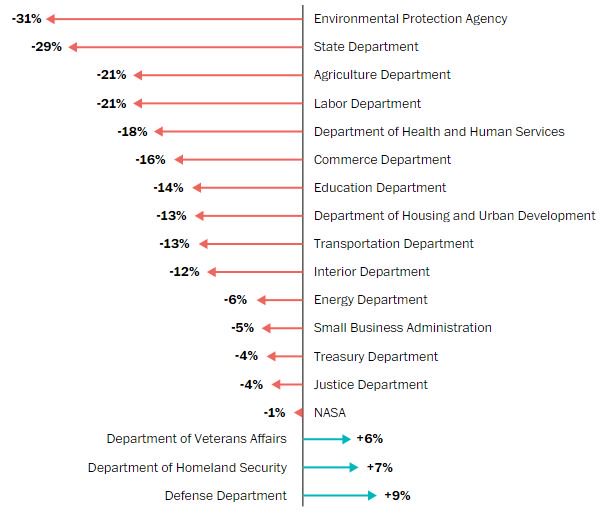
strongly support the proposed 9% increase in the defense budget. Even Obama's Sec. of Defense, (at the time The Sequester was considered a remote apocalyptic possibility before it became a reality) said:
Defense Secretary Leon E. Panetta warned Monday that if the bipartisan debt “supercommittee” fails and an across-the-board spending cut is enacted, the result will be “devastating” for the Pentagon, creating a “substantial risk” that the country’s defense needs might not be met.
“Unfortunately, while large cuts are being imposed, the threats to national security would not be reduced,” Panetta wrote in a letter to Sens. John McCain (R-Ariz.) and Lindsey O. Graham (R-S.C.), two of the GOP’s most prominent voices on defense issues. “As a result, we would have to formulate a new security strategy that accepted substantial risk of not meeting our defense needs.”
http://www.washingtonpost.com/blogs/2ch ... 26fb4db394
I agreed with Leon then, and I agree with him now...
But I have some caveats:
The most important consideration is that this additional money is spent
wisely, where it is most needed...
(And I wouldn't trust the Trump bunch to organize a two car parade wisely, which makes me
highly skeptical on this point...though I do have a certain amount of confidence in Sec. of Defense Matis...
if he's the one who's primarily making the decisions about how this money should be spent...)
If the bulk of this money is going to shiny new weapons programs, that's a
huge mistake...
The Sequester has hollowed out the defense we already have, and produced
huge force readiness issues that
desperately need to be addressed...
Money needs to spent on having more of the hardware (planes, ships, tanks, etc) we
already have up and combat ready... (One thing Trump
did have right in his Norfolk speech was the appalling percentage of military aircraft that are out of commission because the money hasn't been available for proper maintenance)
Money also needs to be spent on training and properly equipping troops and increasing the number of standing forces we would have available for even a semi-large deployment of 50-100 thousand troops...( Meeting that kind of commitment with extended troop deployments, calling up reserves for long rotations, and paying premium prices for "contract" soldiers not only carries an unfair human cost, but is also penny wise and pound foolish)
I'm also
not in favor of funding this increase by trying to take it out of the hide of the State Department...(which you couldn't do if you wanted to, and State Department dollars that are spent wisely
are defense dollars)
I'd pay for it with some modest changes in entitlements (like a gradual rise in the retirement age) and yes...
Even some borrowing...

(if we're going to borrow money for
anything now would be the time , with rock bottom interest rates)
*************************************************************************
As far as the rest of the proposed budget is concerned, this post has gone on long enough without getting into
that in detail...
Suffice it to say for now that after watching Mr. Mulvaney's performance during the press briefing today, it seems to me that Radical Randianism is the guiding philosophy behind it...
Some of what he was saying was quite jaw dropping, even to a lifelong Republican and hardcore Reagan Conservative...
Without getting into the budget specifics, the perspective he demonstrated he's coming from clearly has
nothing to do with contemporary Conservatism...
Mr. Mulvaney isn't about "the government that governs least governs best", or about a healthy suspicion of government efficiency, or about creative ways to make government work better in partnership with the private sector...
He struck me as a true believer not in "how to make the social contract work better", but in how to repeal it in its entirety...
Like William Graham Sumner, his answer to the question "what do social classes owe to each other?" would be "nothing"...
This is not just bad policy from a moral standpoint; it is also bad policy from a practical standpoint...
If you have the point of view that it is immoral to take
anything from the "haves" to assist the "have nots" then sooner or later you're going to have a revolution on your hands...
As a prudent conservative, I believe we should pursue policies that avoid that...