Page 1 of 2

President Norquist ru(i)ns the USA

Posted: Tue Nov 27, 2012 9:45 pm
by Gob
Benjamin Franklin, one of the United States' founding fathers, observed that there are only two certainties in life - death and taxes.

For nearly a quarter of a century we've been able to cling to another certainty, namely that the Republican Party, would never raise taxes. Never.

Since 1990 no Republican in Congress has voted to increase anyone's income tax.

Through three recessions, two booms and three wars the right wing of US politics has held fast to its most important economic principle: taxes must never, ever rise.

Well, all that may be about to change.

The signs aren't necessarily clear, and there aren't that many of them, but it's impossible to watch the US political debate right now without wondering if some big changes are underway.

Most of that debate revolves around the package of spending cuts and tax hikes that will go into effect on 1 January 2013.

The so-called "fiscal cliff" is, partly, America's latest self-imposed deadline for cutting government spending and/or increasing taxes so that its deficit and debt don't eventually consume the economy.

Given the Republicans' refusal ever to raise taxes, the assumption would normally be that government spending would be cut.

The trouble is that the only way you could eliminate the deficit just with spending cuts would be changing the public health scheme for senior citizens in ways that would be described as "profound" or "savage" depending on your political beliefs.

That's before you get to the defence budget.

In short, the arithmetic of the deficit makes it nearly impossible for Republicans to stick to their tax guns much longer.

The Republicans' leader in Congress, John Boehner, offered the first sign that the hard line might be eroding.

After the election he said, "We're willing to accept some additional revenue via tax reform," citing "loopholes" that could be closed.

On the face of it this may not seem a major concession, but it was a new tone for Republican leaders.

During the Republican primary campaign, the final 10 candidates for the party's presidential nomination declared that as president, they would refuse to accept even $1 of increased revenue in exchange for $10 of spending cuts.

Then there is the media.

Right-wing outlets have been dominated lately by a debate over how, or if, the Republicans' pitch to voters must change.

Voices have been heard suggesting the Grand Old Party might need a brand new approach to economic policy.

The editor of the Weekly Standard, William Kristol stated, "It wouldn't kill the country if we raise taxes on millionaires."

To the Republican Party of the last 20-plus years, that's heresy.

Or there's Steve Forbes, publisher and editor-in-chief of Forbes magazine.

In a recent op-ed, writing about the suggestion that US tax rates should be returned to the levels of the 1990s, he says, "Absolutely, let's do it."

Such peculiar - for the right wing - comments have led some to suggest that maybe, just maybe, Republican politicians are about to vote for some kind of tax increase.

No one should count on it yet, though.

There's still Grover Norquist to contend with, and Grover Norquist, of all people, knows something about holding Republicans to their tax promises.

His pressure group, Americans for Tax Reform, was created in 1986 and ever since has been prevailing on Republican officials to sign a pledge to voters never to raise income taxes or corporate taxes, never even to end tax breaks without guaranteeing a matching cut in rates.

Individuals who break the pledge find themselves challenged from within their own party, by challengers heavily backed by the Norquist organisation.

Norquist usually wins.

The pledge's absolutist quality is now out of tune with the more accommodating noises of some on the right.

Undaunted, Norquist has been everywhere, attempting to hold the line.

He rejects the notion that the Republican Party is undergoing any softening of its traditional economic stances.

"The modern Republican Party is infinitely stronger in its economic positions that it was two years ago," he says.
The 95%

Norquist also mocks the notion that the current negotiations to rein in the deficit mean taxes are going up, one way or another.

"Well that's what Obama is hoping for, but that's what he hoped two years ago."

"He ended up extending [the currently reduced tax rates] for two years and I think that's the most likely outcome again."

Some 95% of Republican congressmen and women have signed Norquist's pledge.


Clearly he thinks (or hopes) that even if some are tempted to abandon it there can't possibly be enough of them to end the Republicans' remarkable run of resisting tax increases.

But another near certainty in all of this is that come the new year, if we're reporting that some kind of deal has been struck to constrain America's deficit, then somehow the Republicans will have broken with one of the essential tenets of their faith.

It may not be too much to say that an era of economic policy will have ended.

What the new American politics looks like after that is anything but certain.

Re: President Norquist ru(i)ns the USA

Posted: Tue Nov 27, 2012 11:47 pm
by Andrew D
The trouble is that the only way you could eliminate the deficit just with spending cuts would be changing the public health scheme for senior citizens in ways that would be described as "profound" or "savage" depending on your political beliefs.

That's before you get to the defence budget.
We should start with the so-called "defense budget". Much (most?) of the so-called "defense budget" has nothing to do with defending the US. It is the most bloated, boondoggle-ridden, pork-infested portion of the US budget. And no other sizeable portion of the US budget even comes close.

Re: President Norquist ru(i)ns the USA

Posted: Wed Nov 28, 2012 1:14 am
by rubato
A legislator who promises only to cut taxes and never raise them is like a plumber who promises never to turn a wrench to the left, only to the right.

The Republican party are unfit to govern.


yrs,
rubato

Re: President Norquist ru(i)ns the USA

Posted: Wed Nov 28, 2012 2:28 am
by Lord Jim
The Republican party are unfit to govern.
Shouldn't that be, "The Republican party is unfit to govern." ?

Can I get a grammar ruling from Gen'l Meade over here?

Re: President Norquist ru(i)ns the USA

Posted: Wed Nov 28, 2012 3:10 am
by Gob
I'd say "is" as it is a party, singular.

Re: President Norquist ru(i)ns the USA

Posted: Wed Nov 28, 2012 3:54 am
by Andrew D
The British use plural verbs with collective nouns much more commonly than do Americans:
In American English, most collective nouns are treated as singular, with a singular verb:

√ The whole family was at the table.

√ The government is doing a good job.

√ He prefers an audience that arrives without expectations.

In British English, most collective nouns can be treated as singular or plural:

The whole family was at the table. [singular collective noun; singular verb]
The whole family were at the table. [plural collective noun; plural verb]

The government is doing a good job. [singular collective noun; singular verb]
The government are doing a good job. [plural collective noun; plural verb]
Not that rubato is British or anything -- how would I know? -- but treating a collective noun ("party") as a plural noun with a corresponding plural verb seems well within the bounds of English grammar.

Re: President Norquist ru(i)ns the USA

Posted: Wed Nov 28, 2012 4:10 am
by Gob
Fair enough, as I say, it was only my personal preference.

Re: President Norquist ru(i)ns the USA

Posted: Wed Nov 28, 2012 5:04 am
by dales
Lord Jim wrote:
The Republican party are unfit to govern.
Shouldn't that be, "The Republican party is unfit to govern." ?

Can I get a grammar ruling from Gen'l Meade over here?
That would depend upon one's definition of "is" is.

~ William "BlowJob" Clinton

Re: President Norquist ru(i)ns the USA

Posted: Wed Nov 28, 2012 4:32 pm
by Long Run
Gob wrote:
Since 1990 no Republican in Congress has voted to increase anyone's income tax.

Through three recessions, two booms and three wars the right wing of US politics has held fast to its most important economic principle: taxes must never, ever rise.
And yet, in that time period federal government revenues, on an inflation adjusted basis, have gone from about $1.5 trillion to over $2.5 trillion -- up 67% in real terms. As a percent of GDP, taxes have stayed about the same (noting that they go down in any recession, and especially 2009-10). Granted, some of that increase is due to the 1993 tax rate increases, but even after the elimination of those increased rates in 2001, once the dot.com recession was over in 2002, revenues again grew to over $2.5 trillion. The point being, that until the huge surge in federal spending over the last 5-6 years, there was no need to raise taxes faster than they were already rising; until there is an agreement to reduce the rate of federal spending increases, like the deal Clinton and Gingrich made, there will be no real progress in reducing the budget deficit.

Image

Re: President Norquist ru(i)ns the USA

Posted: Wed Nov 28, 2012 4:59 pm
by oldr_n_wsr
Will I get bailout if I raise my household spending by that amount? (God knows I can't cover that incresase with my salary) :shrug

Re: President Norquist ru(i)ns the USA

Posted: Wed Nov 28, 2012 5:20 pm
by Econoline
Long Run wrote:"the huge surge in federal spending over the last 5-6 years"
...yet the accompanying graph seems to show a "huge surge in spending" from 2001 to 2009.

Hmm. I wonder who was president then?

Re: President Norquist ru(i)ns the USA

Posted: Wed Nov 28, 2012 6:18 pm
by Long Run
Econo, there is definitely an upward tilt in the spending line with the Bush years. My guess is that that is mostly due to Iraq and Afghanistan and general defense buildup; and that a fair bit of the Clinton/Gingrich lower trajectory is due to Cold War-end defense reduction. But after the 2006-07 lull, spending shot up at unprecedented rates, to counter the 2008-09 recession. If the Clinton/Gingrich trajectory were continued to today, we'd be at about $2.6 trillion in spending, over a trillion less than we are spending now. That is why the current R talking point is that if we are going back to the Clinton tax rates, lets also go back to the Clinton spending rate.

Re: President Norquist ru(i)ns the USA

Posted: Wed Nov 28, 2012 9:03 pm
by oldr_n_wsr
if we are going back to the Clinton tax rates, lets also go back to the Clinton spending rate.
Sounds like a solution somewhat. Although I would like even less spending.

Re: President Norquist ru(i)ns the USA

Posted: Thu Nov 29, 2012 6:31 am
by MajGenl.Meade
Lord Jim wrote:
The Republican party are unfit to govern.
Shouldn't that be, "The Republican party is unfit to govern." ?

Can I get a grammar ruling from Gen'l Meade over here?

"The Republican party be unfit to govern" although some hold out for "am"

:lol:

Re: President Norquist ru(i)ns the USA

Posted: Thu Nov 29, 2012 1:22 pm
by Lord Jim
Speaking of Bill Clinton, did you here the latest?

He's finally selected an official biographer...

Yes, he's hired Paula Broadwell....

Re: President Norquist ru(i)ns the USA

Posted: Thu Nov 29, 2012 1:41 pm
by rubato
Long Run wrote:Econo, there is definitely an upward tilt in the spending line with the Bush years. My guess is that that is mostly due to Iraq and Afghanistan and general defense buildup; and that a fair bit of the Clinton/Gingrich lower trajectory is due to Cold War-end defense reduction. But after the 2006-07 lull, spending shot up at unprecedented rates, to counter the 2008-09 recession. If the Clinton/Gingrich trajectory were continued to today, we'd be at about $2.6 trillion in spending, over a trillion less than we are spending now. That is why the current R talking point is that if we are going back to the Clinton tax rates, lets also go back to the Clinton spending rate.
You don't have to guess you can easily check the facts at the CBO website.

Clinton eliminated the deficit by reducing discretionary spending as a % of GDP. Bush II and his free-spending Republicans immediately increased discretionary spending.

http://www.cbo.gov/publication/42911
(you have to be able to open an excel file)

year ........ discretionary spending as a % of GDP
1993 ........8.2
1994 ........7.8 <-- first Clinton budget year*
1995 ........7.4
1996 ........6.9
1997 ........6.7
1998 ........6.4
1999 ........6.2

2000 ........6.3
2001 ........6.3 <-- last Clinton budget year
2002 ........7.0 <-- first Bush II budget year
2003 ........7.5
2004 ........7.7
2005 ........7.8
2006 ........7.7
2007 ........7.5
2008 ........7.9
2009 ........8.9 <-- last Bush II budget year

2010 ........9.4
2011 ........9.0

And from the chart (same link) you can see that Bush increased both defense and non-defense spending (as well as borrowing money for the rich) to increase the deficit:

Discretionary Outlays As a Percentage of Gross Domestic Product
…. ….. Defense …….. Nondefense …….. Total

1991 …. 5.4 …….. 3.6 …….. 9.0
1992 …. 4.8 …….. 3.7 …….. 8.6
1993 …. 4.4 …….. 3.8 …….. 8.2 <-- first Clinton budget year
1994 …. 4.0 …….. 3.7 …….. 7.8
1995 …. 3.7 …….. 3.7 …….. 7.4
1996 …. 3.4 …….. 3.5 …….. 6.9
1997 …. 3.3 …….. 3.4 …….. 6.7
1998 …. 3.1 …….. 3.3 …….. 6.4
1999 …. 3.0 …….. 3.2 …….. 6.2
…. …….. ……..
2000 …. 3.0 …….. 3.3 …….. 6.3
2001 …. 3.0 …….. 3.4 …….. 6.3 <-- last Clinton budget year
2002 …. 3.3 …….. 3.7 …….. 7.0 <-- first Bush II budget year
2003 …. 3.7 …….. 3.8 …….. 7.5
2004 …. 3.9 …….. 3.8 …….. 7.7
2005 …. 4.0 …….. 3.8 …….. 7.8
2006 …. 3.9 …….. 3.8 …….. 7.7
2007 …. 4.0 …….. 3.6 …….. 7.5
2008 …. 4.3 …….. 3.6 …….. 7.9
2009 …. 4.7 …….. 4.2 …….. 8.9 <-- last Bush II budget year
…. …….. ……..
2010 …. 4.8 …….. 4.6 …….. 9.4
2011 …. 4.7 …….. 4.3 …….. 9.0


You can find a further breakdown in the same excel file which shows how NON-discretionary spending (i.e. spending driven by the Republican collapse like unemployment) causes the sharp increase in the years 2009 on by category, but I don't have time to hand-format it to post here. As the name suggests NON-discretionary spending is not the result of Obama's policies.

yrs,
rubato

* budget years go from Oct to Oct and are named by the near in which most of the time happens. Thus Clinton took office in Jan 2002 and his first budget year began Oct of that year , hence 2003. There is some overlap of effect in the final year, Bush II reduced the surplus in 2001 by $50 B dollars with his 'bread and circuses' tax rebate by sending out checks in that year for prospective tax cuts which would appear when people filed in 2002. Else it would have reduced the federal debt by that amount.

Re: President Norquist ru(i)ns the USA

Posted: Thu Nov 29, 2012 4:06 pm
by dgs49
A little data for rumination:

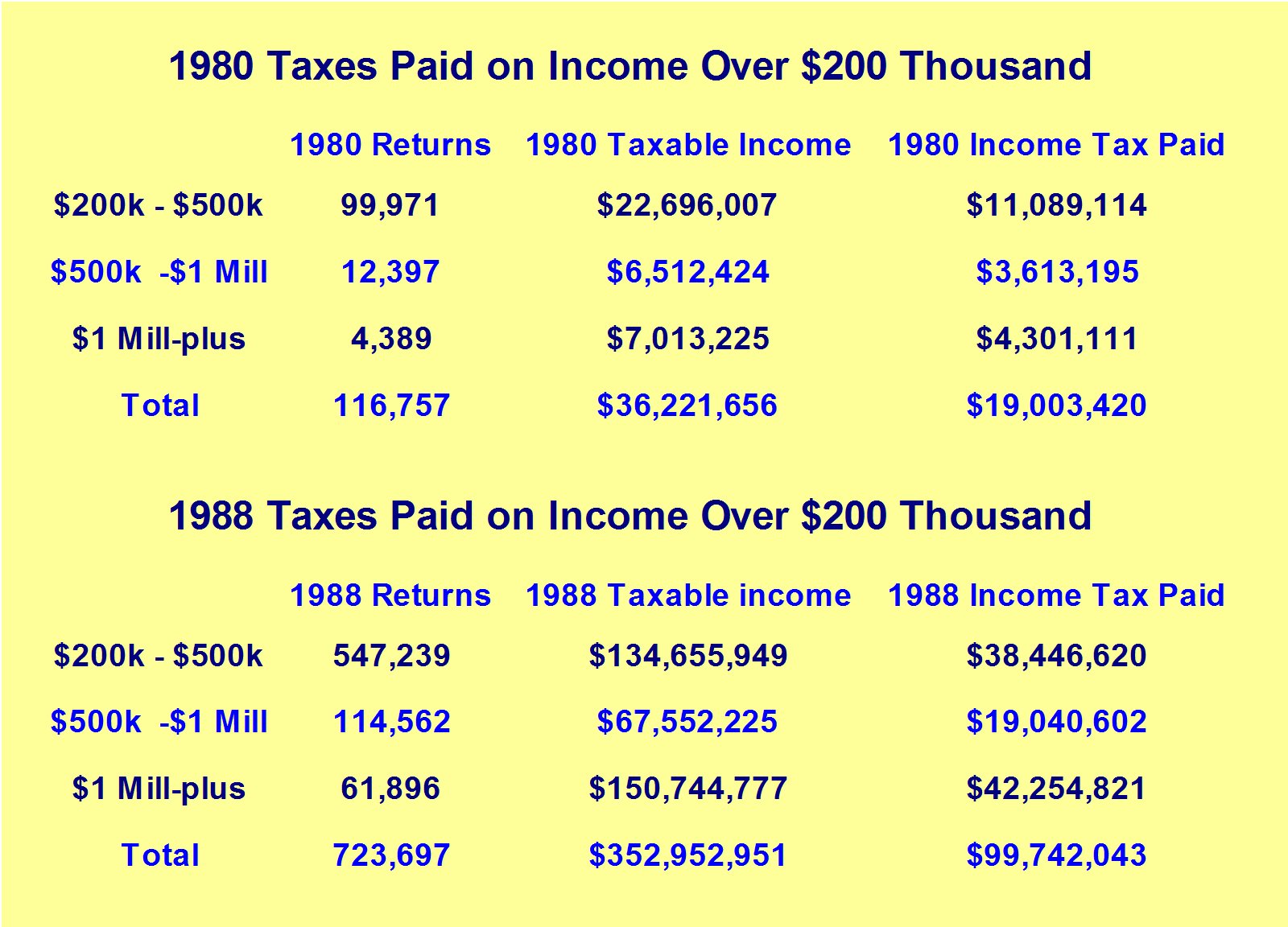
In 1980, when the top marginal tax rate was 70% (and Ronaldus Maximus was elected), the total, aggregate reported taxable income for Americans with $200k plus in taxable income was $36.2B, on which they paid $19B in FIT.

In 1988, when the top marginal tax rate was 28%, the analogous total income was $353B, and the taxes paid were $100B. Taxable income went up ten-fold, and revenue to the Feds went up five-fold.

When the top marginal tax rate was reduced from 70% to 28%.

What a surprise.

http://danieljmitchell.files.wordpress. ... laffer.jpg

Re: President Norquist ru(i)ns the USA

Posted: Thu Nov 29, 2012 5:59 pm
by Grim Reaper
You're taking two points nearly a decade apart with major changes in the tax code in between and trying to compare them.

Re: President Norquist ru(i)ns the USA

Posted: Thu Nov 29, 2012 8:11 pm
by Long Run
You're taking two points nearly a decade apart with major changes in the tax code in between and trying to compare them.
But the point is well-taken. Depending on the myriad of other economic factors, marginal rates can be dropped a lot and yet tax revenues go up a lot over a reasonable time period (8 years). It is the revenue and % of tax burden we should be focused on, not the tax rate.


Long Run wrote:
Econo, there is definitely an upward tilt in the spending line with the Bush years. My guess is that that is mostly due to Iraq and Afghanistan and general defense buildup; and that a fair bit of the Clinton/Gingrich lower trajectory is due to Cold War-end defense reduction. * * *
You don't have to guess you can easily check the facts at the CBO website.

Clinton eliminated the deficit by reducing discretionary spending as a % of GDP. Bush II and his free-spending Republicans immediately increased discretionary spending.
And the data confirm my general understanding that defense spending was the major factor in driving discretionary spending during those periods. First, you have to be aware when evaluating the budget as a percentage of GDP that the numbers will go up if there is a recession because the spending is set but the overall GDP declines (plus there are recession driven spending increases) -- so it is misleading to compare percentages from a recession year with percentages from years when the economy is doing well. Before Clinton took office, defense spending was 4.8% of GDP in 1992 and then 4.4% in 1993 (which was down from the 5.8-6.2% range at the end of the Cold War). By 2001, the Clinton budget had defense spending down to 3.0%. Non-defense discretionary spending went down from 3.8 or 3.7% to 3.4% in the same time period. So obviously, most of the Clinton discretionary reduction was in defense spending.

Conversely, looking at the Bush years, defense spending went from 3.0% in 2001 to about 4.0% in 2007 before the recession. It went up to 4.3 in 2008 and then 4.7% in 2009 as the recession hit because GDP declined (noting that the scheduled defense increases added to this, and also noting that Obama has kept it at the 4.7 to 4.8% range). And non-defense spending stayed in the 3.7-3.8% range until it dropped a bit by 2007 to 3.6%, before rising with the recession. So again, most of the discretionary spending increase during the Bush years was related to defense spending, which would be reflected in the Iraq and Afghanistan wars and other additions to the defense budget to reflect the dangers that were brought home by 9/11. There is an argument to be had whether that was good policy, but the fact is that the Clinton budget looks good mainly because of defense cuts, and Bush budgets looks bad mainly because of defense increases.

Re: President Norquist ru(i)ns the USA

Posted: Thu Nov 29, 2012 8:30 pm
by Lord Jim
First, you have to be aware when evaluating the budget as a percentage of GDP that the numbers will go up if there is a recession because the spending is set but the overall GDP declines (plus there are recession driven spending increases) -- so it is misleading to compare percentages from a recession year with percentages from years when the economy is doing well.
Thanks for that Long Run, you saved me the trouble....