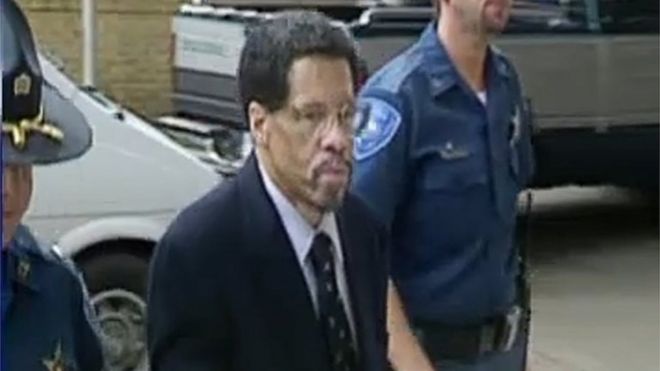
Woodfox was serving time for armed robbery in the notoriously violent Louisiana State Penitentiary, known as Angola, in 1972, when a prison guard named Brent Miller was stabbed to death. Woodfox and a fellow-prisoner, Herman Wallace, were accused of Miller’s murder, despite the fact that no physical evidence linked them to the crime and that both men consistently maintained their innocence. They claimed they were framed by the prison authorities because of their membership in the Black Panther Party and their outspoken criticism of prison conditions. Louisiana juries convicted Woodfox in the early seventies and again in the late nineties, but both convictions were thrown out for racial discrimination in grand-jury selection. Meanwhile, the appeals process dragged on, and Woodfox remained in solitary confinement for decades. (Wallace was also held in solitary confinement until his conviction was overturned, also on grand-jury-discrimination grounds, in 2013, just a few days before his death.)
In February, Louisiana’s Attorney General, James (Buddy) Caldwell, announced that he intends to try Woodfox a third time, even though all four purported eyewitnesses to the murder have died and Miller’s widow opposes retrial. In a press release accompanying Woodfox’s latest reindictment, Caldwell wrote, “We will continue to fight to ensure that this dangerous man is held fully accountable for his actions.” Last Monday, U.S. District Judge James Brady ordered Woodfox’s immediate release and barred his retrial. But Louisiana has appealed Brady’s order, and last Friday the Fifth Circuit Court of Appeals stayed Woodfox’s release pending its ruling on the appeal.
Brady’s order is admittedly unusual. Normally, when a federal court reverses a state court’s conviction for constitutional error, as was the case with Woodfox’s last trial, the federal judge would order a “conditional” release, directing that the individual be freed unless he is given a fair retrial within a set period of time. But, in extraordinary circumstances, federal courts may issue an “unconditional” release order, barring retrial, to serve “the ends of justice.” Brady, who has presided over several aspects of Woodfox’s case for many years, found that the ends of justice demanded an end to Woodfox’s ordeal.
Brady cited multiple reasons for his order, including Woodfox’s frail health (he has hypertension, hepatitis C, a weak heart, and renal disease), the length of time and harsh conditions of his ongoing incarceration, the fact that the state has already botched two attempts to convict him, and the difficulty of providing a fair trial more than forty years after the fact.
The last factor is the most important. The state’s case and Woodfox’s defense both turn exclusively on eyewitness testimony, and all the state’s principal witnesses are now dead. In what would surely be one of the most surreal trials of all time, the state proposes to retry the case by having stand-ins read from the transcripts of these witnesses’ prior testimony.
Reading a deceased witness’s prior testimony into the record is not unprecedented, but almost the entirety of the case against Woodfox would rest on the words of dead men. And, while Woodfox’s attorneys were able to cross-examine the state’s witnesses in his initial trial, it emerged only afterward that the prosecution had failed to turn over exculpatory evidence that calls their motives and testimony into question. A retrial based on the reading of forty-year-old statements would deprive Woodfox’s attorneys of the opportunity to cross-examine the witnesses using the new evidence, and would deny the jury the opportunity to more fully assess their credibility, in a case that turns entirely on judgments about whether witnesses are (or were) telling the truth.
Take the government’s star witness, Hezekiah Brown, who testified in the first trial, in 1973, but had died by the second, in 1998. The state has admitted that it would not have had a case without Brown, another Angola inmate. When investigators first questioned him, he claimed he was not in the vicinity of the murder. But he later changed his story and implicated Woodfox. After the first trial, it came out that prison authorities had threatened Brown with solitary confinement if he did not testify, promised to support a pardon request if he did, and transferred him to a minimum-security area after he appeared in court. Because Brown is dead, he can’t be confronted with these critical facts.
Of course, if Woodfox were tried a third time, and convicted in a third proceeding that violated his constitutional rights, he could conceivably appeal the verdict once again. But each of the first two appeals took twenty years to reach the conclusion that his constitutional rights had been violated. Given his age and health, he almost certainly doesn’t have that much time left.
Louisiana authorities have never given any reason other than the original crime for keeping Woodfox in solitary confinement. On the few occasions in the past four decades when he has been temporarily housed with others, he has posed no real threat to them. Since 1972, he has been charged with only a single act of violence, a fight with another inmate in 1985, for which he received a suspended sentence because of his record of good conduct. In 2006, his warden testified that “in the last five years, [Woodfox] could be described as a model prisoner.” In a related civil lawsuit, Judge Brady found “no legitimate penological interest in continuing” Woodfox’s solitary confinement.
The vindictiveness of the state is perhaps best illustrated in its treatment of Woodfox’s co-defendant, Herman Wallace. When Wallace’s conviction was also overturned on discrimination grounds in 2013, the judge in his case ordered his release, in view of the fact that Wallace was dying of liver cancer and had only days to live. Wallace was released on a Monday, and died on a Friday. He’d had three and a half days of freedom. Two days before he died, the prosecution reindicted him.