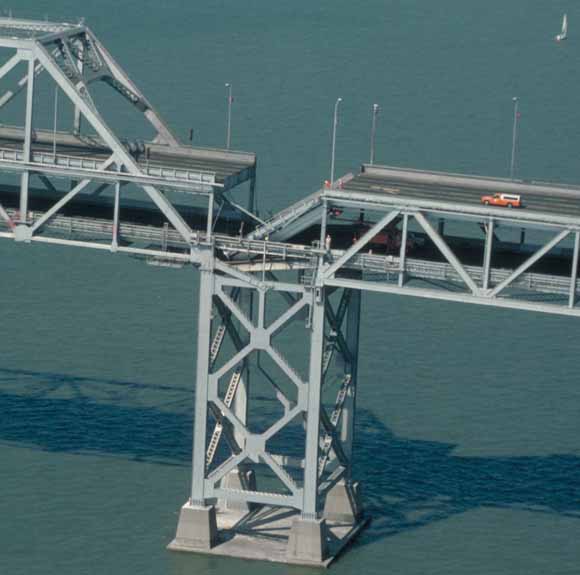
Well, let's see...Caltrans still seeks fix and cause for Bay Bridge's busted bolts
By Lisa Vorderbrueggen
Contra Costa Times
Posted: 04/04/2013 06:20:12 AM PDT
Updated: 04/04/2013 06:21:04 AM PDT
Three weeks after steel bolts snapped on the new Bay Bridge, Caltrans is still working to find the cause, choose a permanent fix and identify all the steel parts on the rest of the span that came from the same manufacturer.
A possible manufacturing glitch or nuts that were perhaps wrenched too tightly[nah, not gonna touch that one... too easy] are among the reasons under investigation. And the long-term engineering solution mentioned most often is an exterior steel sheath that would clamp together the affected bridge pieces.
But there are no definitive answers yet, and the $1 million dollar price tag being bandied about in the media in the past few days is a "highly preliminary estimate," said a Caltrans spokesman. The bridge construction budget includes a $300 million contingency fund.
Caltrans Director Malcolm Dougherty has put into writing the agency's investigation plan, which includes a reinspection of all other parts for the bridge supplied by Ohio-based Dyson.
"I want to reiterate that safety of the bridge once opened is the paramount and controlling factor in all decision-making on this issue," Dougherty wrote in his March 29 memo issued shortly after the agency briefed Bay Area transportation leaders.
Among Dougherty's directives:
Advise American Bridge/Fluor, the contractor building the self-anchored suspension span segment, in writing that it must show how it will meet the terms of its contract to deliver a safe bridge.[that's good; at least they had the sense to write a requirement for a "safe bridge" into the contract...]
Retest the failed rods under load circumstances similar to conditions on the bridge.
Spell out the quality assurance process used to test the rods before they were installed.
Identify the rods' suppliers and manufacturers along with all other components these firms produced for use on the Bay Bridge and inspect them.
High-strength steel can become brittle if exposed to hydrogen during the manufacturing or galvanizing processes, according to metallurgical engineers. Hydrogen atoms work their way into the spaces between the other elements and weaken the bonds that make the product strong.
The dearth of details is frustrating as the $6.4 billion bridge [well, half a bridge actually; the Eastern Span] nears the end of 11 years of construction, agreed Senate Transportation Committee Chairman Mark DeSaulnier, D-Concord.
Over and over, Caltrans has said that it does not expect the bolt problems to delay the Labor Day opening of the new bridge, [If you believe that, I have a bridge I can sell you] even though it can't say how it will overcome the construction setback.
"It's been 24 years since Loma Prieta, and we know the current bridge we're using is unsafe," DeSaulnier said. "But I'm relying on (California Business, Transportation and Housing) Secretary Brian Kelly to make sure that Caltrans gets the work done and can give us a report within two weeks."
The furor centers on the third of the 96 threaded steel rods -- 3 inches thick and 9 to 24 feet long -- that snapped in early March after crews tightened them down with nuts.
http://www.mercurynews.com/breaking-new ... ge-project
The original Bay Bridge took three years to build, (both spans) and stood without failure, from 1936, to 1989...(with some retrofitting, it continues to get the job done...it was only out of commission a few months)
Getting this new, single span of the bridge built, between political wrangling and construction, has taken twenty four years....
And it's still a clusterfuck....
Hell, The Great Pyramid Of Giza only took 15 years to build...
As the evolution of engineering and construction proficiency goes, it doesn't seem like we're oaring in the right direction...
ETA:
It took six years (1863-1869) to build The First Continental Railroad....