Will There Be Another Last Minute Reprieve For Greece?

Right? Left? Centre?
Political news and debate.
Put your views and articles up for debate and destruction!
User avatar
Lord Jim
Posts: 29716
Joined: Thu Jun 10, 2010 12:44 pm
Location: TCTUTKHBDTMDITSAF

Re: Will There Be Another Last Minute Reprieve For Greece?

Post by Lord Jim »

Long Run wrote:As has been pointed out before, the term "bailout" is a vague term. But there are two main types of bailout -- 1) a loan to an entity that can't get one from a normal lending source, and 2) a grant or donation to pay off bills and debts. All of the lenders on the list got the first type of bailout, and they have all paid back their loans with interest. This is an example of the government stepping in, doing something unpopular but necessary, and saving hundreds of thousands of jobs that would be lost, as well as untold declines in retirement and other investment assets, that would negatively impact everyone across our country and world-wide (i.e, as bad as 2008-09 was, it would have been exceedingly worse without that intervention).

What Greece is asking for and needs to avoid bankruptcy is A GIFT of $350 billion. They have already gone through several loan bailouts, and it is clear that Greece cannot repay its debt. Heck, take away the debt service, and Greece can't come close to paying for its governmental bills. It is time to let Greece default, go through a bankruptcy and reorganization, and figure out how to live within its means. The impact on Greece would probably be a little tougher in the short run, but much better within a short period of time. And the impact on the rest of the world will be minor.

Thus, on the one hand we have a necessary but unpleasant loan bailout of banks that could and did repay their loans; the failure to make the bailout loans would have been a world-wide catastrophe. On the other hand, we have a long-time incompetent national government in Greece that is asking for a donation of $350 billion, which will not solve its problems, and the failure of Greece will have minimal impact on the world economy.

The quoted post, from a far-left Scottish independence blog site, simply illustrates the ignorant and mindless comparisons that simpletons can come up with.
As usual, Long Run hits the nail on the head...
:ok
ImageImageImage

rubato
Posts: 14245
Joined: Sun May 09, 2010 10:14 pm

Re: Will There Be Another Last Minute Reprieve For Greece?

Post by rubato »

The bailouts were not for Greece but for the loan holders who didn't want to have to write off loans they ought to have known were foolish when they made them.

The point of the money was to buy hegemony over the Greek government and society and get them to accept wholly one-sided and abusive terms. Greece accepted the German terms and now are worse off in all respects; The debt to GDP has gone up to 180% from 118%, GDP has collapsed causing tax revenues to fall, unemployment is at 26% and not falling, pensions have been cut by 40%, and if they took another round all of the above will get worse. This is known.


They are just another victim of the same corrupt banking system which screwed the US economy.


"No Bankers Left Behind"
My telephone rang one evening, my buddy called for me
F C G
Said the bankers are all leavin', you better come round and see
C
It started revelation, they robbed the nation blind,
F C F C G C
They're all down at the station, no banker left behind.
G
No banker, no banker, no banker could I find.
C F C G C
They were all down at the station, no banker left behind

Well the bankers called a meetin', to the whitehouse they went one day
They was going to call one the president, in a quiet and a sociable way
The afternoon was sunny and the weather it was fine
They counted all our money and no banker was left behind

No banker, no banker, no banker could I find.
They were all down at the white house, no banker was left behind

Well I hear the whistle blowin, it plays a happy tune
The conductor is calling "all abort", we'll be leavin soon
With champagne and shrimp cocktails and that's not all you'll find
There's a billion dollar bonus and no banker left behind

No banker, no banker, no banker could I find.
When the train pulled out next mornin', no banker was left behind
No banker, no banker, no banker could I find.
When the train pulled out next mornin', no banker was left behind

No banker, no banker, no banker could I find.
They were all down at the station, no banker left behind
No banker, no banker, no banker could I find.
When the train pulled out next mornin', no banker was left behind
https://www.youtube.com/watch?v=ZXHckAFMzaw


yrs,
rubato

User avatar
Lord Jim
Posts: 29716
Joined: Thu Jun 10, 2010 12:44 pm
Location: TCTUTKHBDTMDITSAF

Re: Will There Be Another Last Minute Reprieve For Greece?

Post by Lord Jim »

The bailouts were not for Greece but for the loan holders who didn't want to have to write off loans they ought to have known were foolish when they made them.

The point of the money was to buy hegemony over the Greek government and society and get them to accept wholly one-sided and abusive terms.
LOL :lol:

The obvious contradiction of those two consecutive sentences is apparently completely lost on you...

So which is it rube? Are the lenders (both private and government) a bunch of ignorant stumble bums who foolishly loaned money to irresponsible deadbeats, or are they cunning sadists who fiendishly hatched a plot to rule over and destroy the Greek economy? (Cleverly losing their own money in the process...)
They are just another victim blah blah blah
That is of course complete horseshit; the only things the Greeks are a "victim" of are their own foolish choices in leaders for more than two decades, (Even The Colonels did a better job) and now, (judging from the referendum results) the decision to elevate irresponsibility and dead beatism to the level of national ethos...

But then what do you expect in a country where tax avoidance is the national pastime?

There is no moral or rational economic reason to not cut the Greeks loose and let them lie in the bed they have made for themselves. However as I pointed out before, there is one important strategic defense reason for the Western countries to grit their teeth and continue to try to help these irresponsible ingrates:

Putin reassures PM Alexis Tsipras after 'no' referendum vote in Greece


Image

ATHENS, Greece, July 6 (UPI) -- Russian President Vladimir Putin called Greek Prime Minister Alexis Tsipras and lent his support in their hopes for overcoming future financial difficulties.

A Greek government official said Putin initiated the phone call. This comes just one day after 61 percent of Greek voters voted 'no' on a referendum on a lenders-proposed bailout, which dealt with spending cuts and tax increases in exchange for further financial assistance to the Mediterranean country, Sputnik News reported. The overwhelming rejection of this financial bailout comes as talks between Greece and the financial creditors had collapsed in recent weeks. The vote was seen as a harsh rebuke to the shared values and tenets of the European Union.

Prime Minister Tsipras said the voters made a "very brave choice" in a televised address on Sunday night. After voters overwhelmingly rejected tough austerity terms set by international creditors, Greek Finance Minister Yanis Varoufakis resigned, ITV News reported. Several rounds of talks between Athens and major international creditors, including the European Central Bank, the International Monetary Fund and the Eurogroup collapsed in recent weeks.

The Kremlin released a statement on Monday: "[The sides] discussed the outcome of the referendum that took place in Greece on the conditions of international creditors providing Athens with financial aid, as well as several issues of further development of Greek-Russian cooperation." Putin personally "expressed support for the Greek people in overcoming the difficulties facing the country," the statement also read.

On June 19, President Putin and Prime Minister Tsipras met on the sidelines at the St. Petersburg International Economic Forum to discuss possible routes of transporting Russia natural gas to Europe via the Turkish Stream pipeline. The Greek and Russian energy ministers also signed a memorandum to set up a joint company for the construction of the Turkish Stream pipeline across Greek territory. This would supply 47 billion cubic meters of gas a year, Russian news agencies also reported.
http://www.upi.com/Top_News/World-News/ ... 436189670/

The absolute worst possible idea for how to help the Greeks that I can conceivably imagine is the idiotic "stimulus" package nonsense being touted by left-wing economists...

Yeah, hand this Greek government a big pile of money and count on them to spend it wisely...that'll work... :roll:

Any package like that would find most of the funds sucked into skimming and bribe paying. It would make the Sochi Olympics look like the height of financial integrity. (Why this doesn't occur to the morons proposing this is beyond me)

What the Greeks need to do is make every legal and cultural reform possible to make their country attractive to private investment, both foreign and domestic. Eliminate red-tape and over-regulation, the policy of bribe paying in exchange for permits, etc.. Maybe do something creative like New York state has done, and offer a tax holiday to new businesses that invest in Greece and put Greeks back to work.

Some really innovative and creative thinking is needed to revitalize the Greek private sector, (between pensions, government employment and the dole, over 50% of the Greek adult population is currently getting a government check) and this is where the emphasis should be put.

Any development aid that might be considered needs to go directly to whatever organizations or businesses that are engaging in the project. Not one more nickle should go into the hands of this government. I wouldn't trust the dolt who currently occupies the Prime Minstership of Greece to organize a two car parade, much less the financial revitalization of a country.

ImageImageImage

Big RR
Posts: 14907
Joined: Thu Apr 15, 2010 9:47 pm

Re: Will There Be Another Last Minute Reprieve For Greece?

Post by Big RR »

But then what do you expect in a country where tax avoidance is the national pastime?
Now, now, very few countries, companies, or persons want to pay more taxes than they have to. And if they can avoid paying taxes by taking advantage of deductions and credits, etc., do you honestly see that as a bad thing?
There is no moral or rational economic reason to not cut the Greek loose and let them lie in the bed they have made for themselves
I don't know; if the lender's can't survive the losses they would have to recognize, then restructuring the debt and not having to recognize the loss makes good economic sense for them. And as for moral sense, granted the country of Greece should have known what it is doing, but when a man is drowning he'll grasp at whatever aid is offered, just as Greece did, whether that aid really helps him or not. Running the debt higher and higher helps no one but the lenders who don't have to recognize the losses and can schedule the new debt as an even bigger asset. That place some moral culpability IMHO on the persons brokering the deals--namely the other EU countries.

rubato
Posts: 14245
Joined: Sun May 09, 2010 10:14 pm

Re: Will There Be Another Last Minute Reprieve For Greece?

Post by rubato »

Speaking of bailouts:

http://krugman.blogs.nytimes.com/2015/0 ... ut-2/?_r=1

Lone Star Bailout
July 6, 2015 10:02 am July 6, 2015 10:02 am

Jared Bernstein weighs in on the big No, hopes that it leads to a change in Europe’s approach, but acknowledges the political difficulties:

To be fair, it’s not that simple. There are structural political factors in play, endemic to the fact that the currency union is not a political union, nor a fiscal union, nor a banking union. As one German economist put it to me, “How do you think the people of Manhattan would like bailing out Texas?” Fair point, and a non-trivial challenge, for sure.

Ahem. As it happens, the people of Manhattan did bail out Texas, big time. I wrote about it here. The savings and loan crisis, which was very costly to taxpayers, was mainly a Texas affair:

The cleanup from that crisis cost taxpayers about $125 billion (pdf), back when that was real money. As best I can tell, around 60 percent of the losses were in Texas (pdf). So that’s around $75 billion in aid — not loans, outright transfer.

Texas GDP was about $300 billion in 1987. So this was equivalent to giving — not lending, not even taking an equity stake — Spain 25 percent of its GDP to bail out its banks.

But of course Manhattan was never asked to bail out Texas; we had a national system of deposit insurance, and the big Lone Star bailout was automatic.

User avatar
Gob
Posts: 33646
Joined: Tue Apr 06, 2010 8:40 am

Re: Will There Be Another Last Minute Reprieve For Greece?

Post by Gob »

As eurozone leaders meet in another effort to broker a deal between Greece and its creditors, those who have lent to the near-bankrupt country are asking if they will ever get their money back.

Greece owes €323bn (£228bn) to a combination of official and private creditors, equivalent to more than 175% of its GDP. Much of that debt mountain was built up by Greece receiving bailout packages, funded in part by its eurozone neighbours.

Germany is far and away the most exposed country within the single currency bloc. However, when adjusting exposure for the sizes of a country’s respective economy, Germany appears better placed than most neighbours to absorb losses.

Eurozone governments loaned Greece €52.9bn under the first bailout in 2010 and a further €141.8bn under a bailout in 2012.

Germany’s exposure for the two bailouts is €57.23bn, with Franceowed €42.98bn, Italyowed €37.76bn and Spain €25.1bn, according to calculations by Reuters based on official data. That is in addition to those countries’ contributions to International Monetary Fund (IMF) loans made to Greece.

When taking into account the countries’ exposure via bailouts, via European Central Bank (ECB) loans and via their banking systems, Germany is again well out in front, according to the thinktank Open Europe.

http://www.theguardian.com/business/201 ... st-to-lose
“If you trust in yourself, and believe in your dreams, and follow your star. . . you'll still get beaten by people who spent their time working hard and learning things and weren't so lazy.”

rubato
Posts: 14245
Joined: Sun May 09, 2010 10:14 pm

Re: Will There Be Another Last Minute Reprieve For Greece?

Post by rubato »

Gob wrote:
As eurozone leaders meet in another effort to broker a deal between Greece and its creditors, those who have lent to the near-bankrupt country are asking if they will ever get their money back.

They failed to do due diligence in the first place because they said "Greece is in the EU, they won't be allowed to default so we don't have to do our jobs as lenders." They assumed that THEY would be bailed out forever.

That is exactly what happened and they were wrong, weren't they?


If you are a lender and you are collecting interest on a loan the interest should serve to remind you, that there is risk. A competent lender scales the interest based on the scale and type of risk. They made loans at interest rates which were far too low, as it turned out, because they assumed there was really NO risk.


yrs,
rubato

rubato
Posts: 14245
Joined: Sun May 09, 2010 10:14 pm

Re: Will There Be Another Last Minute Reprieve For Greece?

Post by rubato »

yet another explanation for why the "bailout of the German banks" has been a total failure:
Milton Friedman, Irving Fisher, and Greece
July 7, 2015 3:32 pm July 7, 2015 3:32 pm


This story is included with an NYT Opinion subscription.
Learn more »

I continue to be amazed by how many people regard debt relief and devaluation as wild-eyed radical ideas; of course, it matters most that so many influential people in Europe share this ignorance. Anyway, for the record (and for my own future reference) I thought it would be helpful to post what Milton Friedman and Irving Fisher had to say about the Greek disaster. OK, they weren’t writing specifically about Greece — Friedman was writing in 1950, Fisher in 1933. But their analyses ring truer than ever.

First, Friedman (why oh why isn’t there a full electronic copy of this essay online?):

Image

That tells you everything you need to know about why “internal devaluation” has been such a costly strategy — and why the ECB’s failure to move aggressively early on to achieve and if possible surpass its 2 percent inflation target was a major contributing factor to this disaster.

Then Fisher on why austerity hasn’t even helped on the debt:

Image

The basic story of the European periphery — not just Greece — is one of a poisonous interaction between Friedman and Fisher, which has produced incredible suffering while failing to reduce the debt/GDP ratio, which even in star pupils like Ireland and Spain is far higher than when austerity began; the only success has been in suffering long enough so that some growth has finally resumed, and they can call it vindication.

The bizarreness of the whole thing is how flaky, speculative ideas like expansionary austerity became orthodoxy, while applying the economics of Fisher and Friedman became heterodoxy bordering on Chavismo.

User avatar
Gob
Posts: 33646
Joined: Tue Apr 06, 2010 8:40 am

Re: Will There Be Another Last Minute Reprieve For Greece?

Post by Gob »

“If you trust in yourself, and believe in your dreams, and follow your star. . . you'll still get beaten by people who spent their time working hard and learning things and weren't so lazy.”

rubato
Posts: 14245
Joined: Sun May 09, 2010 10:14 pm

Re: Will There Be Another Last Minute Reprieve For Greece?

Post by rubato »

The 'cultural difference' is that the Germans refused the Greeks the same terms THEY got from the Greeks in 1953.

Nigel is a jackass ideologue braying for the masses.


yrs,
rubato

User avatar
Econoline
Posts: 9607
Joined: Sun Apr 18, 2010 6:25 pm
Location: DeKalb, Illinois...out amidst the corn, soybeans, and Republicans

Re: Will There Be Another Last Minute Reprieve For Greece?

Post by Econoline »

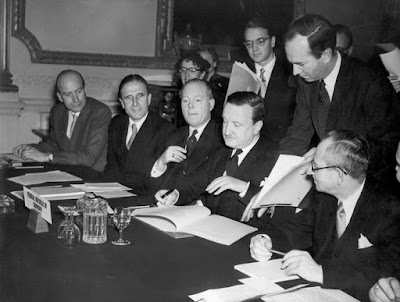
Germans Forget Postwar History Lesson on Debt Relief in Greece Crisis
As negotiations between Greece and its creditors stumbled toward breakdown, culminating in a sound rejection on Sunday by Greek voters of the conditions demanded in exchange for a financial lifeline, a vintage photo resurfaced on the Internet.
Image

It shows Hermann Josef Abs, head of the Federal Republic of Germany’s delegation in London on Feb. 27, 1953, signing the agreement that effectively cut the country’s debts to its foreign creditors in half.

It is an image that still resonates today. To critics of Germany’s insistence that Athens must agree to more painful austerity before any sort of debt relief can be put on the table, it serves as a blunt retort: The main creditor demanding that Greeks be made to pay for past profligacy benefited not so long ago from more lenient terms than it is now prepared to offer.

But beyond serving as a reminder of German hypocrisy, the image offers a more important lesson: These sorts of things have been dealt with successfully before.

The good news is that by now economists generally understand the contours of a successful approach. The bad news is that too many policy makers still take too long to heed their advice — insisting on repeating failed policies first.

“I’ve seen this movie so many times before,” said Carmen M. Reinhart, a professor at the Kennedy School of Government at Harvard who is perhaps the world’s foremost expert on sovereign debt crises.

“It is very easy to get hung up on the idiosyncrasies of each individual situation and miss the recurring pattern.”

The recurring, historical pattern? Major debt overhangs are only solved after deep write-downs of the debt’s face value. The longer it takes for the debt to be cut, the bigger the necessary write-down will turn out to be.

Nobody should understand this better than the Germans. It’s not just that they benefited from the deal in 1953, which underpinned Germany’s postwar economic miracle. Twenty years earlier, Germany defaulted on its debts from World War I, after undergoing a bout of hyperinflation and economic depression that helped usher Hitler to power.

It is a general lesson about the nature of debt. Yet from the World War I defaults of more than a dozen countries in the 1930s to the Brady write-downs of the early 1990s, which ended a decade of high debt and no growth in Latin America and other developing countries, it is a lesson that has to be relearned again and again.

Both of these episodes were preceded by a decade or more of negotiations and rescheduling plans that — not unlike Greece’s first bailout programs — extended the maturity of debts and lowered their interest rate. But crises ended and economies improved only after the debt was cut.

In a recent study, Professor Reinhart and Christoph Trebesch of the University of Munich found sharp economic rebounds after the 1934 defaults — which cut debtors’ foreign indebtedness by at least 43 percent, on average — and the Brady plan, which sliced debtors’ burdens by an average of 36 percent.

“The crisis exit in both episodes came only after deep face-value debt write-offs had been implemented,” they concluded. “Softer forms of debt relief, such as maturity extensions and interest rate reductions, are not generally followed by higher economic growth or improved credit ratings.”

Policy makers have yet to get this.

This is true even at the International Monetary Fund, which was created after World War II to deal precisely with such situations. Its approach to the European debt crisis, five years ago, started with the blanket assertion that default in advanced nations was “unnecessary, undesirable and unlikely.” To justify this, it put together an analysis of the Greek economic potential that verged on fantasy.

Even as late as March 2014, the I.M.F. held that the government in Athens could take out 3 percent of the Greek economy this year, as a primary budget surplus, and 4.5 percent next year, and still enjoy an economic growth surge to a 4 percent pace.

How could it achieve this feat? Piece of cake. Greek total factor productivity growth only had to surge from the bottom to the top of the list of countries using the euro. Its labor supply had to jump to the top of the table and its employment rate had to reach German levels.

The assumptions come in shocking contrast to the day-to-day reality of Greece, where more than a quarter of the work force is unemployed, some three-quarters of bank loans are nonperforming, tax payments are routinely postponed or avoided and the government finances itself by not paying its bills.

Peter Doyle, a former senior economist at the I.M.F. who left in disgust over its approach to the world’s financial crises, wrote: “If ‘optimism’ results in serial diagnostic underestimation of a serious problem, it is no virtue: At best, it badly prolongs the ailment; at worst, it is fatal.”

Creditors, of course, do not generally like debtors to write down their debt. But that’s not how Germany and its allies justify their approach. They rely instead on a “moral hazard” argument: If Greece were offered an easy way to get out of debt, what would prevent it from living the high life on other people’s money again? What kind of lesson would this send to, say, Portugal?

But the Greek economy has shrunk by a quarter. Its pensioners have been impoverished. Its banks are closed. That counts as suffering consequences. No sane government would emulate the Greek path.


Germany, in fact, understands moral hazard backward. The standard definition refers to lenders; covering their losses will encourage them to make bad loans again. And that is, let us not forget, exactly what Europe’s creditors have done. Their financial assistance to Greece was deployed to pay back German, French and other foreign banks and investors that held Greek debt. It did Greece little if any good.

Greece has done little to address its endemic economic mismanagement. But it has few incentives to do so if the fruits of economic improvements will flow to its creditors.

A charitable explanation of the strategy of Greece’s creditors is that they feared Europe’s financial system was too fragile in 2010, when Greece’s insolvency first became apparent, to survive a write-down of Greek debts. Greece, moreover, was not an outlier but one of several troubled European countries that might have followed the same path.

But Adam S. Posen, who heads the Peterson Institute for International Economics, says he thinks it has more to do with political cowardice. Greece’s creditors were not prepared to take a hit from a Greek debt write-down and then explicitly bail out their own banking system. So they resorted to what Mr. Posen calls “extend and pretend.”

“There’s an incredibly strong incentive not to recognize losses,” Mr. Posen told me. Governments “will do things that are more costly as long as they don’t appear as a line-item on the budget.”

There is a slim case for optimism. Today, the risk of contagion from Greece is low, Professor Reinhart says. Other peripheral European countries are in better shape. And even the I.M.F.’s economists recognize that there may be no way around a Greek write-down. The cost to Europe’s creditors would be minuscule.

Yet Germany has not come around. It took a decade or more from the onset of the Latin American debt crisis to the Brady deal. Brazil alone had six debt restructurings. Similarly, the generalized defaults of 1934 followed more than a decade of failed half-measures. Does Greece have to wait that long, too?
People who are wrong are just as sure they're right as people who are right. The only difference is, they're wrong.
God @The Tweet of God

User avatar
Gob
Posts: 33646
Joined: Tue Apr 06, 2010 8:40 am

Re: Will There Be Another Last Minute Reprieve For Greece?

Post by Gob »

Professor Piketty insists.
"When I hear the Germans say that they maintain a very moral stance about debt and strongly believe that debts must be repaid, then I think: what a huge joke! Germany is the country that has never repaid its debts. It has no standing to lecture other nations".

Mmmm. In fact, the two situations are completely different. Under the London Agreement on German External Debts of 1953, around a half of Germany's external debts - substantially the legacy of the first world war - were written off and extremely generous terms were granted for repayment of the balance. Yet the assets that notionally backed these debts had already suffered a calamitous meltdown, having been all but wiped out by the destruction of the second world war and the post war hyperinflation. The debt write-off merely recognised the underlying reality of a severely depleted asset base.


This has not happened in Greece. Membership of Europe's currency union prevents it. Inflation is non existent, and asset prices are sustained by the homogenising effect of the single currency.


The trouble with the European take on the Greek debt crisis, and this applies even to those like Professor Piketty who recognises that something has gone seriously wrong, is that nobody can bring themselves to accept that monetary union has failed. The upshot is that ever more contorted thought patterns and solutions are required to reconcile the irreconcilable.
“If you trust in yourself, and believe in your dreams, and follow your star. . . you'll still get beaten by people who spent their time working hard and learning things and weren't so lazy.”

rubato
Posts: 14245
Joined: Sun May 09, 2010 10:14 pm

Re: Will There Be Another Last Minute Reprieve For Greece?

Post by rubato »

https://en.wikipedia.org/wiki/Anglo-American_loan

When the UK was broke we gave them a bailout and allowed 50 years to pay it back at 2% interest; below the rate of inflation so the 'loan' was essentially a 'gift'. The UK were graceless and nasty about it at the time and were 6 years late paying it back in the end.

We even wrote off $8 billion (in current dollars) still owed for lend-lease.

The UK is not in a position to lecture others about debts and loans either.


Human society, even writ large internationally, is a cooperative enterprise and we will only succeed if we understand that the human dimensions of our interactions are more important than mere rules of business written to benefit business at the expense of all else.


Wales, Mississippi, N. Ireland, Virginia, Puerto Rico, Greece all exist only with financial transfers from other political entities. They are all dependents. We, who are at the moment the richer and more smug parts of the world, can either say "they pay or they suffer, they pay or they die" or we can accept that it is our obligation, and privilege, to make the world a better and more humane place.


Is money really worth torturing someone else for? To you?


yrs,
rubato

User avatar
Gob
Posts: 33646
Joined: Tue Apr 06, 2010 8:40 am

Re: Will There Be Another Last Minute Reprieve For Greece?

Post by Gob »

Aspergers boy knows nothing...

Doesn't seem to understand the difference between a paid back loan, and three unpaid bailouts while begging for more cash.....
“If you trust in yourself, and believe in your dreams, and follow your star. . . you'll still get beaten by people who spent their time working hard and learning things and weren't so lazy.”

User avatar
Long Run
Posts: 6723
Joined: Sat Apr 17, 2010 2:47 pm

Re: Will There Be Another Last Minute Reprieve For Greece?

Post by Long Run »

On the one hand, we have a country that went into debt because it was the sole defender of the free world for nearly three years against the most formidable heinous regimes in history, plus bearing a huge burden in that fight for another 3+ years and having their country devastated in the process. On the other hand, we have a country that went into debt to feed its kick-back lifestyle which left it completely unprepared for a tough economic downturn, and even 6 years later is unwilling to change its easy living ethos in order to get its financial house in order. I can see how some people would equate those things.

User avatar
Econoline
Posts: 9607
Joined: Sun Apr 18, 2010 6:25 pm
Location: DeKalb, Illinois...out amidst the corn, soybeans, and Republicans

Re: Will There Be Another Last Minute Reprieve For Greece?

Post by Econoline »

"Easy living"????? The Greek economy has shrunk by a quarter. Unemployment there is the highest of any nation in Europe. Its pensioners have been impoverished. Its banks are closed. There's no realistic hope of improvement in the foreseeable future. If that's "easy living" where you live, I'd hate to see what "hard times" looks like....
People who are wrong are just as sure they're right as people who are right. The only difference is, they're wrong.
God @The Tweet of God

User avatar
Long Run
Posts: 6723
Joined: Sat Apr 17, 2010 2:47 pm

Re: Will There Be Another Last Minute Reprieve For Greece?

Post by Long Run »

The Greeks got into this mess by failing to collect taxes, at the rate of 90% uncollected, while also having a high level of public spending, having people retire at the average age of 61, etc. (actually, their public spending is high but no worse than some other European countries, the real problem is the failure to collect revenues to pay for this). So, while living isn't "easy" there anymore, they are unwilling to adopt policies that -- assuming all things are equal (i.e., a non-crisis economy) -- the government will have the income to pay its expenses. That is, they have yet to propose a plan where they aren't using Germany's good credit to borrow yet more money to pay for normal operating expenses, so, yes, they still want "easy" living, and the vote this week was an affirmation of that.

There are two ways out of this mess: 1) have the leading lenders, mainly Germany (through the EU bank and IMF), write off a bunch of debt, and restructure the rest of the debt, and then make grants to stimulate the Greek economy; or 2) have Greece go off the Euro, write down debts through devaluation and/or lender concessions, go through more pain in the short run as the government is forced to live within its means, but come out with a more viable economy in the long run. The first path seems a non-starter as the northern European countries have gotten to the end their patience and do not believe for a second that Greece will reform if it is given yet another chance. This leaves the second option.

User avatar
Gob
Posts: 33646
Joined: Tue Apr 06, 2010 8:40 am

Re: Will There Be Another Last Minute Reprieve For Greece?

Post by Gob »

Please stop making sense L-R, you'll confuse rubato.
“If you trust in yourself, and believe in your dreams, and follow your star. . . you'll still get beaten by people who spent their time working hard and learning things and weren't so lazy.”

User avatar
Gob
Posts: 33646
Joined: Tue Apr 06, 2010 8:40 am

Re: Will There Be Another Last Minute Reprieve For Greece?

Post by Gob »

This is in 2014, in the middle of "Greek austerity".
On Wednesday, Greek Labor Minister Yiannis Vroutsis presented data to the parliament, explaining that almost 75% of Greek pensioners are trying to secure their early retirement through legal provisions that allow them to stop working before the age of 61.

“In the public sector, 7.91% of pensioners retire between the ages of 26 and 50, 23.64% between 51 and 55, and 43.53% between 56 and 61. In IKA, 4.44% of pensioners retire between the ages of 26 and 50, 12.83% retire between 51 and 55, and 58.61% retire between 56 and 61. Meanwhile, in the so-called healthy funds, 91.6% of people retire before the national retirement age limit,” Vroutsis said.

- See more at: http://greece.greekreporter.com/2014/12 ... qLj7z.dpuf
“If you trust in yourself, and believe in your dreams, and follow your star. . . you'll still get beaten by people who spent their time working hard and learning things and weren't so lazy.”

User avatar
Econoline
Posts: 9607
Joined: Sun Apr 18, 2010 6:25 pm
Location: DeKalb, Illinois...out amidst the corn, soybeans, and Republicans

Re: Will There Be Another Last Minute Reprieve For Greece?

Post by Econoline »

When you're out of work and have no realistic prospect of gainful employment, early retirement looks like a viable option. My own father was laid off at the age of 60 and after 2 years out of work took early retirement at 62. Under the same circumstances I'd do the same thing.

And I pretty much agree with the analysis in Long Run's second paragraph. If Germany won't even consider the first option, that means that the second option is the only possibility.
People who are wrong are just as sure they're right as people who are right. The only difference is, they're wrong.
God @The Tweet of God

Post Reply