1. Reduce the risibly and deceitfully misnamed "defense budget" to what it takes actually to defend the US. That means a reduction of at least 50%.
2. Tax all income, from whatever source derived, equally.
3. Institute genuinely progressive -- which is to say rational -- marginal tax rates:
$0 - $25,000: 0%
$25,001 - $50,000: 5%
$50,000 - $100,000: 11%
$100,101 - $250,000: 18%
$250,001 - $500,000: 26%
$500,001 - $750,000: 35%
$750,001 - $1,000,000: 45%
$1,000,000 - $10,000,000: 56%
$10,000,001 - $50,000,000: 68%
$50,000,001 and up: 81%
4. Impose upon any entity which produces goods or services outside the US and sells them in the US a prohibitve tax -- whatever it takes (a) to make producing goods or services in the US and selling them in the US profitable and (b) to make producing goods or services outside the US and selling them in the US a losing proposition.
I have no doubt that there are more things that need doing. But the foregoing are the basics.
Toward Sensible Debt Reduction
Toward Sensible Debt Reduction
Reason is valuable only when it performs against the wordless physical background of the universe.
-
MajGenl.Meade

- Posts: 21522
- Joined: Sun Apr 25, 2010 8:51 am
- Location: Groot Brakrivier
- Contact:
Re: Toward Sensible Debt Reduction
I could go with 1 - 3 until someone really smart explains why those are not good ideas. But #4 is out.
First off, did you mean US companies producing overseas and importing to the USA? Otherwise every country in the world will rightly call "protectionism" and "tariffs" as you punish their manufacturers and they will do likewise or sue us in the new United Nations Court to Help Developmentally Challenged Countries get a Zimmer.
Secondly, US business enterprises are encouraged to invest in growing markets by purchasing overseas companies which as it happens serve both domestic and export consumers. You suggest that such companies based in say Kenya, should pay a penalty for having U.S. owners but only on material shipped to the USA?
Thirdly, where is your plan to initially hold down and then reduce U.S. wage levels so that the U.S. worker is competitive in the world, thus permitting business to invest in those yearning-to-work-hard areas of the country that are crying out to manufacture TVs, cell phones, clothes, shoes and all those other quaint things that U.S. workers were wont to spend their 8-hours a day doing?
There are fourths and fifths and so on
Meade
First off, did you mean US companies producing overseas and importing to the USA? Otherwise every country in the world will rightly call "protectionism" and "tariffs" as you punish their manufacturers and they will do likewise or sue us in the new United Nations Court to Help Developmentally Challenged Countries get a Zimmer.
Secondly, US business enterprises are encouraged to invest in growing markets by purchasing overseas companies which as it happens serve both domestic and export consumers. You suggest that such companies based in say Kenya, should pay a penalty for having U.S. owners but only on material shipped to the USA?
Thirdly, where is your plan to initially hold down and then reduce U.S. wage levels so that the U.S. worker is competitive in the world, thus permitting business to invest in those yearning-to-work-hard areas of the country that are crying out to manufacture TVs, cell phones, clothes, shoes and all those other quaint things that U.S. workers were wont to spend their 8-hours a day doing?
There are fourths and fifths and so on
Meade
For Christianity, by identifying truth with faith, must teach-and, properly understood, does teach-that any interference with the truth is immoral. A Christian with faith has nothing to fear from the facts
-
oldr_n_wsr
- Posts: 10838
- Joined: Sun Apr 18, 2010 1:59 am
Re: Toward Sensible Debt Reduction
Tax rates need to take into account "areas" fo the country. Someone making $50K in bumfuck state is living high on the card where as in NY city or Long Island they are barely making ends meet.
And do not say, "they should move".
And do not say, "they should move".
Re: Toward Sensible Debt Reduction
First: Sorry, General; I wrote overbroadly. I meant what is commonly called "outsourcing," not the mere export to the US of goods made in foreign countries. The flood of imports from foreign countries, which hurts the US far more than it helps the US, needs to be addressed (see below), but that is not what I had in mind.
Second: I am not sure that I fully grasp your point. But it seems to dovetail with your third point.
Third: I have no "plan to initially hold down and then reduce U.S. wage levels so that the U.S. worker is competitive in the world". On the contrary, any such plan would be utterly odious.
Much as corporate interests might like the idea, the US should not make itself "competitive" by turning itself into a third-world country. US workers should not have to debase their standard of living -- and themselves -- by competing with workers in foreign countries who have no choice but to work for pittances in miserable conditions.
Rather, the US should protect its workers' standard of living by preventing the products made by those unfortunate workers from polluting the US market.
Many people would call that "protectionism". And they would be right.
How did "protectionism" become a bad word? Since when has protecting American workers from being reduced to poverty been a bad thing?
Second: I am not sure that I fully grasp your point. But it seems to dovetail with your third point.
Third: I have no "plan to initially hold down and then reduce U.S. wage levels so that the U.S. worker is competitive in the world". On the contrary, any such plan would be utterly odious.
Much as corporate interests might like the idea, the US should not make itself "competitive" by turning itself into a third-world country. US workers should not have to debase their standard of living -- and themselves -- by competing with workers in foreign countries who have no choice but to work for pittances in miserable conditions.
Rather, the US should protect its workers' standard of living by preventing the products made by those unfortunate workers from polluting the US market.
Many people would call that "protectionism". And they would be right.
How did "protectionism" become a bad word? Since when has protecting American workers from being reduced to poverty been a bad thing?
Reason is valuable only when it performs against the wordless physical background of the universe.
Re: Toward Sensible Debt Reduction
I have thought for a long time that, in principle, that is a good idea. I have just not been able to come up with a workable way to implement it. But perhaps some people who know more about than do I can help with that.oldr_n_wsr wrote:Tax rates need to take into account "areas" fo the country.
Reason is valuable only when it performs against the wordless physical background of the universe.
-
oldr_n_wsr
- Posts: 10838
- Joined: Sun Apr 18, 2010 1:59 am
Re: Toward Sensible Debt Reduction
Agreed and this may go against my stand on "right to work states" of which I pretty much support. But then again, being contradictory is my main asset.Much as corporate interests might like the idea, the US should not make itself "competitive" by turning itself into a third-world country.

Maybe a scale of median (or mean) income, taking into account housing costs, local tax rates and prices of needed goods. I own about 1/2 acre here on Long Island, four houses from the Long Island Expressway (THE major highway down the middle of Long Island) and pay over $6k in property taxes (and that is low for my area), and over 60% of that is to the school district. I also have a house in bumf--k north eastern Pa on an acre plot and lake front. I pay less than $1000 in property taxes. If that house was on LI, I would guess taxes would be in the $25k-$30k range.Andrew D wrote:I have thought for a long time that, in principle, that is a good idea. I have just not been able to come up with a workable way to implement it. But perhaps some people who know more about than do I can help with that.oldr_n_wsr wrote:Tax rates need to take into account "areas" fo the country.
Location, location, location.

Re: Toward Sensible Debt Reduction
I haven't been awake very long so I'm probably missing something here.
Are 2 and 3 not conflicting ideas?
How can you tax all income equally and progressively?
Are 2 and 3 not conflicting ideas?
How can you tax all income equally and progressively?
Re: Toward Sensible Debt Reduction
All income, from whatever source derived, should be equally subject to the same progressive taxation. Specifically (but without limitation), capital-gains income should be treated, for tax purposes, identically to earned income.Joe Guy wrote:I haven't been awake very long so I'm probably missing something here.
Are 2 and 3 not conflicting ideas?
How can you tax all income equally and progressively?
Reason is valuable only when it performs against the wordless physical background of the universe.
Re: Toward Sensible Debt Reduction
Okay. At first I took # 2 to mean "equally" as everyone, regardless of level of income, to be taxed at the same fixed percentage on all income.Andrew D wrote:All income, from whatever source derived, should be subject to the same progressive taxation. Specifically (but without limitation), capital-gains income should be treated, for tax purposes, identically to earned income.Joe Guy wrote:I haven't been awake very long so I'm probably missing something here.
Are 2 and 3 not conflicting ideas?
How can you tax all income equally and progressively?
-
oldr_n_wsr
- Posts: 10838
- Joined: Sun Apr 18, 2010 1:59 am
Re: Toward Sensible Debt Reduction
I can go for that.Okay. At first I took # 2 to mean "equally" as everyone, regardless of level of income, to be taxed at the same fixed percentage on all income.
-
MajGenl.Meade
- Posts: 21522
- Joined: Sun Apr 25, 2010 8:51 am
- Location: Groot Brakrivier
- Contact:
Re: Toward Sensible Debt Reduction
I think that speaks volumes - and yes, I curtailed your sentence which concluded "who have no choice but to work for pittances in miserable conditions" because it is patent nonsense, reducing all imports to the level of "made in China by tiny children beaten senseless for 8-hours a day and that while they're not actually working".US workers should not have to debase their standard of living -- and themselves -- by competing with workers in foreign countries
US-owned entities in the UK, Germany, France, Canada, Australia, Japan and so on produce goods for consumption in the US market. The employees of those companies are not "work(ing) for pittances in miserable conditions". Well, France maybe.
The American TV manufacturing industry was not destroyed by Indonesian sweat-shops but by the industrial improvements of Japan which produced better goods, more cheaply and by so doing improved their standard of living. Meanwhile, US workers lived high on the hog until there was no more hog left. Not that there's anything wrong with that - get it while you can.
Let me also add that companies in the UK, Germany, France, Canada, Australia, Japan and so on happen to own many companies in the USA which produce for export back to those same countries (and world-wide of course). Should those countries impose punitive protective tariffs on imports from the USA?
That would (of course) protect their own domestic work forces from goods produced by people who "work for pittances in miserable conditions" in Ohio, New York, Georgia, California and so on.
I don't think you quite have the hang of "global economy" Andrew. Let them eat cake.
Meade
For Christianity, by identifying truth with faith, must teach-and, properly understood, does teach-that any interference with the truth is immoral. A Christian with faith has nothing to fear from the facts
Re: Toward Sensible Debt Reduction
The US consumer market is flooded with products made in China.
Are you seriously suggesting that the US ought to "compete" with China by reducing its labor standards -- wages, hours, working conditions, etc. -- to those of China?
Are you seriously suggesting that the US ought to "compete" with China by reducing its labor standards -- wages, hours, working conditions, etc. -- to those of China?
Reason is valuable only when it performs against the wordless physical background of the universe.
-
MajGenl.Meade
- Posts: 21522
- Joined: Sun Apr 25, 2010 8:51 am
- Location: Groot Brakrivier
- Contact:
Re: Toward Sensible Debt Reduction
No, I'm suggesting that you propose punitive taxation against USA companies that own foreign businesses and export to the USA. You do not propose punitive taxation against foreign-owned companies that export to the USA althought that would be required, wouldn't it?
I also suggest that your view of foreign-based manufacturing as consisting solely of sweat-shops is a generalisation that ignores the huge US investment in manufacturing in first world countries that export to the USA. The "China flooding" is less a result of US ownership of Chinese manufacturing as it is US purchasing PRC manufactures.
Under your plan, the union-produced widget that the USA companies will be 'forced' to manufacture will continue to cost a lot more than the Chinese widget unless US workers are willing to work for less. They must have a lower standard of living or no one will buy their widgets (which is the history of the past 50 years). So all your USA companies will go bankrupt; mass unemployment will result; the collapse of civilisation as the USA calls it will ensue.
Clearly US companies will not bother to build any widgets in a non-competitive labour market - hence no new manufacturing in the USA. The USA companies will instead invest even more overseas and export to all other countries not calling themselves the United States of anything. And US manufacturing will collapse even more behind its wall of 'protection'
I think you are an undercover ChiCom.
Meade
I also suggest that your view of foreign-based manufacturing as consisting solely of sweat-shops is a generalisation that ignores the huge US investment in manufacturing in first world countries that export to the USA. The "China flooding" is less a result of US ownership of Chinese manufacturing as it is US purchasing PRC manufactures.
Under your plan, the union-produced widget that the USA companies will be 'forced' to manufacture will continue to cost a lot more than the Chinese widget unless US workers are willing to work for less. They must have a lower standard of living or no one will buy their widgets (which is the history of the past 50 years). So all your USA companies will go bankrupt; mass unemployment will result; the collapse of civilisation as the USA calls it will ensue.
Clearly US companies will not bother to build any widgets in a non-competitive labour market - hence no new manufacturing in the USA. The USA companies will instead invest even more overseas and export to all other countries not calling themselves the United States of anything. And US manufacturing will collapse even more behind its wall of 'protection'
I think you are an undercover ChiCom.
Meade
For Christianity, by identifying truth with faith, must teach-and, properly understood, does teach-that any interference with the truth is immoral. A Christian with faith has nothing to fear from the facts
Re: Toward Sensible Debt Reduction
The idea that China is a threat to US manufacturing because of low wages is false and in any case self-correcting; as we can already see. Wages have multiplied in the past decade and the labor advantage is shrinking:

I have pointed out before that often it does not matter where something is made. I gave the example of a $100 pair of Nike sneakers made in china where only 12$ goes to china and almost all of the rest goes to the US:

I have not mentioned before, but do now, that the manufacturing advantage China enjoys because they can exploit labor; poison and kill people on the job and force people to work 80 hour-weeks* (like US companies used to do before Unions and Liberals stopped them) is being effectively reduced by NGOs because Apple, Nike and all other name-brand companies are sensitive to public pressure in the US and do act to reform workplace abuses when they are pointed out.
All three of the above are either not problems or are currently self-correcting and so we don't have to do anything about them on the government level other than monitor and publish human rights abuses and let the affluent (free time + education) and caring lobby do its thing.
What we should do, and I think ultimately we must, is to tax Chinese manufactures which contribute to pollution and global warming so that they cannot compete at an advantage because they are ruining the very same planet that all of us have to live on.. Which we have to do with all of our trading partners.
And what we also must do is require the government of China to eliminate the routine product counterfeiting, dangerous products, software piracy, and IP theft. Or at least reduce it to a more tolerable level.
yrs,
rubato
I have pointed out before that often it does not matter where something is made. I gave the example of a $100 pair of Nike sneakers made in china where only 12$ goes to china and almost all of the rest goes to the US:
I have not mentioned before, but do now, that the manufacturing advantage China enjoys because they can exploit labor; poison and kill people on the job and force people to work 80 hour-weeks* (like US companies used to do before Unions and Liberals stopped them) is being effectively reduced by NGOs because Apple, Nike and all other name-brand companies are sensitive to public pressure in the US and do act to reform workplace abuses when they are pointed out.
All three of the above are either not problems or are currently self-correcting and so we don't have to do anything about them on the government level other than monitor and publish human rights abuses and let the affluent (free time + education) and caring lobby do its thing.
What we should do, and I think ultimately we must, is to tax Chinese manufactures which contribute to pollution and global warming so that they cannot compete at an advantage because they are ruining the very same planet that all of us have to live on.. Which we have to do with all of our trading partners.
And what we also must do is require the government of China to eliminate the routine product counterfeiting, dangerous products, software piracy, and IP theft. Or at least reduce it to a more tolerable level.
yrs,
rubato
Re: Toward Sensible Debt Reduction
If that is true, substitute for China the Czech Republic. Or Hungary. Or Poland. Or Russia or Mexico or Romania or Brazil or South Africa or Thailand or Tunisia or Ukraine or Jordan or Morocco or Egypt or Sri Lanka or Senegal or India or Kenya or Vietnam or Ghana or Pakistan or Bangladesh or Madagascar or ....rubato wrote:The idea that China is a threat to US manufacturing because of low wages is false and in any case self-correcting ....
Reason is valuable only when it performs against the wordless physical background of the universe.
Re: Toward Sensible Debt Reduction
This specious argument:
First, keeping jobs in the US is not just a matter of where things are produced. It is also a matter of service.
It would be a simple matter, for example, for us to say "If you want to sell your computers (or whatever) in the US, you must maintain your call centers, help lines, etc., in the US."
No more calling for help and having your call routed to Mumbai or Bangkok or Kuala Lumpur or ....
No sanely run company would take a pass on the US consumer market -- the dizzyingly huge US consumer market (see below) -- just to keep its call centers, help lines, etc., somewhere else.
Second, businesses are about profit. If in order to sell goods in the US, a company had to produce those goods in the US, then the cost of producing those goods in Bangladesh or Singapore or wherever would be irrelevant. The Chinese widget would be of no significance. What would matter would be whether businesses could sell their goods in the US for more than it cost them to produce (and market, etc.) their goods in the US.
The US is, far and away, the world's largest consumer market. No other consumer market even comes close:
--> The US consumer market is more than 2/7 (28.9036%) of the entire world's consumer market.
--> The US consumer market is larger than the consumer market of the entire European Union -- larger than those of Austria, Belgium, Bulgaria, Cyprus, the Czech Republic, Denmark, Estonia, Finland, France, Germany, Greece, Hungary, Ireland, Italy, Latvia, Lithuania, Luxembourg, Malta, Netherlands, Poland, Portugal, Romania, Slovakia, Slovenia, Spain, Sweden, and the United Kingdom combined.
--> The US consumer market is larger than the next five largest consumer markets combined -- larger than those of Japan plus Germany plus China plus Italy plus the UK. The US consumer market is 3.4 times that of Japan, 5.1 times that of Germany, 5.5 times that of China, 6.5 times that of Italy, and 7.1 times that of the UK.
--> The US consumer market is larger than the twenty-one largest consumer markets after that combined -- larger than those of Brazil plus Spain plus France plus Canada plus India plus Russia plus Mexico plus Australia plus South Korea plus Turkey, plus Netherlands plus Argentina plus Switzerland plus Poland plus Belgium plus Greece plus Malaysia plus Austria plus Norway plus Iran plus Indonesia.
--> The US consumer market is larger than all of the other consumer markets in the world after that combined.
The bottom line -- which is what businesses exist to care about -- is straightforward. If sales revenue generated in the US minus production cost incurred in the US equals profit, then companies will flock to the 800-pound-gorilla-in-the-world's-living-room consumer market that is the US.
Exactly contrary to your claims, companies producing goods in the US and selling them in the US would profit; employment in the US would rise; US workers would be better off; and civilization, as the US and the rest of the civilized world call it, would thrive.
ignores economic reality.MajGenl.Meade wrote:Under your plan, the union-produced widget that the USA companies will be 'forced' to manufacture will continue to cost a lot more than the Chinese widget unless US workers are willing to work for less. They must have a lower standard of living or no one will buy their widgets (which is the history of the past 50 years). So all your USA companies will go bankrupt; mass unemployment will result; the collapse of civilisation as the USA calls it will ensue.
Clearly US companies will not bother to build any widgets in a non-competitive labour market - hence no new manufacturing in the USA. The USA companies will instead invest even more overseas and export to all other countries not calling themselves the United States of anything. And US manufacturing will collapse even more behind its wall of 'protection'
First, keeping jobs in the US is not just a matter of where things are produced. It is also a matter of service.
It would be a simple matter, for example, for us to say "If you want to sell your computers (or whatever) in the US, you must maintain your call centers, help lines, etc., in the US."
No more calling for help and having your call routed to Mumbai or Bangkok or Kuala Lumpur or ....
No sanely run company would take a pass on the US consumer market -- the dizzyingly huge US consumer market (see below) -- just to keep its call centers, help lines, etc., somewhere else.
Second, businesses are about profit. If in order to sell goods in the US, a company had to produce those goods in the US, then the cost of producing those goods in Bangladesh or Singapore or wherever would be irrelevant. The Chinese widget would be of no significance. What would matter would be whether businesses could sell their goods in the US for more than it cost them to produce (and market, etc.) their goods in the US.
The US is, far and away, the world's largest consumer market. No other consumer market even comes close:
--> The US consumer market is more than 2/7 (28.9036%) of the entire world's consumer market.
--> The US consumer market is larger than the consumer market of the entire European Union -- larger than those of Austria, Belgium, Bulgaria, Cyprus, the Czech Republic, Denmark, Estonia, Finland, France, Germany, Greece, Hungary, Ireland, Italy, Latvia, Lithuania, Luxembourg, Malta, Netherlands, Poland, Portugal, Romania, Slovakia, Slovenia, Spain, Sweden, and the United Kingdom combined.
--> The US consumer market is larger than the next five largest consumer markets combined -- larger than those of Japan plus Germany plus China plus Italy plus the UK. The US consumer market is 3.4 times that of Japan, 5.1 times that of Germany, 5.5 times that of China, 6.5 times that of Italy, and 7.1 times that of the UK.
--> The US consumer market is larger than the twenty-one largest consumer markets after that combined -- larger than those of Brazil plus Spain plus France plus Canada plus India plus Russia plus Mexico plus Australia plus South Korea plus Turkey, plus Netherlands plus Argentina plus Switzerland plus Poland plus Belgium plus Greece plus Malaysia plus Austria plus Norway plus Iran plus Indonesia.
--> The US consumer market is larger than all of the other consumer markets in the world after that combined.
The bottom line -- which is what businesses exist to care about -- is straightforward. If sales revenue generated in the US minus production cost incurred in the US equals profit, then companies will flock to the 800-pound-gorilla-in-the-world's-living-room consumer market that is the US.
Exactly contrary to your claims, companies producing goods in the US and selling them in the US would profit; employment in the US would rise; US workers would be better off; and civilization, as the US and the rest of the civilized world call it, would thrive.
Reason is valuable only when it performs against the wordless physical background of the universe.
Re: Toward Sensible Debt Reduction
I think you need to read the history of the corn laws in England, some J.S. Mill on free trade, and Ricardo on comparitive advantage.
Protectionism is a race to the bottom economically. India tried to restrict imports to protect local industries and the result was two generations of stagnation.
If my t-shirts are sewn together in Jordan or India they cost me less and I spend the difference on something else; like an I-Phone (which is made in Japan and China and most of the profit goes here). The wages paid in India or Jordan raise their std of living and allow them to buy US-made goods. We have become so GOOD at manufacturing, as a species, that manufacturing has itself become a commodity. And commodities are low-margin activities.
By focussing too much on one part of the economic web you are losing sight of the whole.
China is not a major threat. Whatever has allowed the financial services industry to capture a larger part of the pie is. Financial services should be MUCH cheaper now that most of the things that they do are done by computers and thus their share of the economy should shrink, like agriculture shrank when it became more efficient. Why is so much money being sucked out of the economy there?

http://captaincapitalism.blogspot.com/2 ... f-gdp.html
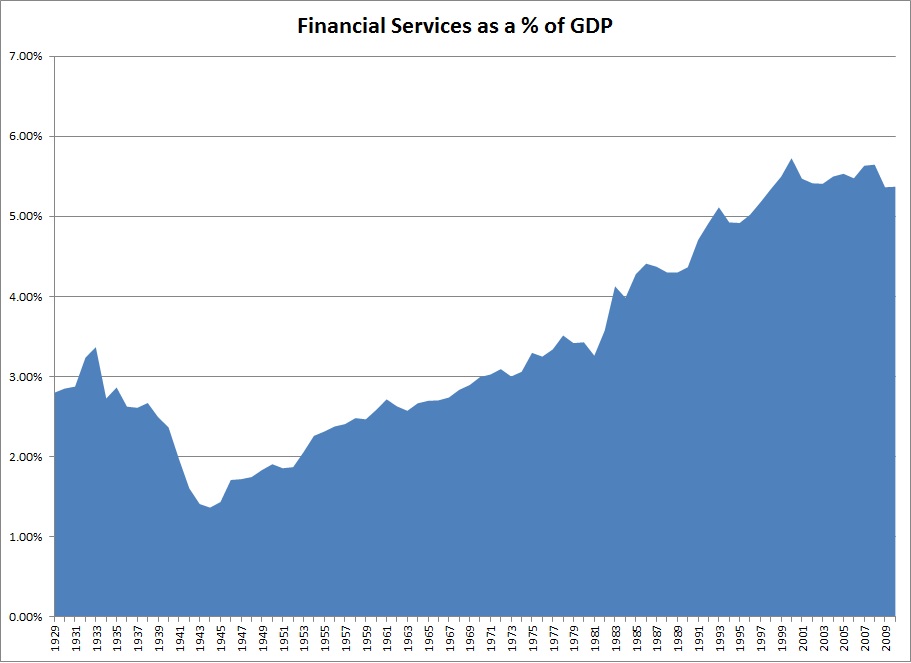
Financial services produce nothing. They seldom appear to bear their own risks. They are pure parasites.
yrs,
rubato
yrs,
rubato
Protectionism is a race to the bottom economically. India tried to restrict imports to protect local industries and the result was two generations of stagnation.
If my t-shirts are sewn together in Jordan or India they cost me less and I spend the difference on something else; like an I-Phone (which is made in Japan and China and most of the profit goes here). The wages paid in India or Jordan raise their std of living and allow them to buy US-made goods. We have become so GOOD at manufacturing, as a species, that manufacturing has itself become a commodity. And commodities are low-margin activities.
By focussing too much on one part of the economic web you are losing sight of the whole.
China is not a major threat. Whatever has allowed the financial services industry to capture a larger part of the pie is. Financial services should be MUCH cheaper now that most of the things that they do are done by computers and thus their share of the economy should shrink, like agriculture shrank when it became more efficient. Why is so much money being sucked out of the economy there?
http://captaincapitalism.blogspot.com/2 ... f-gdp.html
Financial services produce nothing. They seldom appear to bear their own risks. They are pure parasites.
yrs,
rubato
yrs,
rubato
Re: Toward Sensible Debt Reduction
And another specious argument:
When the people who object to the US's maintaining high standards of living for people in the US can show that their policies would result in the US's having a trade surplus with the rest of the world, they will, perhaps, have a leg to stand on.
Until then, they should either (a) admit that they don't care about most Americans' standards of living or (b) just shut up.
founders on the impervious rock of the facts:rubato wrote:If my t-shirts are sewn together in Jordan or India they cost me less and I spend the difference on something else; like an I-Phone (which is made in Japan and China and most of the profit goes here). The wages paid in India or Jordan raise their std of living and allow them to buy US-made goods.
While people who are paying no attention to the facts rail against "protectionism," the US keeps hemorrhaging tens of billions of dollars to countries who are waging economic war against us.US trade deficit grows to $42.2B because of fewer exports; deficit with China hits record high
By Associated Press,December 11, 2012
WASHINGTON — The U.S. trade deficit increased in October because exports fell by a larger margin than imports, a sign that slower global growth could weigh on the U.S. economy.
The Commerce Department said Tuesday that the trade deficit grew 4.8 percent in October from September to $42.2 billion.
Exports dropped 3.6 percent to $180.5 billion. Sales of commercial aircraft, autos and farm products all declined.
When the people who object to the US's maintaining high standards of living for people in the US can show that their policies would result in the US's having a trade surplus with the rest of the world, they will, perhaps, have a leg to stand on.
Until then, they should either (a) admit that they don't care about most Americans' standards of living or (b) just shut up.
Reason is valuable only when it performs against the wordless physical background of the universe.
Re: Toward Sensible Debt Reduction
You do not understand the facts.
again:
"I think you need to read the history of the corn laws in England, some J.S. Mill on free trade, and Ricardo on comparitive advantage."
Yes, we have a trade deficit. And?
yrs,
rubato
again:
"I think you need to read the history of the corn laws in England, some J.S. Mill on free trade, and Ricardo on comparitive advantage."
Yes, we have a trade deficit. And?
yrs,
rubato

Re: Toward Sensible Debt Reduction
I said once before:
Scooter wrote:You are way too focussed on who produces the cheap shit you consume. Here's a not-so-much-a-secret: China is already moving its economy away from producing cheap shit for Walmart. They have already figured out that it's a dead end. In 50 years time the world's most powerful economies will not be manufacturing-based.
You have one of the world's most educated workforces, and you want them to, what? Sit on a line making sneakers? Your economy could do that when you had an underclass of black and hispanic and female workers who were ready to work for pennies. You don't have that anymore, unless they are illegals. Time to move on.
"Hang on while I log in to the James Webb telescope to search the known universe for who the fuck asked you." -- James Fell