Mea Culpa
Real Economists on Raising the Minimum Wage (Not a List)
Re: Real Economists on Raising the Minimum Wage (Not a List)
Sorry, oldr----- not directed at you just people in general.
Mea Culpa
Mea Culpa
Your collective inability to acknowledge this obvious truth makes you all look like fools.
yrs,
rubato
-
oldr_n_wsr
- Posts: 10838
- Joined: Sun Apr 18, 2010 1:59 am
Re: Real Economists on Raising the Minimum Wage (Not a List)
No problem and you are right, anyone with a job should be thankful. and I am certainly one who is thankful
Re: Real Economists on Raising the Minimum Wage (Not a List)
Ah, see ! I knew we had something in common, we're both anti-American!!dgs49 wrote: Unlike those other countries, the United States is, at least theoretically, constrained by a Constitution under which the Government has NOT committed to saving the wretched from their natural lot in life.
“If you trust in yourself, and believe in your dreams, and follow your star. . . you'll still get beaten by people who spent their time working hard and learning things and weren't so lazy.”
Re: Real Economists on Raising the Minimum Wage (Not a List)
The UK is worse off than we are, a lot worse off, because they are following the prescriptions of the Republican party. Too bad for them!dgs49 wrote:Fucking hilarious, Gobster! You are joking, right?
We should modify our policies to be like FRANCE??????? The UK?
So our economy can be like theirs?
Priceless.
Unlike those other countries, the United States is, at least theoretically, constrained by a Constitution under which the Government has NOT committed to saving the wretched from their natural lot in life.
It is amazing how the people on this board, who have no idea where the MW fits into most peoples' lives, can pontificate about related public policy. We do not live in a caste system in the U.S. If you remain in a MW job for more than a year or so, YOU DESERVE TO BE MAKING MINIMUM WAGE! That's all you are worth.
Overall the French are not doing as badly and I have to tell you they really know how to live. You're a miserable little bastard compared to them. But you would be a miserable little bastard in any group, yes?
yrs,
rubato
Re: Real Economists on Raising the Minimum Wage (Not a List)
I await a graph.rubato wrote:dgs49 wrote: The UK is worse off than we are, a lot worse off, because they are following the prescriptions of the Republican party. Too bad for them!
“If you trust in yourself, and believe in your dreams, and follow your star. . . you'll still get beaten by people who spent their time working hard and learning things and weren't so lazy.”
Re: Real Economists on Raising the Minimum Wage (Not a List)
Gob wrote:I await a graph.

Re: Real Economists on Raising the Minimum Wage (Not a List)
“If you trust in yourself, and believe in your dreams, and follow your star. . . you'll still get beaten by people who spent their time working hard and learning things and weren't so lazy.”
Re: Real Economists on Raising the Minimum Wage (Not a List)
looks to me like you're still in the shits:

And will be for the forseeable future.
yrs,
rubato
And will be for the forseeable future.
yrs,
rubato
Re: Real Economists on Raising the Minimum Wage (Not a List)
Looks to me like you've just posted another meaningless graph. 
“If you trust in yourself, and believe in your dreams, and follow your star. . . you'll still get beaten by people who spent their time working hard and learning things and weren't so lazy.”
Re: Real Economists on Raising the Minimum Wage (Not a List)
Meaningless, to an illiterate.Gob wrote:Looks to me like you've just posted another meaningless graph.
yrs,
rubato
Re: Real Economists on Raising the Minimum Wage (Not a List)
Well, you'd know...
“If you trust in yourself, and believe in your dreams, and follow your star. . . you'll still get beaten by people who spent their time working hard and learning things and weren't so lazy.”
Re: Real Economists on Raising the Minimum Wage (Not a List)
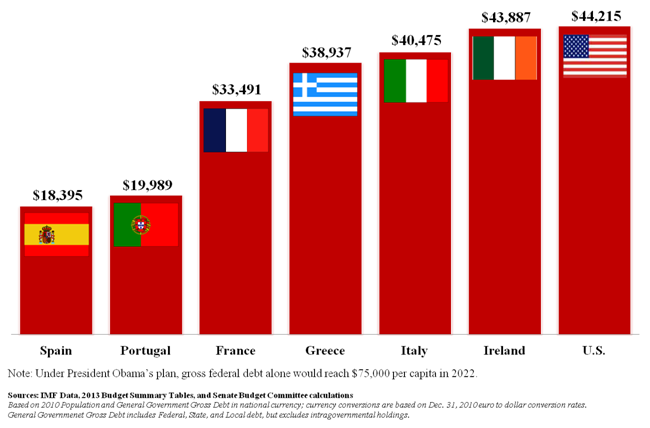
Apparently there is a very good reason that we can sustain a higher debt/ person:

Our economy has been growing while most of the EU and Britain are in an ongoing series of recessions. France has done relatively well after a shallower dip in the original collapse with a stagnation occurring in the past year (since 2011).
yrs,
rubato

Our economy has been growing while most of the EU and Britain are in an ongoing series of recessions. France has done relatively well after a shallower dip in the original collapse with a stagnation occurring in the past year (since 2011).
yrs,
rubato
- Econoline
- Posts: 9607
- Joined: Sun Apr 18, 2010 6:25 pm
- Location: DeKalb, Illinois...out amidst the corn, soybeans, and Republicans
Re: Real Economists on Raising the Minimum Wage (Not a List)
I've been meaning to answer this, but it's taken me a few days to get around to it.dgs49 wrote:Dearest Econoline: The question might be characterized in the following example:
Say some empathetic Emperor decided that he wanted to eliminate poverty in his empire. He decreed that there would be (in today's U.S. dollars) a minimum wage of $25/hour.
It is not difficult to see that this initiative would have catastrophic results, unforseen by our well-meaning monarch. Small businesses, such as restaurants, would have to either raise their prices to prohibitive levels in order to pay their staff, or simply go out of business. People who now would consider eating out a couple times a week would have to forego that pleasure, or cut it back to once or twice a month, as eating out would cost a minimum $100. Janitor service would become so prohibitively expensive that businesses would upgrade cleaning equipment to require an absolute minimum of human involvement, and those people would be trained technicians. And so on.
The job market for, say, high school dropouts, or the mildly retarded would dry up completely, because those people would simply have no way of earning anywhere near the minimum wage.
So the question is, if raising it dramatically is clearly a bad and stupid thing, how much can you raise it without seeing the harmful results that occur when you raise the required value of human effort beyond its economic value?
Or, to compare it to something the rubato person would appreciate, if you can tolerate water with, say 22ppb arsenic, how much arsenic can you tolerate without getting sick? And do you voluntarily add more arsenic in the hope that it won't do any measurable harm?
The minimum wage in itself is a stupid, stupid idea, and should be abolished.
I knew that the usual reductio ad absurdum argument would come up. The part I highlighted is really at the crux of it all, isn't it?
You are assuming a tight labor market, where employers will pay whatever is necessary--but not a penny more--in order to get employees to work for them...and further assuming that there is some exact figure for this level of pay that can be determined objectively, somehow.
In reality, the line between "not enough" and "too much" is never clear, and never exact, and in a buyer's market the buyer (employer) has all the advantage. In other words, an employer has every incentive to see how little he can get away with paying, and if some workers are desperate enough to take a wage that is not enough to live on, the employer can count on the rest of society (i.e., you and me) to pay the difference in the form of food stamps, Medicaid, emergency medical services, the Earned Income Tax Credit, etc., etc. (Yes, I know, in some cases the employer can count on the employee's family or some private charity to make up the difference, but that situation is far from universal or certain--and it still constitutes relying on the rest of society.)
The best solution, which has worked pretty well so far (despite conservatives' arguments to the contrary) is to set a legal minimum wage somewhere in that gray area between "not enough" and "too much" and keep raising it to keep up with inflation. And because economics is an inexact science--as even you have acknowledged earlier in this thread--a bit of trial-and-error must necessarily play a part in setting that precise legal figure. Yes, it's possible that in some instances the minimum wage has been set too high, or too low. But the fact that numerous studies (which others have cited above) show that raising the legal minimum wage has had little or no effect on unemployment shows that, by and large, the law has so far gotten it right.
People who are wrong are just as sure they're right as people who are right. The only difference is, they're wrong.
— God @The Tweet of God
Re: Real Economists on Raising the Minimum Wage (Not a List)
The actual question is "why should we allow ourselves to be exploited by employers who pay less than the cost which a human life represents and thus transfer all of the additional costs onto the rest of society."?So the question is, if raising it dramatically is clearly a bad and stupid thing, how much can you raise it without seeing the harmful results that occur when you raise the required value of human effort beyond its economic value?
Businesses which are so marginal that they cannot afford to pay for labor are supposed to be allowed to fail. That, is capitalism.
yrs,
rubato
Re: Real Economists on Raising the Minimum Wage (Not a List)
Seriously, dgs49, have you ever studied any economics beyond Econ 101?
I do not claim expertise, but even I know enough to grasp the dizzyingly obvious truth that raising the earnings of those earning the least stimulates economic growth.
It works like this:
If people working at fast-food "restaurants" earn more, that means that they have more money to spend on things.
If people working at fast-food "restaurants" have more money to spend on things, that means that they buy more things.
If people working at fast-food "restaurants" buy more things, that means that the people who make those things will make and sell more of those things.
If people working at fast-food "restaurants" buy more things, that means that the people who distribute those things from the people who make them to the people who buy them will distribute more of them.
If people working at fast-food "restaurants" buy more things, that means that the people who maintain and repair those things will maintain and repair more of them.
Etc.
The people who make and sell more things will make more money. The people who distribute more things will make more money. The people who maintain and repair more things will make more money.
The people who make and sell more things and make more money will, in turn, buy more things. The people who distribute those things will distribute more of them and make more money and buy more things. The people who maintain and repair those things will maintain and repair more of them and make more money and buy more things.
Etc.
There are, of course, other factors, and the cycle of more-earnings-more-spending-more-profit-more-production-more-earnings cannot be spun out indefinitely at this level of simplicity.
But the foregoing abstract description at least takes into account the first-order effects of increased earnings and the resultant increased spending on economic growth. And those are basic effects which you seem either oblivious to or determined to ignore.
I do not claim expertise, but even I know enough to grasp the dizzyingly obvious truth that raising the earnings of those earning the least stimulates economic growth.
It works like this:
If people working at fast-food "restaurants" earn more, that means that they have more money to spend on things.
If people working at fast-food "restaurants" have more money to spend on things, that means that they buy more things.
If people working at fast-food "restaurants" buy more things, that means that the people who make those things will make and sell more of those things.
If people working at fast-food "restaurants" buy more things, that means that the people who distribute those things from the people who make them to the people who buy them will distribute more of them.
If people working at fast-food "restaurants" buy more things, that means that the people who maintain and repair those things will maintain and repair more of them.
Etc.
The people who make and sell more things will make more money. The people who distribute more things will make more money. The people who maintain and repair more things will make more money.
The people who make and sell more things and make more money will, in turn, buy more things. The people who distribute those things will distribute more of them and make more money and buy more things. The people who maintain and repair those things will maintain and repair more of them and make more money and buy more things.
Etc.
There are, of course, other factors, and the cycle of more-earnings-more-spending-more-profit-more-production-more-earnings cannot be spun out indefinitely at this level of simplicity.
But the foregoing abstract description at least takes into account the first-order effects of increased earnings and the resultant increased spending on economic growth. And those are basic effects which you seem either oblivious to or determined to ignore.
Reason is valuable only when it performs against the wordless physical background of the universe.
Re: Real Economists on Raising the Minimum Wage (Not a List)
So, if I am understanding the data posted in this thread (without regard to who posted what) correctly:
(1) The US's total debt (not a per capita figure) is greater than that of the Euro Zone + the U.K.
(2) The US's per capita debt is greater than that of certain European countries (France, Greece, Ireland, Italy, Portugal, and Spain).
(3) The US's real GDP from the first quarter of 2007 through the second quarter of 2012 grew.
(4) The UK's real GDP from the first quarter of 2007 through the second quarter of 2012 shrank.
(5) From the fourth quarter of 2007 through the fourth quarter of 2012:
(a) The US's total GDP grew;
(b) The Euro Zone's total GDP shrank; and
(c) The UK's total GDP shrank.
Have I got that right?
(1) The US's total debt (not a per capita figure) is greater than that of the Euro Zone + the U.K.
(2) The US's per capita debt is greater than that of certain European countries (France, Greece, Ireland, Italy, Portugal, and Spain).
(3) The US's real GDP from the first quarter of 2007 through the second quarter of 2012 grew.
(4) The UK's real GDP from the first quarter of 2007 through the second quarter of 2012 shrank.
(5) From the fourth quarter of 2007 through the fourth quarter of 2012:
(a) The US's total GDP grew;
(b) The Euro Zone's total GDP shrank; and
(c) The UK's total GDP shrank.
Have I got that right?
Reason is valuable only when it performs against the wordless physical background of the universe.
-
oldr_n_wsr
- Posts: 10838
- Joined: Sun Apr 18, 2010 1:59 am
Re: Real Economists on Raising the Minimum Wage (Not a List)
With an over 10% unemployment rate? Which means the real unemployment rate is higher. Yeah they know how to live off the backs of those who still have a job. No wonder all the workers go on strike, they are jealous of those who don't work and hang out at the cafe all day drinking wine and eating cheese and bread while they are working.Overall the French are not doing as badly and I have to tell you they really know how to live.