Top 10 Traitors in US History
Xilebat July 4, 2010
Black’s Law Dictionary defines “treason” as ”attempting to overthrow the government of the state to which one owes allegiance, either by making war against the state or by materially supporting its enemies”. Submitted here are ten people who did their level best to see that America couldn’t celebrate her official 234th birthday this week. And yes, this list is “too American.”
10
Jane Fonda
During the height of the Vietnam war in 1972, film starlet Jane Fonda visited North Vietnam and shilled for the North Vietnamese government, screeching that American prisoners of war (POWs) were being treated humanely. She then went on to condemn all US soldiers as “war criminals”. On hearing that many POWs claimed to have been tortured, Fonda denounced them as “liars”. She encountered no legal or professional repercussions upon her return to the US, but claims to deeply regret her actions today. How nice for her.
9
Adam Yahiye Gadahn
An American-born convert to Islam, Adam Yahiye Gadahn (aka, “Azzam the American”) threatened a terrorist attack on Los Angeles in a 2005 Al Qaeda video. As a full-on member of their “media committee”, Gadahn served Al Qaeda as translator, video producer, cultural interpreter and spokesman. His zeal in their propaganda was cartoonish in its intensity, but all too real. After Al Qaeda leader Ayman Al-Zawahiri endorsed the videos—some of which referred to the United States as “enemy soil”–the Justice Department indicted Gadahn, the first American accused of treason since World War Two. It is widely believed that “Azzam the American” is now “Azzam the Dead American”; following reports that he was killed by a Predator drone in January 2008.
8
Aldrich Ames
Aldrich Ames began working for the CIA during high school, and did so until he was discovered to be a Soviet double agent in 1994. He specialized in selling the identities of CIA agents, placed within the KGB, to the KGB. In true cloak-and-dagger fashion, Ames would mark a blue postal drop box with a piece of chalk whenever he needed to contact his KGB handlers. The damage he caused US intelligence efforts can’t really be known, but conservative estimates indicate that he exposed over 100 agents, and was directly responsible for at least 10 deaths. A thorough accounting of his finances revealed that he and his wife made over $4.6 million over the course of their espionage career. Ames explained the full extent of his activities as part of a plea bargain to mitigate his wife’s sentence (how gallant). As a result, Ames was sentenced to life in prison, while his wife received 63 months.
7
Tokyo Rose
“Tokyo Rose” is a collective nickname applied to not one, but several sultry-voiced women who worked for Radio Tokyo during World War 2. In between popular songs, these sirens cooed Japanese propaganda designed to make American soldiers nostalgic and homesick. UCLA grad Iva Toguri D’Aquino was the most infamous. An American citizen of Japanese descent, she worked as a Radio Tokyo announcer from 1943-1945. Immediately after the war, D’Aquino was arrested, but released without being charged. Authorities reopened her case with a vengeance in 1948, and she was promptly convicted of treason in 1949. D’Aquino served six years in prison. Throughout her trial she denied any disloyalty to the US, and prosecutors didn’t present a single radio broadcast as evidence against her. In fact, critical testimony against her was later found to be false and coerced, to the extent that President Gerald Ford pardoned D’Aquino in 1977.
6
Aaron Burr
Yes, an American Vice President was also one of its greatest traitors. Fresh off his duel with Alexander Hamilton, Aaron Burr noticed his political career was now as dead as Hamilton was. So he looked fondly on the Louisiana territory, with its disputed borders, and residents toying with secessionist notions. Burr believed a small army could steal Louisiana away, so he contacted Britain’s ambassador, offering to help Britain take the territory. In return, Burr wanted money and ships. But he also needed a general. So Burr sent the infamous “Cipher Letter” to General James Wilkinson, Commander-in-Chief of the US Army, detailing the plot and requesting his services. However, Wilkinson believed the plan would fail, and ratted him out to President Thomas Jefferson. Thus, on December 9, 1806, the US Army seized most of Burr’s boats and supplies. But Burr knew it was REALLY over when he saw a New Orleans newspaper article with a verbatim copy of the Cipher Letter to Britain. Burr appeared in court and was not initially indicted, but fled when asked to appear a second time. After recapture, he was found not guilty, due to a very precise Supreme Court reading of the Constitution’s definition of treason. He then fled to Europe but returned after four years, finding work as an attorney.
5
Julius and Ethel Rosenberg
In 1953, Julius and Ethel Rosenberg were the first American civilians executed under Section 2 of the Espionage Act. Charges related to passing atomic bomb secrets to Russian agents (the data came from Ethel’s brother, who worked on the Manhattan Project in Los Alamos). Their legal prosecution was the “Trial of the Century” (prior to O.J., at least), and many felt the couple were unfairly convicted. However, recently declassified cables from the Soviet Union’s VENONA project, now support testimony that Julius was, indeed, a courier and recruiter for the USSR. In fact, Morton Sobell, who was tried along with the Rosenbergs (and served 17 years in prison), admitted in 2008 that yes, he was a spy, and that Julius Rosenberg handed atomic bomb information to the Soviets.
4
Robert Hanssen
Robert Hanssen is a former FBI agent who spied for Soviet and Russian intelligence services against the United States for 22 years (1979 to 2001). During his espionage career Hanssen compromised scores of investigations and operations, including the surveillance of suspected mole Felix Bloch, and completed an eavesdropping tunnel directly under the Soviet Embassy decoding room. At one time, he even became responsible for apprehending himself, and he passed some of that off to Aldrich Ames (above). Worse, however, were his leaks to the USSR of every KGB agent contacting the FBI— conveniently identifying detected double-agents and prospective defectors alike. The FBI was so flummoxed at finding Hanssen, they had to buy the information to put him away (most of which they already had). Cash and Hanssen’s carelessness eventually led to his capture, and in 2001 he pled guilty to 13 counts of espionage in the United States. He was then sentenced to life in prison, without the possibility of parole, and can be found in America’s “Supermax” prison, where he remains in his cell, alone, 23 hours a day. Many have described his activities as “possibly the worst intelligence disaster in US history.”
3
Nidal Malik Hasan
Nidal Malik Hasan was a U.S. Army Major, and the sole suspect in a shooting at the Fort Hood military base, only weeks before he would have deployed to Afghanistan. Prior to the shooting, Hasan had repeatedly expressed extremist views, most of which had been communicated to his superiors and the FBI. The Feds had even monitored his e-mails to Imam Anwar al-Awlaki, also known as the “Bin Laden of the Internet”. Sadly, political correctness and a slow-moving investigation prevented the Army from taking action before Hasan murdered 13 people and wounded 30 others. Oddly, the Pentagon never mentions Hasan’s Islamism in its entire 86-page review of the incident. Never mind that during the attack, he was not in uniform, but dressed in traditional Muslim clothing, and was shooting unarmed victims while shouting “Allah Ackbar”. Hasan currently resides under heavy guard at the Brooke Army Medical Center in Houston, Texas, reportedly a paraplegic.
2
John Walker, Jr.
In 1967, Navy communications officer John Walker, Jr. snuck into the Soviet Embassy in Washington, D.C., and offered to sell secrets. He then handed over settings for the KL-47 cipher machine, which decoded sensitive US Navy messages. His motivations were purely financial, and he proved to be a screaming bargain: over the next 17 years, Walker gave the KGB the locations of all American nuclear submarines, as well as the procedures the US would follow to launch nuclear missiles at the Soviet Union in the event of war. The Soviets also learned the locations of underwater microphones tracking Soviet nuclear submarines. Moreover, KGB agents learned every American troop and air movement to Vietnam from 1971-1973, and they passed this on to their allies, including the planned sites and times for U.S. airstrikes against North Vietnam. According to Vitaly Yurchenko, a KGB defector, “It was the greatest case in KGB history. We deciphered millions of your messages. If there had been a war, we would have won it.”
1
Benedict Arnold
His name is synonymous with disloyalty. During the American Revolutionary War, Arnold began the war in the Continental Army, but later defected to the British Army. While still a general on the American side, he became Commander of the West Point fort in New York, and offered to surrender it to the British. After the plot came to light, in September 1780, Arnold joined the British Army as a brigadier general, with a sizable pension and £6,000 signing bonus. Many believe that he was frustrated at being passed over for promotion, sickened by others taking credit for his achievements, and tired of (groundless) accusations that he exacted private property for the use of the army . In fact, Congressional investigations later found Arnold had spent much of his own money on the American war effort. Much like Aaron Burr (above) Arnold’s plan unraveled due to an intercepted document: when American forces captured British Major John André carrying papers revealing the proposed surrender of West Point, Arnold fled to a British ship docked on the Hudson river, narrowly escaping the forces of one highly pissed off George Washington. Britain quickly secured Arnold’s services, and he led British raids in Virginia, New London and Groton, Connecticut, before the war ended with the American victory at Yorktown. Arnold died in London, and monuments to him there are ambiguous at best.
Share
Why Did We Abandon Reconstruction?
Re: Why Did We Abandon Reconstruction?
Soon, I’ll post my farewell message. The end is starting to get close. There are many misconceptions about me, and before I go, to live with my ancestors on the steppes, I want to set the record straight.
Re: Why Did We Abandon Reconstruction?
error
Last edited by liberty on Mon May 27, 2013 6:05 pm, edited 1 time in total.
Soon, I’ll post my farewell message. The end is starting to get close. There are many misconceptions about me, and before I go, to live with my ancestors on the steppes, I want to set the record straight.
-
Econoline
- Posts: 9607
- Joined: Sun Apr 18, 2010 6:25 pm
- Location: DeKalb, Illinois...out amidst the corn, soybeans, and Republicans
Re: Why Did We Abandon Reconstruction?
If Eisenhower were alive today he'd be called a RINO and run out of the Republican party. (Today the politician who most closely resembles an "Eisenhower Republican" is Barack Obama.)dales wrote:Isn't it interesting that the segregationist south was run by democrats and it took a republican president to call in federal troops to integrate the schools.
Yes, the southern racists all left the Democratic Party and joined the Republican Party. Or maybe you could say that the Democrats have left their racist past behind. Which is a good thing.
Unfortunately, the Republicans seem to have left behind much of what was good about their party. Which is a bad thing.
People who are wrong are just as sure they're right as people who are right. The only difference is, they're wrong.
— God @The Tweet of God
— God @The Tweet of God
Re: Why Did We Abandon Reconstruction?
If Ronald Reagan were alive today there are a lot of folks who'd be calling him a RINO...If Eisenhower were alive today he'd be called a RINO


Re: Why Did We Abandon Reconstruction?
By that reasoning, thirty-nine counties in the U.S. are their own separate countries.liberty wrote:One man is a traitor, a million is a separate country. A man can only be a traitor to his own country.
Reason is valuable only when it performs against the wordless physical background of the universe.

Re: Why Did We Abandon Reconstruction?
The same with Dick Nixon.Lord Jim wrote:If Ronald Reagan were alive today there are a lot of folks who'd be calling him a RINO...If Eisenhower were alive today he'd be called a RINO
Your collective inability to acknowledge this obvious truth makes you all look like fools.
yrs,
rubato
-
MajGenl.Meade

- Posts: 21522
- Joined: Sun Apr 25, 2010 8:51 am
- Location: Groot Brakrivier
- Contact:
Re: Why Did We Abandon Reconstruction?
Act Natural Lee
WILLARD HOTEL
May 2, 1869.
To Mrs. George G. Meade
Today I accompanied General Howard whom you will remember from West Point to attend services at his church the First Congregational at 10th and G streets. The regular minister preached his final sermon on Sunday last and has since departed under a cloud, taking half the congregation with him and alleging many improprieties by Howard who claims the cause of the split is to be found in their different desires for the future of the Negro race, a question of integration versus independent development. Howard has always been quite the radical and remains a familiar of the Grant administration for whom he heads the Bureau of Freedmen.
Speaking of Grant, I shall not soon forget the events of yesterday morning. The President was ensconced in the lobby at Willard’s and somehow espying me through the fog created by cigars and brandy even at such an early hour, insisted that I accompany him to the White House as he was expecting a person of great importance and of both our acquaintance. As we walked the two blocks of the city Grant confided in me that the best of his former army staff and generals such as Rollins, Dent, Porter and Badeau were either with him at the White House or were named Sherman, which he alone found vastly amusing.
Upon reaching his new home he inadvertently called the doorkeeper “Meade” although that worthy servant politely corrected him to “Pendel” more than once as he slipped the chain to allow us entry to the second floor. Leaving me quite alone in the secretary’s anteroom Grant went into his office and closed the door.
To my surprise, only one hour later John Motley our former Ambassador to the Austrians came into the room followed within a few minutes by none other than General Lee and a civilian couple. I rose at once and held out my hand but he only gave me his hat, understandably confusing me with the absent secretary. All four personages then entered Grant’s office and the door was once again closed.
Grant made loud and boisterous sallies about destroying southern railroads, the inexplicable result at Gettysburg, had Lee visited the new cemetery at Arlington and the like but Lee is soft-spoken and I was unable to hear his necessarily brief replies if any.
After no more than ten minutes, a visibly embarrassed General Lee and his party took their leave and he his hat from me with a brief word of thanks. Grant emerged also flushed in the face to say that he’d forgotten my presence but hoped I had enjoyed almost catching up with Lee for a change, before once again vanishing into his office. I sat for a time bemused by his behavior and then left to return to the hotel and my abandoned breakfast plans.
As I walked I fell to pondering why a subordinate Union commander humiliated at both Chancellorsville and Gettysburg should obtain the honor of having a university named after him and a good position within a presidential administration, while another and more significant leader who shone at those same battles may receive no more recognition than a gold medal of Congress, an honorary law degree from Harvard and an onerous military department.
My business here in that most tiresome matter of Reconstruction being almost concluded I anticipate returning to Philadelphia on Tuesday next.
WILLARD HOTEL
May 2, 1869.
To Mrs. George G. Meade
Today I accompanied General Howard whom you will remember from West Point to attend services at his church the First Congregational at 10th and G streets. The regular minister preached his final sermon on Sunday last and has since departed under a cloud, taking half the congregation with him and alleging many improprieties by Howard who claims the cause of the split is to be found in their different desires for the future of the Negro race, a question of integration versus independent development. Howard has always been quite the radical and remains a familiar of the Grant administration for whom he heads the Bureau of Freedmen.
Speaking of Grant, I shall not soon forget the events of yesterday morning. The President was ensconced in the lobby at Willard’s and somehow espying me through the fog created by cigars and brandy even at such an early hour, insisted that I accompany him to the White House as he was expecting a person of great importance and of both our acquaintance. As we walked the two blocks of the city Grant confided in me that the best of his former army staff and generals such as Rollins, Dent, Porter and Badeau were either with him at the White House or were named Sherman, which he alone found vastly amusing.
Upon reaching his new home he inadvertently called the doorkeeper “Meade” although that worthy servant politely corrected him to “Pendel” more than once as he slipped the chain to allow us entry to the second floor. Leaving me quite alone in the secretary’s anteroom Grant went into his office and closed the door.
To my surprise, only one hour later John Motley our former Ambassador to the Austrians came into the room followed within a few minutes by none other than General Lee and a civilian couple. I rose at once and held out my hand but he only gave me his hat, understandably confusing me with the absent secretary. All four personages then entered Grant’s office and the door was once again closed.
Grant made loud and boisterous sallies about destroying southern railroads, the inexplicable result at Gettysburg, had Lee visited the new cemetery at Arlington and the like but Lee is soft-spoken and I was unable to hear his necessarily brief replies if any.
After no more than ten minutes, a visibly embarrassed General Lee and his party took their leave and he his hat from me with a brief word of thanks. Grant emerged also flushed in the face to say that he’d forgotten my presence but hoped I had enjoyed almost catching up with Lee for a change, before once again vanishing into his office. I sat for a time bemused by his behavior and then left to return to the hotel and my abandoned breakfast plans.
As I walked I fell to pondering why a subordinate Union commander humiliated at both Chancellorsville and Gettysburg should obtain the honor of having a university named after him and a good position within a presidential administration, while another and more significant leader who shone at those same battles may receive no more recognition than a gold medal of Congress, an honorary law degree from Harvard and an onerous military department.
My business here in that most tiresome matter of Reconstruction being almost concluded I anticipate returning to Philadelphia on Tuesday next.
For Christianity, by identifying truth with faith, must teach-and, properly understood, does teach-that any interference with the truth is immoral. A Christian with faith has nothing to fear from the facts
Re: Why Did We Abandon Reconstruction?
I always enjoy your letters Meade...
In this one, I particularly liked this bit:
In this one, I particularly liked this bit:
he’d forgotten my presence but hoped I had enjoyed almost catching up with Lee for a change
Re: Why Did We Abandon Reconstruction?
Meade wasn’t General Lee dying of heart decease about this time. I believe other than his visit to his father grave, I don’t believe he made any other trips.Lord Jim wrote:I always enjoy your letters Meade...
In this one, I particularly liked this bit:he’d forgotten my presence but hoped I had enjoyed almost catching up with Lee for a change
Soon, I’ll post my farewell message. The end is starting to get close. There are many misconceptions about me, and before I go, to live with my ancestors on the steppes, I want to set the record straight.
-
MajGenl.Meade
- Posts: 21522
- Joined: Sun Apr 25, 2010 8:51 am
- Location: Groot Brakrivier
- Contact:
Re: Why Did We Abandon Reconstruction?
Meade's letter goes a long way to clearing up what he likes to refer to as a "mystory" - history without adequate explanation. Unfortunately, it creates another. According to Meade, John Motley and an unidentified "civilian couple" (named by the Herald as Mr. and Mrs. Taggart) accompanied Lee into Grant's office and yet none of those three persons provided any information, at least attributable to them, on the substance of the conversation.
Lee's incipient heart condition may well have contributed to his failure to recognize Meade as well as his failure to tip him for holding his hat.
Lee's incipient heart condition may well have contributed to his failure to recognize Meade as well as his failure to tip him for holding his hat.
http://www.clevelandcivilwarroundtable.com/On May 1, 1869, President Ulysses S. Grant welcomed the president of Washington College, Robert E. Lee, to the White House. Lee had considered inviting President-elect Grant to visit Washington College before Grant was inaugurated, but Lee didn’t want to make a request that his busy former adversary felt obligated to accept. After Grant was inaugurated in March 1869, he learned of Lee’s interest in visiting with him, and the President invited Lee to the White House. Unfortunately, there are no definitive answers to what was said between President Grant and General Lee. They two men only spent about 15 minutes together, and one observer suggested that there was a bit of sadness when the two men saw each other. Perhaps it was because of what they put each other through five years earlier, but perhaps it was the fact that the two former generals were older and in much different places.
What’s remarkable about the short meeting is that Robert E. Lee may have been the only American in history to visit the White House after being stripped of his citizenship. A bill to restore General Lee’s American citizenship was passed by Congress in 1975 — 110 years after the Civil War ended — and President Gerald Ford signed off on the restoration of Lee’s citizenship in a ceremony at Arlington House, the home that Lee lived in before it was occupied by Union soldiers during the Civil War and turned into a National Cemetery.
http://penelope.uchicago.edu/Thayer/E/G ... es/6*.htmlR.E. Lee - A Biography
Douglas Southall Freeman
Appendix IV-6
Of the two most detailed contemporary published versions of Lee's interview with President Grant at the White House on May 1, 1869, one represented General Lee as saying too little, the other as talking too much. The New York Herald reported the incident in this manner:
"The following conversation occurred between the President and General Lee, which lasted about five minutes:
"General Lee: Mr. President, I called today, in accordance with your kind invitation, with my friends here, Mr. and Mrs. Taggart [sic], of Baltimore, to thank you for the honor you have done me.
"President: I did wish, General, to have a somewhat lengthy conversation with you in regard to matters relating to your section of the country, if such will be agreeable to you.
"General Lee: Mr. President, I would much prefer that you should not take my opinions and views as representing those of the people of Virginia and the South, and I do not think I could give any useful information on that subject. If you will excuse me, Mr. President, I will repeat my thanks for your invitation, and bid you goodday."
All this may conceivably have been said, in substance, but it certainly is not all that was said. Lee would not have been so abrupt.
p521 The other extended version is that of The New York Tribune. It described the interview as "polite and cordial," but marked by "a certain reserve." Nothing was said about the war, but Lee, at Grant's instance, is alleged to have "made several suggestions" on politics respecting Virginia and the South. He is credited, also, in this account, with opinions that hardly could be ascribed to him.
As neither of these accounts can be accepted, it probably is best to take the statements of Robert M. Douglas and of Robert E. Lee, Jr., as authentic, however much one might wish for something colorful, something dramatic: "The visit," Judge Douglas wrote long afterwards, "was merely one of courtesy, and did not last long."3 Said Captain Lee, "this meeting was of no political significance whatever, but simply a call of courtesy. . . . The interview lasted about fifteen minutes, and neither General Lee nor the President spoke a word on political matters."
General Badeau, who was not present, stated that his information came from Grant and from J. L. Motley. He wrote: "Motley said that both men were simple and dignified, but he thought there was a shade of constraint in the manner of Lee, who was indeed always inclined to be more formal than the Northern general. The former enemies shook hands; Grant asked Lee to be seated, and presented Motley. The interview was short, and all that Grant could remember afterwards was that they spoke of building railroads, and he said playfully to Lee, 'You and I, General, have had more to do with destroying railroads than building them.' But Lee refused to smile, or to recognize the raillery. He went on gravely with the conversation, and no other reference was made to the past. Lee soon arose, and the soldiers parted. . . ."
For Christianity, by identifying truth with faith, must teach-and, properly understood, does teach-that any interference with the truth is immoral. A Christian with faith has nothing to fear from the facts
-
Econoline
- Posts: 9607
- Joined: Sun Apr 18, 2010 6:25 pm
- Location: DeKalb, Illinois...out amidst the corn, soybeans, and Republicans
Re: Why Did We Abandon Reconstruction?
source (also a few more graphs there)Legacy of Slavery Still Fuels Anti-Black Attitudes in the Deep South
September 18, 2013
Although slavery was abolished 150 years ago, its political legacy is alive and well, according to researchers who performed a new county-by-county analysis of census data and opinion polls of more than 39,000 southern whites.
The team of political scientists found that white Southerners who live today in the Cotton Belt where slavery and the plantation economy dominated are much more likely to express more negative attitudes toward blacks than their fellow Southerners who live in nearby areas that had few slaves. Residents of these former slavery strongholds are also more likely to identify as Republican and to express opposition to race-related policies such as affirmative action.
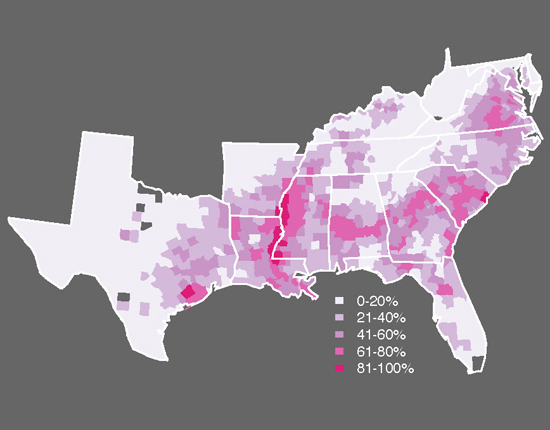
Slaves were concentrated in counties where cotton thrived, as shown in the above map based on the 1860 census.
White Southerners in these same areas today express more racial resentment and are more likely to be Republican
and oppose affirmative action, than other Southerners.
Conducted by Avidit Acharya, Matthew Blackwell, and Maya Sen from the University of Rochester, the research is believed to be the first to demonstrate quantitatively the lasting effects of slavery on contemporary political attitudes in the American South. The findings hold even when other dynamics often associated with racial animosity are factored in, such as present day concentrations of African Americans in an area, or whether an area is urban or rural.
"Slavery does not explain all forms of current day racism," says Acharya. "But the data clearly demonstrates that the legacy of the plantation economy and its reliance on the forced labor of African Americans continues to exacerbate racial bias in the Deep South."
The findings are reported in a working paper that will be presented for the first time at the Politics of Race, Immigration, and Ethnicity Consortium at the University of California at Riverside on Sept. 27.
The study looked at data from 93 percent of the 1,344 Southern counties in the Cotton Belt—the crescent-shaped band where plantations flourished from the late 18th century into the 20th century. The researchers found that a 20 percent increase in the percentage of slaves in a county's pre-Civil War population is associated with a 3 percent decrease in whites who identify as Democrats today and a 2.4 percent decrease in the number of whites who support affirmative action.
The "slavery effect" accounts for an up to 15 percentage point difference in party affiliation today; about 30 percent of whites in former slave plantation regions report being Democrats, compared to 40 to 45 percent white Democrats in counties that had less than 3 percent slaves, according to the authors. Despite the region's similarity in culture and its shared history of legalized slavery and Jim Crow laws, "the South is not monolithic," says Blackwell.
Their analysis shows that without slavery, the South today might look fairly similar politically to the North. The authors compared counties in the South in which slaves were rare—less than 3 percent of the population—with counties in the North that were matched by geography, farm value per capita, and total county population. The result? There is little difference in political views today among residents in the two regions.
"In political circles, the South's political conservatism is often credited to 'Southern exceptionalism,'" says Blackwell. "But the data shows that such modern-day political differences primarily rise from the historical presence of many slaves."
But how is it possible that an institution so long outlawed continues to influence views in the 21st century? The authors point to both economic and cultural explanations. Although slavery was banned, the economic incentives to exploit former slaves persisted well into the 20th century. "Before mechanization, cotton was not really economically viable without massive amounts of cheap labor," explains Sen. After the Civil War, southern landowners resorted to racial violence and Jim Crow laws to coerce black field hands, depress wages, and tie tenant farmer to plantations.
"Whereas slavery only required a majority of (powerful) whites in the state to support it, widespread repression and political violence required the support and involvement of entire communities," the authors write.
Again comparing the county-by-county data, the researchers found evidence of the relationship between racial violence and economics in the historical record of lynchings. Between 1882 and 1930, lynching rates were not uniform across the South, but instead were highest where cotton was king; a 10 percent increase in a county's slave population in 1860 was associated with a rise of 1.86 lynchings per 100,000 blacks. "For the average Southern county, this would represent a 20 percent increase in the rate of lynchings during this time period," says Blackwell.
By the time economic incentives to coerce black labor subsided with the introduction of machinery to harvest cotton in the 1930s, anti-black sentiment was culturally entrenched among local whites, the authors write. Those views have simply been passed down, argue the authors, citing extensive research showing that children often inherit the political attitudes of their parents and peers.
The data, says Sen, points to the importance of institutional and historical legacy when understanding political views. Most quantitative studies of voters rely on contemporary influences, such as education, income, or the degree of urbanity. The findings are also in line with research on the lingering economic effects of slavery. Studies have shown that former slave populations in Africa, South and Central America, and the United States continue to experience disparity in income, school enrollment, and vaccinations.
For the study, the authors drew on publically available data, including the 1860 census and the Cooperative Congressional Election Study, a large representative survey of American adults. No external funding was required for the analysis.
People who are wrong are just as sure they're right as people who are right. The only difference is, they're wrong.
— God @The Tweet of God
— God @The Tweet of God

Re: Why Did We Abandon Reconstruction?
It's nice to know there are places in Texas where the percentage is less than zero.
Sometimes it seems as though one has to cross the line just to figger out where it is
Re: Why Did We Abandon Reconstruction?
Complete innumeracy.
Re: Why Did We Abandon Reconstruction?
The time lapse between the end of the Civil War and today requires that some investigation be done into whether there is any connection between the people who lived there (and presumably owned slaves?) in 1865 and the current residents.
Also, does the fact that they are majority Baptist mean anything?
Is it "racist" to oppose Affirmative Action? Is it racist to NOT be a Democrat?
If this is scientific research, I'm a nuclear physicist.
Also, does the fact that they are majority Baptist mean anything?
Is it "racist" to oppose Affirmative Action? Is it racist to NOT be a Democrat?
If this is scientific research, I'm a nuclear physicist.
Re: Why Did We Abandon Reconstruction?
It is interesting that the geographic distribution of racist attitudes today follows so closely the geographic distribution of slaveholding, or perhaps it is the distribution of the types of crops which required slaves to be economically viable. Like all good observations it raises interesting questions; here the question is about the transmission of culture. Why hasn't it been more 'blurred' by migration over time? Is the observation true? Can we do some followup studies? I've seen the maps of slave-ownership by county pre-civil war and they do mirror this very well. Here is the one:
http://www.nytimes.com/interactive/2010 ... .html?_r=0

We are a self-justifying species. We will often justify what we have already done no matter if we have learned later that it was wrong. (see Aronson et al)
yrs,
rubato
http://www.nytimes.com/interactive/2010 ... .html?_r=0
We are a self-justifying species. We will often justify what we have already done no matter if we have learned later that it was wrong. (see Aronson et al)
yrs,
rubato
Re: Why Did We Abandon Reconstruction?
Really--I see a lot or racism every day in former non slave holding states; especially in the northeastern US, not to mention Arizona and California (which I've spent a good deal of time in--just look at the anti-immigration propaganda coming out of those states). As a black coworker once said to me--northern (for want of a better word) racism is less open, but just as bad. It is achieved through exclusion of blacks from certain communities--one need only look at the yearbooks of most affluent northeastern suburban high schools to see how few people of color attend those schools.It is interesting that the geographic distribution of racist attitudes today follows so closely the geographic distribution of slaveholdi
I do accept the conclusion in the original post
; I've noticed that myself in many southern cities. But expressing hidden racism in action is much worse IMHO.white Southerners who live today in the Cotton Belt where slavery and the plantation economy dominated are much more likely to express more negative attitudes toward blacks
Re: Why Did We Abandon Reconstruction?
Neighborhoods are usually segregated economically. You don't see poor white folks living in prosperous suburbs or middle-class Blacks living in the ghetto.
Maybe if White Folks had a 70% illegitimacy rate the inner cities would be more "integrated."
Maybe if White Folks had a 70% illegitimacy rate the inner cities would be more "integrated."
Re: Why Did We Abandon Reconstruction?
True, but you don't see many affluent blacks in those same affluent white neighborhoods; and many suburbs have richer and poorer areas that are still just white. It's not entirely economic.
As for illegitimacy, I'm really not sure what it adds to the discussion.
As for illegitimacy, I'm really not sure what it adds to the discussion.
Re: Why Did We Abandon Reconstruction?
Detroit was segregated by 8 Mile Road
Sometimes it seems as though one has to cross the line just to figger out where it is

Re: Why Did We Abandon Reconstruction?
that is the city limit of detroit and the boundary of wayne and Macomb & Oakland county.....
Okay... There's all kinds of things wrong with what you just said.