All the consultants I know are expecting the Exchange rates to increase a lot in the next few years; the current rates, which are already high (though some of that cost is due to more comprehensive coverage), are essentially teaser rates to get people into the system.
And yes, let's look at the numbers.
rubato wrote:[
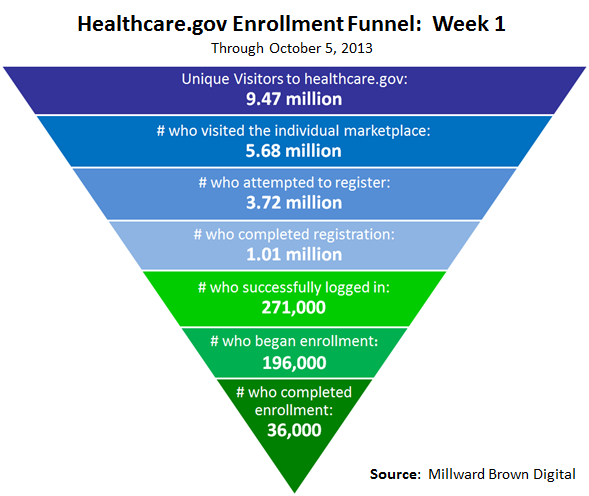
36,000 enrollments in 5 days. Multiplied by the number of people covered by each one, since many are families.
Let's go ahead and say, the average is 2 people per enrollment, though I think that is probably high. During the period of time with the highest interest in enrolling, they managed to get 7,000 enrollments per day in to cover 14,000 people. Of course, some of those people are already covered in other plans, so we aren't actually gaining 14,000 newly covered people, but let's just assume we are. There are 40 million Americans without insurance (isn't that more than the population of Australia?). There will be millions more going off of their current plans and onto the exchanges. As LJ notes, the Exchanges need about 10 million to get to viability,
assuming a reasonable number of healthy people join to offset all of the high risk insureds. At 14,000 per day, that means in 100 days, or three months, there will be 1.4 million covered. At that rate, it will take nearly three years to get the 10 million covered to make the Exchanges viable. That's how bad things have gone.
But the good news is that at some point they will get the system working reasonably well so that people can get signed up without unreasonable efforts. This could be weeks, but more likely months. In the meantime, they will have missed their big chance for a major success in signing up hundreds of thousands per day who do want coverage. More unfortunate, they are missing out on healthy people who have very limited incentive to sign up and so won't spend much time at singing up. More good news is that some state run exchanges are actually doing okay, like Washington and Oregon. Oregon's success is mainly due to signing up more people on Medicaid; it turns out that when people can get free health care they are more likely to sign up than when they have to pay for it. So, for states that had a good track record on health care reform at the state level, if they started several years ago planning and working toward this day, they were able to do a pretty good job implementing at least parts of the new law.