http://acasignups.net/
Percent of CBO projection =25.15%
Exchanges= 1,777,171
Expanded Medicaid= 3,924,092
.
Total: 5,701,263
yrs,
rubato


If Obama says 1.1million signed up, is that like when he said we can keep our plan/doctor and the average savings will be $2500?How Many Healthy People Are Signing Up For Obamacare? The White House Won't Say
On Sunday, the Obama administration announced that a total of 1.1 million Americans have signed up for health insurance coverage on Obamacare’s federally-run exchange at Healthcare.gov. While that number falls well short of the administration’s previous expectations of 3.3 million, it is a big step up; as of the end of November, only 137,204 individuals had “selected a marketplace plan.” But the Centers for Medicare and Medicaid Services continue to conceal critical data regarding actual enrollment in the exchanges—data that will tell us whether or not Obamacare’s insurance marketplaces will ever end up functioning as they were intended.
‘Sign-ups’ ≠ enrollments
First off, CMS won’t tell us how many people have actually enrolled in exchange-based coverage. As a reminder, you aren’t actually enrolled in a health plan unless the insurer has received your premium payment for the first month of coverage. Previously, we heard that only around 5 to 15 percent of SAMPs—people who have “selected a marketplace plan,” in CMS lingo—had actually enrolled in coverage.
In addition, in November, one of CMS’ top IT officials, Henry Chao, testified before Congress that the administration has yet to build the system needed to pay the insurers.
Healthy vs. unhealthy enrollments
The most important thing CMS won’t tell us is the proportion of healthy people, as opposed to sick people, who are signing up for exchange-based coverage. If too many sick people sign up, and not enough healthy people, the average health spend per enrollee will increase, leading to higher premiums that are increasingly unaffordable for average Americans.
Some Obamacare enthusiasts argue that this problem doesn’t matter, because the poor will be protected from rate hikes by taxpayer-funded subsidies. But over time, the subsidies will not be able to keep pace, if healthy people drop out and only sick people by Obamacare-based insurance plans.
And make no mistake: on average, sicker and older people will fare far better under Obamacare than healthy people will. According to an analysis I conducted with colleagues at the Manhattan Institute, older, sicker individuals will benefit most from Obamacare’s exchange subsidies. On the other hand, in many parts of the country, healthier Americans—especially younger ones—will see their premiums double or triple under the law.
Congress should subpoena the enrollment data
If CMS won’t provide this information, on the mix of patients enrolling in Obamacare’s exchanges, Congress should subpoena it. Congress could also get the data directly from insurers like Aetna and Humana that are participating in the exchanges.
What we need to know is: What is the breakdown of enrollees by age? How many people in each age group are signing up for bronze vs. silver vs. gold plans? This is the kind of data that can help us compare the pool of enrollees in the exchanges to the normal U.S. population. Ideally, we’d see data on what percentage have chronic conditions like Type 2 diabetes, high cholesterol, and high blood pressure, once insurers have had several months’ experience with the patient population.
It’s almost certain that, so far, this enrollment data is not encouraging. Because if it was encouraging, CMS would have released it.
Not a lot of time left
Unless CMS changes its mind, for the umpteenth time, the 2014 deadline for purchasing an Obamacare insurance plan is March 31. Within weeks of that deadline, insurers are going to have to start filing their proposed premiums for the 2015 plan year.
If their experience in 2014 is poor, we might see a second round of rate shock. Only this time, it won’t have been caused by Obamacare’s costly changes to the design of the insurance plan, but by the fact that the law incentivized healthy people to drop out of the market.
It’s good news that the administration has improved the ability of Americans to sign up for coverage on Healthcare.gov. But if you ever want to know the real story with Obamacare, you have to pay attention to what the administration isn’t telling you.
The Obamacare Exchange Scorecard: Around 100,000 Enrollees And Five Million Cancellations
Medicare Deputy CIO: Somewhere Between '30-40%' Of Obamacare's Exchange Software Has Not Yet Been Built
49-State Analysis: Obamacare To Increase Individual-Market Premiums By Average Of 41%
2 Million out of the to-date projection of 3.3 million or about 60% of the CBO projection 'to date'.Wonkblog
The December deluge: 1.1 million have enrolled on HealthCare.gov
By Sarah Kliff
December 29 at 12:20 pm
Consider it Obamacare's December deluge.
More than 1.1 million people have enrolled for private health insurance through HealthCare.gov, the Obama administration announced early Sunday. More than 975,000 of them signed up this month, prior to the Dec. 24 deadline. In other words: Enrollment in the federal exchange was about nine times as high in December than all of October and November.
...
Whether this is good news depends a bit on the context you put it in. Obviously enrollment has spike dramatically in December. Just as the administration has predicted -- and hoped -- there was a rush to sign-up in December, right before the deadline to get coverage starting Jan. 1. Lots of these people weren't first-time shoppers; many had started shopping in October and had been stymied by technical issues. Their December signup wasn't a product of procrastination: It tended to have a lot more to do with the fact the website wouldn't let them sign up earlier.
The administration had previously projected 3.3 million signups through the end of December, so 2 million obviously falls quite short of that. So while enrollment is increasing rapidly, the White House is still behind where it had expected to be at this point.
You're really makin' this easy rube...Lord Jim wrote:I'll tell you how rube comes up with the grossly misleading numbers he posts on this, oldr...Got a source for that?
First he combines the paid exchange numbers (which are already inflated, because they continue to count people who have enrolled but not paid; some percentage of which will obviously never pay and therefore won't really be enrolled) with the medicare numbers, and then he uses this source:
http://acasignups.net/
(I see the format has changed a bit; you need to click on the "spread sheet" button when you get to that page.) If you scroll over to the final column, you will see a huge number of qualifiers relating to many of the numbers that make clear that the total is not some sort of accurate snapshot of the situation. Rather it is a "best case scenario" including many extrapolations, projections and some things that are very unlikely.
For example, next to the totals for Washington state, you'll find this caveat:
The combined number is used for the total. (This also indicates that while the administration refuses to provide the national breakdown on what percentage of those who have signed up for the exchanges have not actually paid, it is likely to be quite substantial.)*65,472 had enrolled & paid; 69,606 had enrolled but not paid yet as of 12/24
There's nothing dishonest or unethical with whoever compiled this report doing it this way, since they are quite honest about the limitations on the validity of the numbers they report.
The dishonesty and lack of ethics belong to rube, who continuously misuses this report, and posts these combined inflated numbers as established fact.
A real scientist (or any person with even a minimal regard for truth) would be ashamed to brazenly misuse data in this way, but obviously it provides no problem for our rube.
So whenever he reposts these claims the thing to do is read whatever he posted as "Here's some more complete bull shit from me. I think you won't be bothered to look at the actual spread sheet, so I believe I can get away with lying about what it means." and shine it on...
ETA:
In order see the relevant column, after you press on the button for the spread sheets, you'll need to scroll down to the bottom, and then scroll over using the page's scroll bar.
Are we now shooting for mediocrity?“From zero to ten, I’d give it a confidence level of about a three.” Hess: “That’s still not very good.” Chaney: “That’s not, but it’s better than where I was, a one, a week before last. “Chaney says the unofficial count is around two thousand people enrolled, but he says if the confidence trend continues upward, his confidence will rise to a five.”

And we count this as part of the "success"? People renewe their medicaid every year. These numbers should not even be part of the equations. If they really want to count success, why not just include all the people who get their insurance from their employer which they renewed this year.And more than 88,000 people already covered by Medicaid renewed their eligibility.
At least he's admitting this.For Medicaid, I'm not counting the 88K since they were just renewals

So here are people who would have been covered even if there was no Obamacare. Seems the gov should have done more to help these people before Obamacare. Maybe a bigger chunk of the uninsured (which Obamacare was invented to help) could have been helped without the need for OC.but the 47.5K do count since they appear to fall into the category of people who were already qualified but didn't know about it until the ACA and the state exchange.
Me thinks some numbers will need to be adjusted.For private enrollments, Washington is the only state that distinguishes between "enrolled but not paid yet" and "enrolled and first month's premium paid"; every other state, and the HHS, counts you as being enrolled even if you haven't actually paid yet,

And there is an additional 3 million who have insurance because the ACA allowed them to be covered on their parents' policy until 26. Since this age group is the least likely to have paid for coverage before they are nearly all new additions to the pool of insured. Putting the total up to over 9 million.http://acasignups.net/spreadsheet
30.55% Of the CBO projection.
Via the Exchanges = 2,158,624
Expanded Medicaid = 4,455,675
Total: 6,615,574
The quasi-final 2013 tally for the ACA: more than 9 million insured
aca
Elva Garcia of Miami signs up for a health plan via the Affordable Care Act a few days before Christmas. (Joe Raedle/Getty Images / January 3, 2014)
By Michael Hiltzik
January 3, 2014, 2:23 p.m.
Enrollment figures for insurance under the Affordable Care Act are all over the place, largely because the act has so many moving parts: the individual insurance exchanges (federal and state), Medicaid (in expansion states and otherwise), children enrolled in their parents' employer-sponsored plans.
Keeping track of the numbers requires an obsession. So be thankful that one Charles Gaba has taken on the responsibility. Gaba's conclusion is that the ACA has brought insurance in one form or another to more than 9 million Americans, possibly 9.5 million.
As Josh Marshall observes at talkingpointsmemo.com, the number would have been much higher if all the states fulfilled their responsibility to bring insurance to their poorest citizens by expanding Medicaid--at federal expense. Estimates are that the refusal of 25 states to do so has left some 5 million of their residents in the cold. (Kudos to Josh for introducing Gaba to a wider audience.)
Gaba, a website developer in the Detroit area who has been compiling publicly available numbers on his own, without pay, has produced what looks like the most authoritative tally. His spreadsheet and an excellent graphic are here. His latest figures show that about 2.1 million people signed up for private insurance through the exchanges. That may understate the total, as some state figures are a week or two behind.
To that should be added some 4.3 million new enrollees in Medicaid or CHIP, the Children's Health Insurance Program reauthorized by the ACA as an adjunct to Medicaid. Then there's another 3.1 million young adults (those up to the age of 26) who have enrolled in their parents' workplace plans since September 2010. That brings the total to 9.5 million.
Not counted are people who have signed up for ACA-compliant health plans directly through their insurers instead of through the exchanges. (The exchanges are mandatory mostly for people seeking premium or cost-sharing subsidies.) Gaba doesn't estimate that figure, though Marshall guesses it might be 500,000, which does not sound out of line.
...
Gaba observes on his blog that Obamacare skeptics have shifted from questioning the raw enrollment numbers to pointing out that enrollments aren't final until the first premium bills are paid, which doesn't have to happen until Jan. 10. The suggestion is that the enrollment figures are inflated by a horde of deadbeats. Gaba doubts this: "Unless there prove to be significant technical issues preventing large numbers of premium payments from going through, this is pretty weak tea in terms of being an anti-ACA talking point," he writes.
Another emerging anti-ACA talking point we've heard is that insurance subject to government subsidies somehow shouldn't count in the totals, apparently on the argument that those people wouldn't enroll if not for the assistance. This is even weaker tea. For one thing, the whole point of the ACA is to provide affordable insurance to people in the individual market; how that goal is reached is immaterial.
And it ignores that all employer-sponsored insurance is heavily subsidized, as the employer's costs and the employees' premiums are both tax-deductible. Any way you cut it, the ACA enrollment numbers are shifting the earth beneath the feet of the anti-Obamacare crowd.
http://www.latimes.com/business/hiltzik ... z2pfeukyxr
http://www.latimes.com/business/hiltzik ... z2pfeP5Wji
As Obamacare Sign-Ups Surge, So Does Conservative Rage
Josh Marshall – January 3, 2014, 2:12 AM EST40491
It is amazing to witness the sheer depths of rage, denial and disgust many people experience as they see millions of people gaining access to affordable health care for the first time. Back on the 31st I wrote this overview which outlined how more than 9 million people now have health care coverage because of the Affordable Care Act (aka Obamacare). It now seems like the number is more like 10 million (more on that in a moment).
This evening I mentioned this number on Twitter and saw the full force of denial and outrage as many anti-Obamacare diehards made first contact with the actual number of Americans who've gained coverage under the program. More though, it was clear how in the absence of a dead in the water website to cry crocodile tears over, anti-Obamacare hardliners have suddenly gotten a whole lot angrier about Obamacare.
...
...
Notably, we also know the number of Americans who have been prevented from getting coverage because Republican governors and/or state legislatures who refused to participate in Medicaid expansion. That's 5 million people.
....
Next there's a number that's been in effect for a couple years now and no one seems to want to discuss: roughly 3.1 million young adults under the age of 26 who now remain covered under their parents policies under a key provision of the ACA. This went into effect in September 2010. And the number of covered young adults in that age bracket grew steadily over the next two years. Here's a good overview from Money magazine from June 2012.
...
Now, as I said up at the top, there are a lot of Obamacare dead-enders out there who just blow a gasket when they make first contact with these numbers. The first claim is that Medicaid expansion somehow doesn't count. Or it doesn't count if a 24 year old is now covered under their parents policy because well that happened a while ago or well, something.
...
And then finally, these numbers are just more administration lies. Because, well, because. Here's where Gaba's spreadsheet is so helpful. It has the breakdown for private insurance and Medicaid expansion in numbers in every state with a link to an independent news source reporting the numbers.
These are the numbers. Lots of people have partisan or ideological or in many cases deeply emotional needs not to believe them. But these are the numbers.
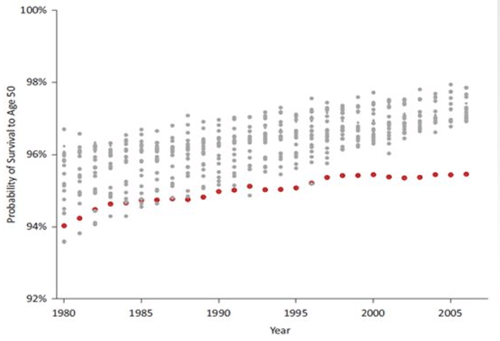

Looks to me on that graph that we are in fact not falling, we are pretty much staying the same at around 95% meanwhile the other "countries" are rising.and falling,
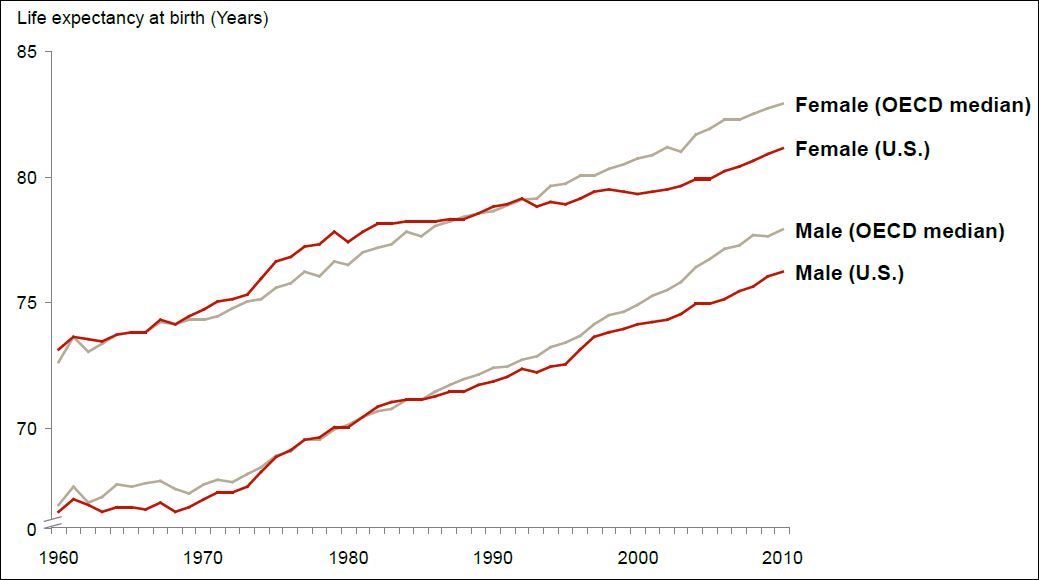
Austin Frakt asks a question:
Austin Frakt: What happened to US life expectancy?: “Apart from the explanation or lack thereof, I also wonder how much welfare has been lost relative to the counterfactual that the US kept pace with the OECD in life expectancy and health spending. It’s got to be enormous unless there are offsetting gains in areas of life other than longevity and physical well-being. For example, if lifestyle is a major contributing factor, perhaps doing and eating what we want (to the extent we’re making choices) is more valuable than lower mortality and morbidity. (I doubt it, but that’s my speculation/opinion.) (I’ve raised some questions in this post. Feel free to email me with answers, if you have any.)
Relative to the OECD average, the U.S. spends an amount of money equal to $1.6 trillion a year extra on health care, and lags in life expectancy by 2 years. If we had kept pace in health spending, we would have $1.6 trillion extra to spend on useful things–and those things would have been worth $1.6 trillion a year. The value of longer life is harder to guesstimate. One way to approach the question would be to simply assert that we combine lifespan and health with goods and services to produce extra utility–say an extra $32 trillion a year of utility–and that with if we had 1/40 more time we would be able to get another $0.8 trillion a year of utility.
The total cost of underperformance would then be $2.4 trillion a year: 2/3 of that from resources we could devote to other useful things but are instead devoting to our extraordinarily inefficient health sector, and 1/3 from the fact that even with these extra resources our health outcomes are still very disappointing…
January 31, 2011
Mortality Amenable to Health Care, 2007
The concept of amenable mortality before age 75 was developed in the 1970s to assess the quality and performance of health systems and to track changes over time. For this study, the researchers used data from the World Health Organization on deaths from conditions considered amenable to health care, such as treatable cancers, diabetes, and cardiovascular disease.
Deaths per 100,000 population
OECD ( 95.1)
United States ( 103.1)
France ( 58.8)
Iceland ( 61.3)
Italy ( 65.1)
Japan ( 66.4)
Sweden ( 68.1)
Netherlands ( 68.3)
Australia ( 68.4)
Austria ( 69.4)
Norway ( 69.6)
Spain ( 70.4)
Canada ( 74.0)
Luxembourg ( 74.6)
Finland ( 78.6)
Greece ( 79.1)
Israel ( 81.1)
Germany ( 81.2)
Ireland ( 82.3)
New Zealand ( 85.0)
United Kingdom ( 86.1)
Korea ( 86.2)
Denmark ( 86.6)
Chile ( 102.5)
Portugal ( 107.6)
Czech Republic ( 125.0)
Mexico ( 136.5)
Poland ( 137.8)
Slovak Republic ( 187.7)
Hungary ( 196.8)
California likely to surprise us with big numbers
Submitted by Olav Grinde on Mon, 01/06/2014 - 12:47am
For California, we presently have data through the December 23rd. However, at the last minute, California extended its deadline to 12/27. This means that we are still waiting for four days of enrollment data! Keep in mind that just prior to the deadline, California was seeing 20,000 private plan enrollments daily.
It that rate continued unabated, we could be looking at as much as 80,000 signups beyond the 428,000 already registered. During the three days December 20–22nd more than 77,000 Californians enrolled in private plans. Granted, this is speculation – we won’t know until Covered California releases its figures.
An important develepmont is that Covered California extended its deadline for paying health insurance premiums to January 15th. Payment was originally due Monday the 6th. The extension also relieves pressure on insurers who were inundated with hundreds of thousands of new customers in December.
Waiting, waiting, waiting...not a word in any of them addressing any of the specific, substantive problems and questions with these numbers that oldr and I have raised...just more misleading blather, more delusional triumphalism, and some sideshow info that's irrelevant to issues that have been raised...

yrs,What this data does prove is that there are clearly far more Americans benefitting from Obamacare than those who are claimed to be losing coverage as a result of the law. The data also highlights that those with Obamacare Brain Meltdown Syndrome must fight through the fog that has descended upon them and try to face up to the actual numbers as, only then, can we continue a rational conversation about this law.