Whatever became of the "land of the free"?
-
oldr_n_wsr
- Posts: 10838
- Joined: Sun Apr 18, 2010 1:59 am
Re: Whatever became of the "land of the free"?
I don't see where someone should/could be guaranteed "freedom from want" nor "freedom from fear".
-
MajGenl.Meade

- Posts: 21522
- Joined: Sun Apr 25, 2010 8:51 am
- Location: Groot Brakrivier
- Contact:
Re: Whatever became of the "land of the free"?
Oh I think you do oldr. What happens to your property, your "rights" if there is no restraint (law) that seeks to prevent other people from simply doing whatever they like in your dining room?oldr_n_wsr wrote:So restraining someone elses actions makes my existance more valuable. I did not know that.

How's the driving if there's no enforcement of speed limts, stop signs, school zones? Society creates restraints upon the selfish and self-actuated actions of its own members in order to provide a regulated environment in which all may live more harmoniously. When it doesn't quite work that way, you and I are only too happy to have the restrainers come in and take away "someone else" for remedial incarceration.
Teaching children to share - that's a restraint on their actons - rather a necessary one. Trying to get some people to stop behaving like rude assholes - that would make some existences more valuable too

For Christianity, by identifying truth with faith, must teach-and, properly understood, does teach-that any interference with the truth is immoral. A Christian with faith has nothing to fear from the facts
Re: Whatever became of the "land of the free"?
oldr_n_wsr wrote:I don't see where someone should/could be guaranteed "freedom from want" nor "freedom from fear".
1/6/1941
Full text:http://en.wikipedia.org/wiki/Four_Freedoms
The Four Freedoms Speech was given on January 6, 1941. Roosevelt’s hope was to provide a rationale for why the United States should abandon the isolationist policies that emerged from WWI. The speech coincided with the introduction of the Lend-Lease Bill, which promoted Roosevelt’s plan to become the “arsenal of democracy”[6] and support the Allies (mainly the British) with much-needed supplies.[7] Furthermore, the speech established what would become the ideological basis for America’s involvement in WWII, all framed in terms of individual rights and liberties that are the hallmark of American politics.[2]
The speech delivered by President Roosevelt incorporated the following
"In the future days, which we seek to make secure, we look forward to a world founded upon four essential human freedoms.
The first is freedom of speech and expression—everywhere in the world.
The second is freedom of every person to worship God in his own way—everywhere in the world.
The third is freedom from want—which, translated into world terms, means economic understandings which will secure to every nation a healthy peacetime life for its inhabitants—everywhere in the world.
The fourth is freedom from fear—which, translated into world terms, means a world-wide reduction of armaments to such a point and in such a thorough fashion that no nation will be in a position to commit an act of physical aggression against any neighbor—anywhere in the world.
That is no vision of a distant millennium. It is a definite basis for a kind of world attainable in our own time and generation. That kind of world is the very antithesis of the so-called new order of tyranny which the dictators seek to create with the crash of a bomb."—Franklin D. Roosevelt, excerpted from the State of the Union Address to the Congress, January 6, 1941
The four freedoms flag or "United Nations Honor Flag" ca. 1943-1948
The declaration of the Four Freedoms as a justification for war would resonate through the remainder of the war, and for decades longer as a frame of remembrance.[2] The Freedoms became the staple of America’s war aims, and the center of all attempts to rally public support for the war. With the creation of the Office of War Information (1942), as well as the famous paintings of Normal Rockwell, the Freedoms were advertised as values central to American life and examples of American exceptionalism.[8]
http://www.americanrhetoric.com/speeche ... eedoms.htm
yrs,
rubato

Re: Whatever became of the "land of the free"?
I am being serious here and free of any type of condensention here and I do feel some what had that I have t preface it this way but thank you rubato for explaining what you meant.
Okay... There's all kinds of things wrong with what you just said.
-
Sue U

- Posts: 9143
- Joined: Thu Apr 15, 2010 4:59 pm
- Location: Eastern Megalopolis, North America (Midtown)
Re: Whatever became of the "land of the free"?
I'm frankly surprised you didn't get the reference, CP. Or maybe you're just a generation too far:
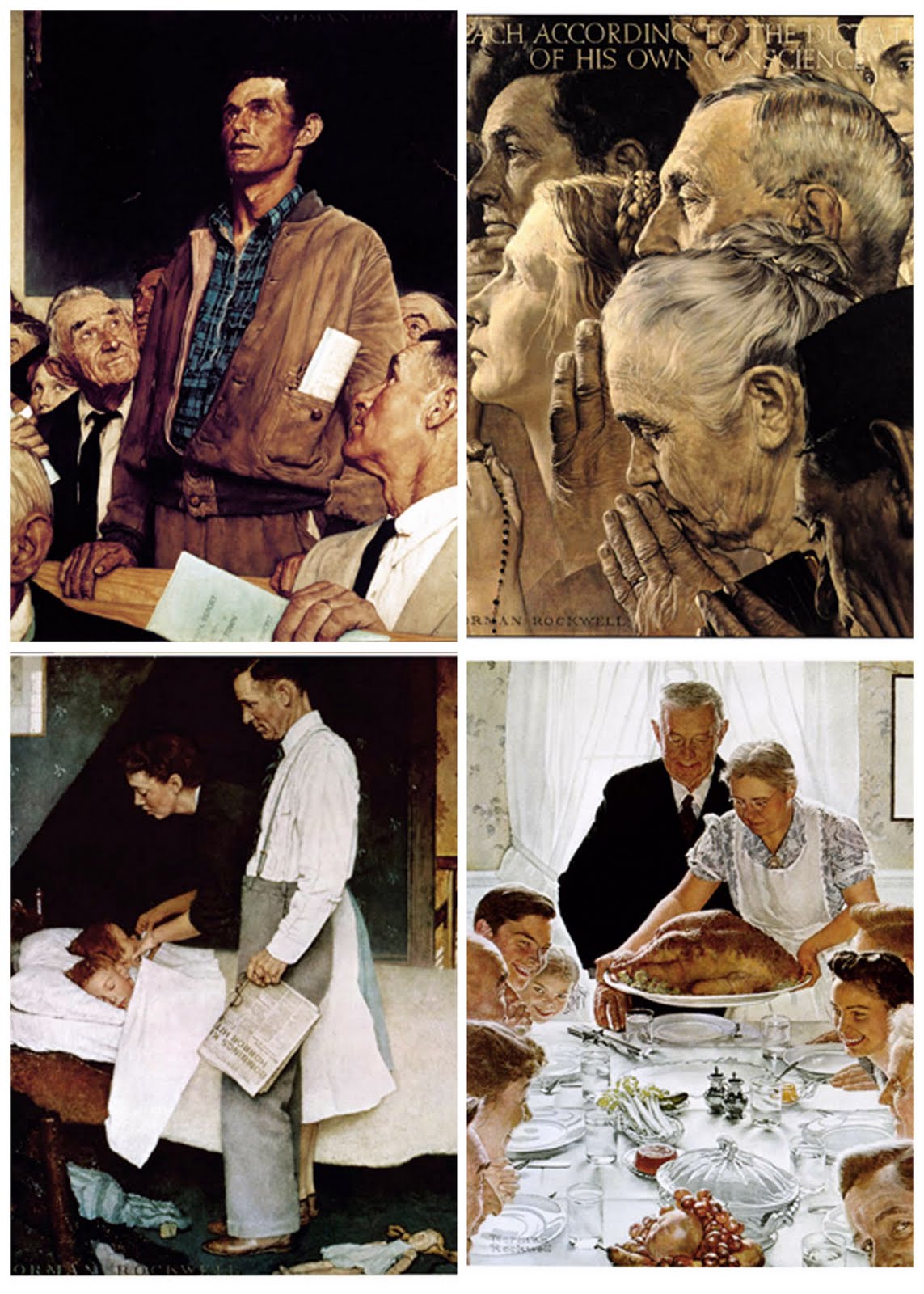
GAH!
-
oldr_n_wsr
- Posts: 10838
- Joined: Sun Apr 18, 2010 1:59 am
Re: Whatever became of the "land of the free"?
Thanks rubato I was unaware of that.
I was thinking of the freedom from want and freedom from fear on more personal levels rather than a national (nation?) level.
My happiness may be altered but not my "worth" (for lack of a better word)
I was thinking of the freedom from want and freedom from fear on more personal levels rather than a national (nation?) level.
My "value" is the same whether someone is doing or not doing something in my dining room.Oh I think you do oldr. What happens to your property, your "rights" if there is no restraint (law) that seeks to prevent other people from simply doing whatever they like in your dining room?
My happiness may be altered but not my "worth" (for lack of a better word)
-
MajGenl.Meade
- Posts: 21522
- Joined: Sun Apr 25, 2010 8:51 am
- Location: Groot Brakrivier
- Contact:
Re: Whatever became of the "land of the free"?
"All that makes existence valuable to any one..."
Yes oldr you are quite right. But he didn't say "all that makes anyone valuable". You are right - things don't make us valuable in ourselves.
He's saying that the things you find valuable (happiness being one of them I'm sure) and the things I find valuable in our existence depend upon others not destroying our things, our values and our very existence. People are restrained from doing those negative things that impact the value of our lives by the law etc.
Of course we wouldn't be happy with yobs entering our house and trashing it. We'd call the police to come and forcibly restrain (or punish) them. Society is, among other things, ruled by laws that enable the maximum opportunities for happiness for all - except those who would destroy it for others. Your American revolution was based on that concept, was it not?
Meade
Yes oldr you are quite right. But he didn't say "all that makes anyone valuable". You are right - things don't make us valuable in ourselves.
He's saying that the things you find valuable (happiness being one of them I'm sure) and the things I find valuable in our existence depend upon others not destroying our things, our values and our very existence. People are restrained from doing those negative things that impact the value of our lives by the law etc.
Of course we wouldn't be happy with yobs entering our house and trashing it. We'd call the police to come and forcibly restrain (or punish) them. Society is, among other things, ruled by laws that enable the maximum opportunities for happiness for all - except those who would destroy it for others. Your American revolution was based on that concept, was it not?
Meade
For Christianity, by identifying truth with faith, must teach-and, properly understood, does teach-that any interference with the truth is immoral. A Christian with faith has nothing to fear from the facts
-
oldr_n_wsr
- Posts: 10838
- Joined: Sun Apr 18, 2010 1:59 am
Re: Whatever became of the "land of the free"?
I don't disagree with your analysis.
Thanks for making your point clearer.
Thanks for making your point clearer.