
http://www.washingtonpost.com/world/hon ... story.htmlHong Kong standoff: Pro-democracy crowds swell as police bolster barricades
BEIJING — Swelling crowds of pro-democracy protesters in Hong Kong on Monday plunged Asia’s normally staid financial hub into a tense standoff with Beijing that strikes directly at China’s expanding political grip in the former British colony.
The rapidly escalating demonstrations are aimed at forcing Beijing’s Communist leaders to abandon newly declared powers to weed out any candidates in upcoming Hong Kong elections. Yet many on the streets proclaimed they are fighting for something even bigger: preserving a vision of Hong Kong promised 14 years ago when it reverted to Chinese rule.
At the time, Chinese leaders promised a state within a state: allowing special hands-off provisions for Hong Kong such as allowing elections and a degree of self-rule in policymaking. But protesters now accuse China of reneging on the deal and trying to exert its control over every aspect of Hong Kong’s political affairs.
The mounting protests present a conundrum for Beijing.
Too hard a crackdown could drive more people to the pro-democracy cause [of course they don't have to worry about that, because Chinese people don't want self-government; we know this for a fact because a few Chinese people living in the US have said so.] and embarrass Chinese authorities who would never permit such a challenge on the mainland. Yet allowing the protesters some room risks encouraging others to question Communist control in other parts of the country over issues such as media freedoms, economic development and minority rights.
Since The Chinese Don't Want Democracy, This Is Surprising..
Since The Chinese Don't Want Democracy, This Is Surprising..


Re: Since The Chinese Don't Want Democracy, This Is Surprisi
Hong Kong
Yrs,
Rubato
Yrs,
Rubato
-
MajGenl.Meade

- Posts: 21522
- Joined: Sun Apr 25, 2010 8:51 am
- Location: Groot Brakrivier
- Contact:
Re: Since The Chinese Don't Want Democracy, This Is Surprisi
Yes, I was going to suggest that Hong Kong folks of Chinese extraction don't see themselves at all in the same way as the filthy commie hordes of the mainland and their hopes and expectations are considerably different. We English teach well. 
For Christianity, by identifying truth with faith, must teach-and, properly understood, does teach-that any interference with the truth is immoral. A Christian with faith has nothing to fear from the facts
Re: Since The Chinese Don't Want Democracy, This Is Surprisi
http://www.thedailybeast.com/articles/2 ... -kong.htmlThe deteriorating situation must make the Communist Party in China nervous, especially because of what’s known as “democracy contagion”: If the people in Hong Kong can vote in meaningful elections, then citizens throughout an increasingly wired China will demand the same. Already, a few protesters in Shanghai’s People’s Square, in the center of that city, are passing around a photo of themselves on Chinese social media showing their support for the students in Hong Kong. And in a written statement, they are also asking for the vote for themselves.
http://sinosphere.blogs.nytimes.com/201 ... -movement/Beijing Blocks Reports on Hong Kong Democracy Movement
Chinese officials moved quickly Monday to control news reports of the pro-democracy demonstrations that began in Hong Kong over the weekend and by Sunday night had turned into the largest street clashes in decades between civilians and the territory’s police force.
A directive from the central propaganda department in Beijing ordered websites to delete any mention of the unrest. The mainland news websites that did discuss the protests mostly posted a short article from Xinhua, the state news agency, that gave few details of what was unfolding down south. Some sites published editorial essays from Global Times, a state-run populist newspaper, taking a typically hard-line stand.
In one area of central Beijing, members of a neighborhood committee went around to shops on Monday telling the owners not to put up any posters with images of Hong Kong, even patriotic ones. The members took away an official poster with an image of Hong Kong that had been previously distributed to merchants to post on their walls ahead of the National Day holiday on Wednesday. Posters showing the Great Wall and Tiananmen Square were handed out.
Starting Sunday night, officials overseeing Internet censorship blocked Instagram, the popular photo-sharing social network, presumably to ensure that images of the rallies would not spread. Only Internet users who had software to leap over the online control system known as the Great Firewall could get on Instagram, and the blocking of the site ignited outrage among some Chinese Internet users who might have been previously unaware of the Hong Kong protests. The action by censors was consistent with earlier moves against other Western-based social media sites, including Twitter, Facebook and YouTube; those bans were put in place during recent periods of political turmoil, and they still endure.
The words “Occupy Central,” the name of the broad Hong Kong pro-democracy movement, and other similar terms were banned on Monday from searches on Sina Weibo, China’s biggest microblog platform.
Gee whiz, the fellas who run the PRC must be a bunch of blithering idiots to expend so much effort to prevent people who have absolutely no interest in democracy from hearing about this...
Re: Since The Chinese Don't Want Democracy, This Is Surprisi
Of course the leaders of the PRC couldn't be the sharpest bulbs on the tree anyway, having wasted all that time and money for 65 years creating the most developed totalitarian system on earth, ( a country of 1.3 billion people that has a police state apparatus that reaches down even into the smallest villages) all to prevent a people who have absolutely no interest in democracy from pursuing it, or even talking or hearing about it...
How dumb is that?
How dumb is that?
Re: Since The Chinese Don't Want Democracy, This Is Surprisi
MajGenl.Meade wrote:Yes, I was going to suggest that Hong Kong folks of Chinese extraction don't see themselves at all in the same way as the filthy commie hordes of the mainland and their hopes and expectations are considerably different. We English teach well.
Meaning you taught them to accept a government which was not at all democratic for all but the last couple of years of British rule and then only small reforms were made. And it is worth pointing out that there was relatively little political pressure for democratic rule during all of that time. But then England has only had one-man one-vote democracy since the end of WW I so perhaps it does not hold as high a cultural value as it does in America..
http://en.wikipedia.org/wiki/History_of_Hong_Kong
yrs,Unchanged after 1997
The long-held British practice of no general elections by HK citizens remains unchanged.
English is still taught in all schools. However, many schools teach in Mandarin in parallel with Cantonese and English.
The border with the mainland continues to be patrolled as before.
Hong Kong remains an individual member of various international organizations, such as the IOC, APEC and WTO.
Hong Kong continues to negotiate and maintain its own aviation bilateral treaties with foreign countries and territories. Flights between Hong Kong and China mainland are treated as international flights (or more commonly known as inter-territorial flights in China mainland).
Hong Kong SAR passport holders have easier access to countries in Europe and North America, while mainland citizens do not. Citizens in mainland China can apply for a visa to Hong Kong only from the PRC Government. Many former colonial citizens can still use British National (Overseas) and British citizen passports after 1997. (
Main article: British nationality law and Hong Kong
)
It continues to have more political freedoms than the mainland China, including freedom of the press.
Motor vehicles in Hong Kong, unlike those in mainland China, continue to drive on the left.
Electrical plugs (BS1363), TV transmissions (PAL-I) and many other technical standards from the United Kingdom are still utilised in Hong Kong. However, telephone companies ceased installing British Standard BS 6312 telephone sockets in Hong Kong. HK also adopts the digital TV standard devised in mainland China. (
Main article: Technical standards in colonial Hong Kong
)
Hong Kong retains a separate international dialling code (+852) and telephone numbering plan from that of the mainland. Calls between Hong Kong and the mainland still require international dialling.
The former British military drill, marching and words of command in English continues in all disciplinary services including all civil organizations. The PLA soldiers of the Chinese Garrison in Hong Kong have their own drills and Mandarin words of command.
Hong Kong still uses the British date format.
All statues of British monarchs like Queen Victoria and King George remain.
Road names like "Queen's Road", "King's Road" remain.
Changed after 1997
The Chief Executive of Hong Kong is now elected by a selection committee with 1200 members, who mainly are elected from among professional sectors and pro-Chinese business in Hong Kong.
All public offices now fly the flags of the PRC and the Hong Kong SAR. The Union Flag now flies only outside the British Consulate-General and other British premises.
Elizabeth II's portrait disappeared from banknotes, postage stamps and public offices. As of 2009, some pre-1997 coins and banknotes are still legal tender and are in circulation.
The 'Royal' title was dropped from almost all organizations that had been granted it, with the exception of the Royal Hong Kong Yacht Club.
Legal references to the 'Crown' were replaced by references to the 'State', and barristers who had been appointed Queen's Counsel were now to be known as Senior Counsel.
A local honours system was introduced to replace the British honours system, with the Grand Bauhinia Medal replacing the Order of the British Empire.
Public holidays changed, with the Queen's Official Birthday and other British-inspired occasions being replaced by PRC National Day and Hong Kong SAR Establishment Day.
Many of the red British style pillar boxes were removed from the streets of Hong Kong and replaced by green Hongkong Post boxes in the Singapore style. A few examples remain, but have been repainted.
British citizens (without the right of abode) are no longer able to work in Hong Kong for one year without a visa; the policy was changed on 1 April 1997.
Secondary schools must teach in Cantonese, unless approved by the Department of Education.[23] Secondary education will move away from the English model of five years secondary schooling plus two years of university matriculation to the Chinese model of three years of junior secondary plus another three years of senior secondary. University education extends from three years to four.
rubato
Re: Since The Chinese Don't Want Democracy, This Is Surprisi
From the prior thread:
The question for the future is what happens with a whole generation of middle-class Chinese children grow up to adulthood? What happens when their "60s generation", a generation who never knew the long slow starvation which made the 'iron rice bowl' a fair trade for freedom, reach their 20s and 30s ?
What will happen when an expectation of growing affluence is not a novel inducement any more and loses its hypnotic power?
yrs,
rubato
Re: Since The Chinese Don't Want Democracy, This Is Surprisi
There has been relatively little pressure for democratic reforms in the PRC in recent decades. This fact is easily learned just by following the news and beyond dispute. There is more unrest over unfair labor practices (Foxconn), poor government oversight of construction (the Szechwan earthquake disaster) and environmental degradation . But as I said, what happens in the future is what is interesting.
And a great deal comes back to this:
yrs,
rubato
And a great deal comes back to this:
You can control the attention and actions of people who have suffered deprivation for generations very well by giving them just a little more, and then a little more, for a very long time. The fact that there is more of a movement for democracy in the relatively affluent HK community supports this idea.If politics is to become scientific, and if the event is not to be constantly surprising, it is imperative that our political thinking should penetrate more deeply into the springs of human action. What is the influence of hunger upon slogans? How does their effectiveness fluctuate with the number of calories in your diet? If one man offers you democracy and another offers you a bag of grain, at what stage of starvation will you prefer the grain to the vote? Such questions are far too little considered. Bertrand Russell Nobel Prize speech.
yrs,
rubato
Re: Since The Chinese Don't Want Democracy, This Is Surprisi
Gee whiz, I wonder what could possibly explain that?There has been relatively little pressure for democratic reforms in the PRC in recent decades.


Re: Since The Chinese Don't Want Democracy, This Is Surprisi
Here are a few more factors that just might be contributing to a certain reticence among the Chinese people to engage in more political protest:
http://www.newrepublic.com/article/1179 ... worse-everTwenty-Five Years After Tiananmen, China's Repression Is Worse Than Ever
By Andrew J. Nathan and Hua Ze
It is unlikely that anyone outside of China who watched the massacre of peaceful protestors in Beijing’s Tiananmen Square on live TV 25 years ago will ever forget the events of that horrible day.
The Chinese regime argues that the shooting of unarmed pro-democracy demonstrators laid the groundwork for political stability and China’s miraculous economic growth. Yet the continuous intensification of repression since then tells another story. Most recently, in early May, the regime “disappeared” a dozen rights activists merely for meeting in a private apartment to commemorate June 4, 1989 and formally detained one of them, human rights lawyer Pu Zhiqiang, for “picking quarrels and provoking trouble.”
This was just the latest in a series of harsh repressions. Five years ago, Tiananmen activist and Nobel Peace Prize winner Liu Xiaobo was handed an eleven-year prison sentence for advocating civil rights and constitutionalism. Earlier this year, human rights activist Xu Zhiyong was sentenced to four years in prison for opposing corruption and abuse of power.
The National Endowment for Democracy, with which we are both affiliated, honored Liu and Xu on May 29 in the U.S. Congress in an effort to raise awareness of their cases in advance of the Tiananmen anniversary—and through their cases, to bring awareness to the estimated 4,800 political prisoners in Chinese jails and camps. [Just a guess, but I'm going to go out on a limb and speculate that the prospect of being "disappeared" and winding up in a prison or a labor camp can have a certain discouraging effect on the amount of political protest...]
The need to sustain and progressively intensify repression is a sign that the June 4 crackdown did not solve China’s problems; it exacerbated them. The ruling Chinese Communist Party faced a fork in the road in 1989. It could have dialogued with the students, as party leader Zhao Ziyang advocated, forming a common front against corruption. But the prime minister, Li Peng, argued that dialogue could end the Party’s monopoly on power. The top leader, Deng Xiaoping, sided with Li and the rest is history.
Refusal to dialogue with citizens has marked the regime’s modus operandi since then. This explains why citizens lack trust in government when it comes to land seizures, corruption, and pollution. Recent demonstrations against the building of a chemical plant in Maoming, Guizhou, and against an incinerator project in Hangzhou are signs of this corrosive mistrust.
Indeed, repressing the memory of June 4 has itself become a fresh motive for repression elsewhere. As Freud (and Nietzsche before him) argued, forgetting is not a natural process. It takes continuous effort. And there are multiple examples of repressed memory besides June 4: the cruelties of the land reform movement in the early 1950s, the anti-rightist movement of the late 1950s, the great famine during the Great Leap Forward, the Cultural Revolution in the 1960s, Mao’s licentious private life, and many other subjects that people would otherwise want to discuss and debate.
Keeping mouths and minds shut is the task of a growing security apparatus. In the Shadow of the Rising Dragon, a book one of us co-edited with Xu Youyu, one of the persons who disappeared on May 3, shows how the political police have a wide range of flexible measures that they can use to warn people to keep quiet. “Inviting to drink tea” (as police interrogations are known), round-the-clock surveillance, and disappearing people for a few weeks or months are just the first steps. These procedures cause less suffering than the beating and killing that took place under Mao, but they are still traumatic and suffice to warn most people to mind their own business. If these measures do not get the message across, the police can escalate to trumped-up criminal trials and jail terms as they did with Liu Xiaobo and Xu Zhiyong.
June 4 is connected not only to other historical memories that have been repressed and to other issues of injustice in the lives of ordinary Chinese people, but also to the way in which China handles the ethnic groups that it designates as “national minorities,” especially the Uighurs in Xinjiang and the Tibetans in the Tibetan Autonomous Region and other provinces near Tibet.
Beijing tries to force modernization, development, secularism, and assimilation on these populations without respecting their sense of identity. This has led—extremely gradually and reluctantly—to acts of resistance, to which Beijing responded again with intensified repression, since dialogue is deemed too risky. Not only does Beijing believe it could lose control over vast strategic areas, but it would also imply the need to talk openly with the residents of Taiwan and Hong Kong—and again, the domestic public in China proper.
With each new regime since Deng Xiaoping, the outside world and many Chinese like Liu and Xu have hoped for liberalizing “political reform.” Instead, repression has worsened under Jiang Zemin, Hu Jintao, and now Xi Jinping. Will China democratize? Probably yes, eventually; the present way of rule is not sustainable. But with every passing year the risk of opening up is greater, because the social demands that have been repressed are growing.
Re: Since The Chinese Don't Want Democracy, This Is Surprisi
25 years ago and almost nothing since. The latter fact is what is remarkable in a nation of 1.4 billion people who have access to global media and who are allowed to travel and study abroad.
Compare it to other social and political movements. Did the civil rights movement disappear for 25 years after the march to Montgomery? Did the gay rights movement disappear after Stonewall? Have the Tibetans stopped using self-immolation to focus world attention on their struggle?
And a counter-example; why are the Russians relatively complacent with a totalitarian leader in Putin?
Physical force is only a small part of it. The remarkable thing is how little physical force they have to exert.
yrs,
rubato
Compare it to other social and political movements. Did the civil rights movement disappear for 25 years after the march to Montgomery? Did the gay rights movement disappear after Stonewall? Have the Tibetans stopped using self-immolation to focus world attention on their struggle?
And a counter-example; why are the Russians relatively complacent with a totalitarian leader in Putin?
Physical force is only a small part of it. The remarkable thing is how little physical force they have to exert.
yrs,
rubato
Re: Since The Chinese Don't Want Democracy, This Is Surprisi
You never bothered to read Deng Xiaopings speech or the rest of the article. No wonder you are such a dull little boy:
Read it this time.
I have only quoted Deng Xiaopings speech but the whole article is worth reading. The 25-year success of their tactic and the lack of interest in democratic reform in China today are proof of their understanding of human psychology.
http://www.vox.com/2014/6/2/5772016/thi ... istory-and
Comrade Xiannian is correct. The causes of this incident have to do with the global context. The Western world, especially the United States, has thrown its entire propaganda machine into agitation work and has given a lot of encouragement and assistance to the so-called democrats or opposition in China — people who are in fact are the scum of the Chinese nation. This is the root of the chaotic situation we face today.
When the West stirs up turmoil in other countries, in fact it is playing power politics — hegemonism — and is only trying to control those other countries, to pull into its power sphere countries that were previously beyond its control. Once we're clear on this point, it's easier to see the essential nature of this issue and to sum up certain lessons. This turmoil has taught us a lesson the hard way, but at least we now understand better than before that the sovereignty and security of the state must always be the top priority. Some Western countries use things like "human rights," or like saying the socialist system is irrational or illegal, to criticize us, but what they're really after is our sovereignty. ...
Two conditions are indispensable for our development goals: a stable environment at home and a peaceful environment abroad. We don't care what others say about us. The only thing we really care about is a good environment for developing ourselves. So long as history eventually proves the superiority of the Chinese socialist system, that's enough. We can't bother about the social systems of other countries.
Imagine for a moment what could happen if China falls into turmoil. If it happens now, it'd be far worse than the Cultural Revolution. Back then the prestige of leaders like Chairman Mao and Premier Zhou [Enlai] still loomed. We talked about "full-scale civil war," but actually no large-scale fighting took place, no true civil war ever happened.
Now it's different, though. If the turmoil keeps going, it could continue until Party and state authority are worn away. Then there would be civil war, one faction controlling parts of the army and another faction controlling others. If the so-called democracy fighters were in power, they'd fight among themselves. Once civil war got started, blood would flow like a river, and where would human rights be then? ...
On the topic of mistakes, we indeed have made them. I said two years ago that our biggest mistake was in education. we haven't educated our kids and students enough. A lot of thought work has been neglected, and a lot of things have not been made clear. Some people, like [former Chinese premier who visited the protests] Zhao Ziyang, have even joined the side of the turmoil, which makes it even more our own faults that people misunderstood.
We must cast a sober and critical eye upon ourselves, review the past while looking to the future, and try to learn from experience as we examine current problems. If we do this, it's possible a bad thing could turn into a good one. We could benefit from this incident.
A majority of the people will sober up, too. After we put down the turmoil, we'll have to work hard to make up all those missed lessons in education, and this won't be easy. It'll take years, not months, for the people who demonstrated and petitioned to change their minds. We can't blame the people who joined the hunger strike, demonstrated, or petitioned. We should target only those who had bad intentions or who took the lead in breaking the law. Education should be our main approach to the student, including the students who joined the hunger strike.
This principle must not change. We should set the majority of the students free from worry. We should be forgiving toward all the students who joined marches, demonstrations, or petitions and not hold them responsible. We will mete out precise and necessary punishments only to the minority of adventurers who attempted to subvert the People's Republic of China.
We cannot tolerate turmoil. We will impose martial law again if turmoil appears again. Our purpose is to maintain stability so that we can work on construction, and our logic is simple: with so many people and so few resources, China can accomplish nothing without peace and units in politics and a stable social order. Stability must take precedence over everything. ...
No one can keep China's reform and opening from going forward. Why is that? It's simple: without reform and opening our development stops and our economy slides downhill. Living standards decline if we turn back. The momentum of reform cannot be stopped. We must insist on this point at all times.
Some people say we allow only economic reform and not political reform, but that's not true. We do allow political reform, but one condition: that the Four Basic Principles [of Marxist ideology and Communist Party rule] are upheld.
We can't handle chaos while we're busy with contradiction. If today we have a big demonstration and tomorrow we have a great airing of views and a bunch of wall posts, we won't have any energy left to get anything done. That's why we have to insist on clearing the square.
yrs,
rubato
Read it this time.
Re: Since The Chinese Don't Want Democracy, This Is Surprisi
LOL 
You clearly never bothered to read the article I posted from The New Republic, or you couldn't have said something this stupid:
Once again, we find ourselves in a situation where meaningful discourse is impossible because you are simply too ignorant of the facts to carry on an intelligent dialog.
You should try and see if you can find out if Quad is posting somewhere and have a debate with him. At least then you'd be on even intellectual footing; you might have a fighting chance.
You clearly never bothered to read the article I posted from The New Republic, or you couldn't have said something this stupid:
To believe that the central cause for the limited nature of political protest in China is anything other than the regime's record for brutally crushing it, and the vast totalitarian apparatus that exists solely for the purpose snuffing it out whenever it appears, evinces an intellectually crippling inability to synthesize basic, obvious, known facts in a way that leads to the formulation of logical conclusions. (Providing yet more evidence for my "Yes, he really is that stupid" explanation for your statements and behavior.)The remarkable thing is how little physical force they have to exert.
Once again, we find ourselves in a situation where meaningful discourse is impossible because you are simply too ignorant of the facts to carry on an intelligent dialog.
You should try and see if you can find out if Quad is posting somewhere and have a debate with him. At least then you'd be on even intellectual footing; you might have a fighting chance.

Re: Since The Chinese Don't Want Democracy, This Is Surprisi
Is it a sign of middle-aged maturity that at this point in my life, the thing I'd most like to live to see is true democracies established in places like China and Russia?
Sure, I'd like someday to achieve a reasonable degree of financial security - but I think it would be more likely that China become a democracy in my lifetime.
Sure, I'd like someday to achieve a reasonable degree of financial security - but I think it would be more likely that China become a democracy in my lifetime.
For me, it is far better to grasp the Universe as it really is than to persist in delusion, however satisfying and reassuring.
~ Carl Sagan
~ Carl Sagan

Re: Since The Chinese Don't Want Democracy, This Is Surprisi
It's a sign of a vivid imagination!bigskygal wrote:Is it a sign of middle-aged maturity that at this point in my life, the thing I'd most like to live to see is true democracies established in places like China and Russia?
“If you trust in yourself, and believe in your dreams, and follow your star. . . you'll still get beaten by people who spent their time working hard and learning things and weren't so lazy.”
Re: Since The Chinese Don't Want Democracy, This Is Surprisi
I worked with about 10-12 Chinese fellows a few years ago. most of them recently arrived, and I assume illegally , since many of their names would change each year.
you have to understand that they are reluctant to speak of tianenmen (sp), even here. all but a couple of them were from the same place in china, the mainland, across from Hainan (sp). there were one or two that would speak about it when we were alone, but they were wary. there were one or two of the fellows who were obviously keeping tabs on the others.
the party apparently has a long reach.
they are also not taught the same history as we are. their views on Tibet were consistent. it always was and always will be Chinese.
you have to understand that they are reluctant to speak of tianenmen (sp), even here. all but a couple of them were from the same place in china, the mainland, across from Hainan (sp). there were one or two that would speak about it when we were alone, but they were wary. there were one or two of the fellows who were obviously keeping tabs on the others.
the party apparently has a long reach.
they are also not taught the same history as we are. their views on Tibet were consistent. it always was and always will be Chinese.
Re: Since The Chinese Don't Want Democracy, This Is Surprisi
big sky, remember 20 some years ago when it seemed almost certain that china and Russia would soon be on the path to freedom?
remember tank man? yeltsin? gorbachov?
things seemed so hopeful, now it s all gone to hell.
remember tank man? yeltsin? gorbachov?
things seemed so hopeful, now it s all gone to hell.
Re: Since The Chinese Don't Want Democracy, This Is Surprisi
bigskygal wrote:Is it a sign of middle-aged maturity that at this point in my life, the thing I'd most like to live to see is true democracies established in places like China and Russia?
Sure, I'd like someday to achieve a reasonable degree of financial security - but I think it would be more likely that China become a democracy in my lifetime.
Before democracy, I want to see the kind of conditions which make a successful transition to democracy possible. Russia, and many other countries, have shown that naively trying to impose democracy without those conditions simply does not work.
If people are ignorant and starving they want food more than democracy and need education before democracy can be possible.
A country ridden by family and clan loyalties above loyalty to principles of justice and fairness must first unlearn tribalism (Somalia, South Sudan, Afghanistan, Iraq) otherwise any attempts at democracy devolve into clan warfare and cycles of revenge (See T.E. Lawrence, and read about why the Mamluks were successful for so long).
A few countries have recently been successful at the transition from totalitarianism to democracy, most of them former Soviet states: Poland, Czech, Latvia, Lithuania, Slovakia, but it includes Chile (where democracy was restored after Reagan supported a brutal dictator), Nicaragua, Spain.
Some have overthrown dictators but are still highly questionable: Egypt, Libya, Tunisia.
We take it for granted but democracy is a difficult thing.
yrs,
rubato
Many others have made some transition in that direction as well: Brazil, Argentina, Bhutan, Myanmar &c &c.
Last edited by rubato on Wed Oct 01, 2014 1:56 pm, edited 1 time in total.
Re: Since The Chinese Don't Want Democracy, This Is Surprisi
wesw wrote:big sky, remember 20 some years ago when it seemed almost certain that china and Russia would soon be on the path to freedom?
remember tank man? yeltsin? gorbachov?
things seemed so hopeful, now it s all gone to hell.
I would worry more that post "Citizens United" we are on the path to slavery. We have a political party who has said "corruption is good" and manipulated the laws to make it so.
yrs,
rubato
Re: Since The Chinese Don't Want Democracy, This Is Surprisi
it includes Chile (where democracy was restored after Reagan supported a brutal dictator)
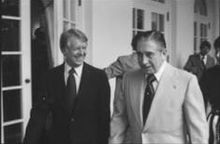
ETA:
And while the peoples of the Eastern European countries you mentioned obviously owe Mr. Reagan a great debt for the freedom from Soviet oppression that they enjoy today, (a fact which most of them recognize and acknowledge) I noticed that you neglected to include The Philippines in your list...
That was the first non-European country to successfully convert from dictatorship to democracy since WW II...
And it did so under strong pressure from the Reagan Administration...
Carter of course supported most of the same dictatorships that every Cold War President , Republican and Democrat had supported, (not faulting him for that; the dynamics of the struggle against Soviet expansionism required it) and in those cases where he did withdraw support for a dictator, those dictatorships were only replaced with other dictatorships, bitterly hostile to US interests. (For that I do fault him; in some cases we continue to pay for his mistakes to this very day.)