
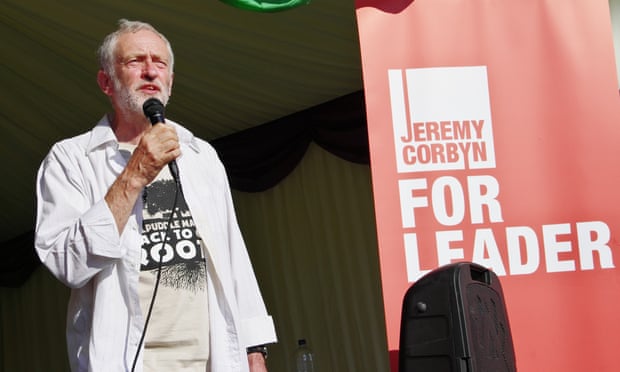
An extraordinary political tale is unfolding in Britain: a little-known politician, relegated to the margins of his party for much of his career, is now the favourite to become leader of the Labour party, the second-largest party in Britain and the government’s main opposition.
Jeremy Corbyn has been addressing increasingly sizeable audiences across the country, enthusing young new voters and Labour veterans alike with his anti-austerity, leftwing message declaring that the current economic and political status quo is neither inevitable nor desirable.
This stands in stark contrast to his rivals in the contest to succeed Ed Miliband, the Labour leader who presided over a huge loss for his party at the election in May. Corbyn’s fellow candidates Andy Burnham, Yvette Cooper and Liz Kendall are struggling to convince potential voters that their moderate policies are what the party needs to win back power from the Conservatives in five years’ time. Meanwhile, senior Labour figures have warned of the “madness” of a Jeremy Corbyn-led party. The former Labour prime minister Tony Blair, who led the party to three election victories, had a simple message to those whose heart was being swayed by Corbyn: “Get a transplant.”
Corbyn is not a sexy politician. Member of parliament for a north London constituency since 1983, he is neither a fresh new face on the national scene, nor a striking orator with a magnetic presence. This is not Britain’s Alexis Tsipras. He is an understated, thoughtful politician, happier to talk policy or discuss the people behind him than to focus on his own personal importance. Age 63, bearded and soft-spoken, Corbyn has attracted mocking headlines for his beige clothing and vests bought from the local market.
Nevertheless, he stands out from the other candidates. Burnham, Cooper and Kendall are seen by many Corbyn supporters as the same type of bland, technocratic and interchangeable career politician that puts people off from getting involved in politics, or even voting at all.
While his rivals desperately try to triangulate a centrist position that will satisfy both the party base and hypothetical voters of the kind they think Labour would need to win to gain power, Corbyn calls for renationalisation of the railways and energy companies, measures to address a burgeoning housing crisis, and increased public investment in banks, infrastructure, education and health. He also offers policies for a younger generation left reeling by cuts to education and welfare.
Some sections of the rightwing British media have barely been able to contain their glee at Corbyn’s rise, with the Daily Telegraph even openly encouraging their readers to sign up as Labour supporters to vote him in as leader, in the expectation that his leadership would lead the party to electoral doom or even to the demise of the party.
Certainly a Corbyn victory would cause tensions within the party: he very much reflects the small section of the party that has refused to accept the neoliberal consensus. He only made it on to the ballot because some politicians felt they should vote for him, despite disagreeing with him, in order to ensure a wide debate. Some of them may be regretting this now.
There are, broadly speaking, two schools of thought on what Jeremy Corbyn represents. One remains very popular with media commentators: that he represents a hysterical and childish response from the British left who, thoroughly rejected in May’s general election, have responded by turning to someone even less likely to be elected; in short, that they are wallowing in the comfort of opposition. Serious figures like the Guardian’s columnist Polly Toynbee have warned that Jeremy Corbyn as leader would be political suicide at a time when the country needs a strong and electable opposition to Conservative cuts.
The other is that after an election in which voters struggled to differentiate between the positions of the three main parties in England, and voted in huge numbers for an anti-austerity nationalist party in Scotland, Corbyn at least represents a jolt to the status quo. Some 60,000 new members have signed up to join Labour since May’s election, and among the returning members are thousands of people who have never taken an interest in politics before.
Like Bernie Sanders in the US, Corbyn is a reminder that voters today seem to crave authenticity and a challenge to to the status quo – even if, in the final analysis, that may not necessarily be an electable one.
Who is Corbyn?
Who is Corbyn?
“If you trust in yourself, and believe in your dreams, and follow your star. . . you'll still get beaten by people who spent their time working hard and learning things and weren't so lazy.”
-
Econoline

- Posts: 9607
- Joined: Sun Apr 18, 2010 6:25 pm
- Location: DeKalb, Illinois...out amidst the corn, soybeans, and Republicans
Re: Who is Corbyn?
Interesting column by Paul Krugman on exactly this issue:
AUG 4 11:36 AM
Corbyn and the Cringe Caucus
I haven’t been closely following developments in UK politics since the election, but people have been asking me to comment on the emergence of Jeremy Corbyn as a serious contender for Labour leadership. And I do have a few thoughts.
First, it’s really important to understand that the austerity policies of the current government are not, as much of the British press portrays them, the only responsible answer to a fiscal crisis. There is no fiscal crisis, except in the imagination of Britain’s Very Serious People; the policies had large costs; the economic upturn when the UK fiscal tightening was put on hold does not justify the previous costs. More than that, the whole austerian ideology is based on fantasy economics, while it’s actually the anti-austerians who are basing their views on the best evidence from modern macroeconomic theory and evidence.
Nonetheless, all the contenders for Labour leadership other than Mr. Corbyn have chosen to accept the austerian ideology in full, including accepting false claims that Labour was fiscally irresponsible and that this irresponsibility caused the crisis. As Simon Wren-Lewis says, when Labour supporters reject this move, they aren’t “moving left”, they’re refusing to follow a party elite that has decided to move sharply to the right.
What’s been going on within Labour reminds me of what went on within the Democratic Party under Reagan and again for a while under Bush: many leading figures in the party fell into what Josh Marshall used to call the “cringe”, basically accepting the right’s worldview but trying to win office by being a bit milder. There was a Stamaty cartoon during the Reagan years that, as I remember it, showed Democrats laying out their platform: big military spending, tax cuts for the rich, benefit cuts for the poor. “But how does that make you different from Republicans?” “Compassion — we care about the victims of our policies.”
I don’t fully understand the apparent moral collapse of New Labour after an election that was not, if you look at the numbers, actually an overwhelming public endorsement of the Tories. But should we really be surprised if many Labour supporters still believe in what their party used to stand for, and are unwilling to support the Cringe Caucus in its flight to the right?
People who are wrong are just as sure they're right as people who are right. The only difference is, they're wrong.
— God @The Tweet of God
— God @The Tweet of God
Re: Who is Corbyn?
This is how you can tell when a major political party in the UK has been "sent to Coventry"...
and has no chance of achieving victory any time in the near future...
They give serious consideration to having complete loonies lead them...
Mr Corbyn is the most "serious" potential Labour leader since Michael Foot was chosen....
Which is to say, not serious at all...

I wish him all the best...
I hope he wins the leadership...
He will assure the Tories a landslide win (bigger than the last one) in the next election cycle...
ETA:
Jiminey cricket, is there any political prognosticator on the planet dumber than Paul Krugman?

and has no chance of achieving victory any time in the near future...
They give serious consideration to having complete loonies lead them...
Mr Corbyn is the most "serious" potential Labour leader since Michael Foot was chosen....
Which is to say, not serious at all...
I wish him all the best...
I hope he wins the leadership...
He will assure the Tories a landslide win (bigger than the last one) in the next election cycle...
ETA:
You mean getting their asses kicked in the biggest back-to-back landslide electoral defeats in American history?What’s been going on within Labour reminds me of what went on within the Democratic Party under Reagan
Jiminey cricket, is there any political prognosticator on the planet dumber than Paul Krugman?




Re: Who is Corbyn?
If you want to achieve political success, Paul Krugman is definitely not your go-to guy....
The next time he makes a correct prediction will be the first time...
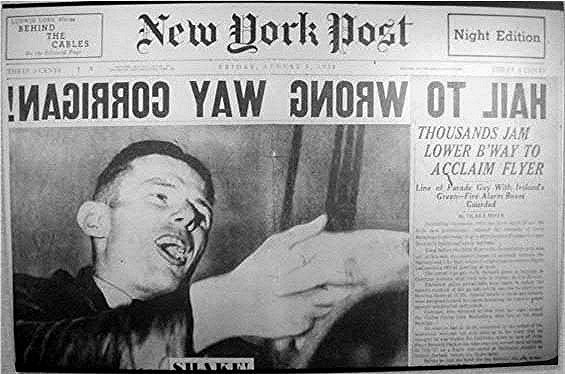
Krugman is the Wrong-Way-Corrigan of economic and political predictions...
The next time he makes a correct prediction will be the first time...
Krugman is the Wrong-Way-Corrigan of economic and political predictions...