
It was the urge to avoid playing ping-pong in the dark that led Luke Irwin to make one of Britain’s most extraordinary archaeological discoveries in recent years.
Without that compulsion, he might never have found out that he lives on the site of one of the biggest Roman villas ever built in the British Isles.
Irwin, a rug designer, and his wife had decided to convert an old barn on their newly purchased Wiltshire property into a room where they and their children could play table tennis, so they hired electricians to lay cables for lights.
“The electricians originally suggested stringing up an overhead cable from our house to supply the power for the barn, but I insisted it had to be an underground cable,” said Irwin. It turned out to be a fateful decision.
The electricians started drilling and hit a hard layer 18 inches below the surface. It was found to consist of pieces of mosaic. “We knew the significance of that straight away,” added Irwin. “No one since the Romans has laid mosaics as house floors in Britain. Fortunately we were able to stop the workmen just before they began to wield pickaxes to break up the mosaic layer.”
Irwin called in Historic England (formerly English Heritage), whose archaeologists confirmed that the mosaic had formed part the floor of a grand villa built between AD175 and 220, and had been remodelled several times before the fifth century.
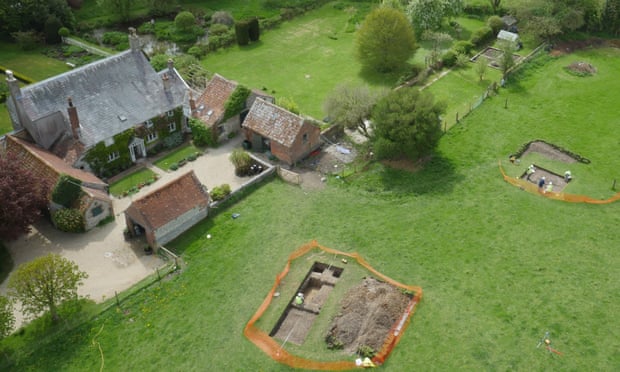
The Irwins’ house, created out of two labourers’ cottages, was built in the centre of the old villa and rests on a large slab of Purbeck marble, which is probably of Roman origin. According to the experts, the discovery is of “national significance”.
“The rest of the site has not been touched since the house collapsed more than 1,400 years ago, and it is unquestionably of enormous importance,” said Dr David Roberts, an Historic England archaeologist.
“This is a hugely valuable site with incredible potential. The discovery of such an elaborate and extraordinarily well-preserved villa, undamaged by agriculture for over 1,500 years, is unparalleled in recent years and it gives us a perfect opportunity to understand Roman and post-Roman Britain.”
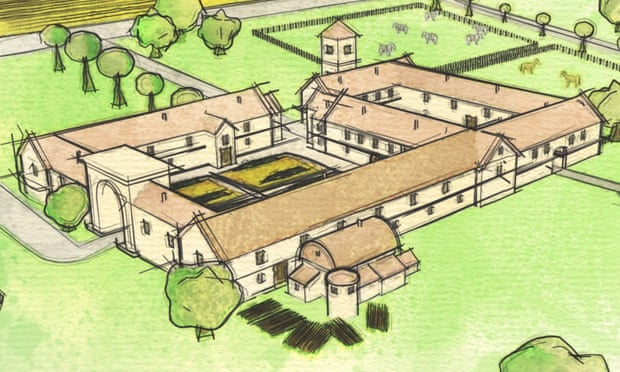
It is believed that the three-storey structure, which would have dominated the valley, was similar to that found at Chedworth, one of Britain’s most important Roman villa sites. It is thought to have belonged to a family of extraordinary wealth and importance. “It is not just the size of the building – which is vast – but the other discoveries that we have made that reveal what a special place this must have been,” said Roberts. “We have found discarded oyster and whelk shells. To keep them fresh, they must have been brought in barrels of salt water from the sea, which is miles away, and that shows just how rich the villa’s owners must have been.
Other discoveries have included a perfectly preserved Roman well and the stone coffin of a Roman child. This had been used to hold geraniums until its significance was realised. Only a few test pits have been dug, but Roberts said it was clear the walls of the villa were probably still more than a metre high, although they are buried under alluvial sediment from a nearby river. In addition, the mosaic has been revealed to be of particularly high quality. “Everything about this villa suggests it was made of the highest-quality materials,” added Roberts. “We have identified bits of stone that have come from at least 13 different British quarries. This was the country house of a powerful, rich Roman. Doubtless he also had a city house in London or Cirencester.”
Intriguingly, the house was not destroyed after the collapse of the Roman empire, said Roberts. Archaeologists have discovered timber structures erected in the fifth century. Roberts said the remains from this period, between the end of Roman occupation and the completion of Saxon domination of England, could open a window into one of the least understood periods in British history. It could also reveal how people responded to the collapse of the Roman empire, the superpower of the age.
In an English country garden
In an English country garden
“If you trust in yourself, and believe in your dreams, and follow your star. . . you'll still get beaten by people who spent their time working hard and learning things and weren't so lazy.”
-
Burning Petard
- Posts: 4638
- Joined: Fri Feb 12, 2016 5:35 pm
- Location: Near Bear, Delaware
Re: In an English country garden
Clearly a matter of confusion for two peoples speaking the same language. The Singing Brakeman never had nothing to do with English Country Gardens.
Snail gate
Snail gate