
VIENNA (Reuters) - Austria could elect the European Union's first far-right head of state on Sunday, with support for Freedom Party candidate Norbert Hofer buoyed by a migration crisis that has heightened fears about employment and security.
Opinion polls suggest the presidential race between Hofer and former Greens leader Alexander van der Bellen will be close-run. A far-right victory would resonate throughout the 28-member bloc where migration driven by conflict in the Middle East and Africa has become a major political issue.
Austria took in 90,000 asylum seekers last year, more than 1 percent of its population, many of them shortly after it and neighboring Germany threw open their borders last autumn to a wave of migrants including refugees from Syria's civil war.
The government has since clamped down on immigration and asylum, but that about-face only fueled support for the far right, which was already capitalizing on widespread frustration with the country's two traditional parties of government.
Sunday's run-off election comes four weeks after Hofer unexpectedly won the first round with 35 percent of the vote.
The president traditionally plays a largely ceremonial role but swears in the chancellor, can dismiss the cabinet and is commander in chief of the military.
Whoever wins, the election is likely to be a new high-water mark for Europe's resurgent far right, all the more significant for being in a relatively prosperous country with comparatively low, albeit rising, unemployment.
It will also indicate whether mainstream parties were right not to close ranks and call for an anti-Freedom Party (FPO) vote, with many feeling it would only have bolstered the FPO's argument that it is taking on a hostile political establishment.
Oh Vienna
Oh Vienna
“If you trust in yourself, and believe in your dreams, and follow your star. . . you'll still get beaten by people who spent their time working hard and learning things and weren't so lazy.”
Re: Oh Vienna
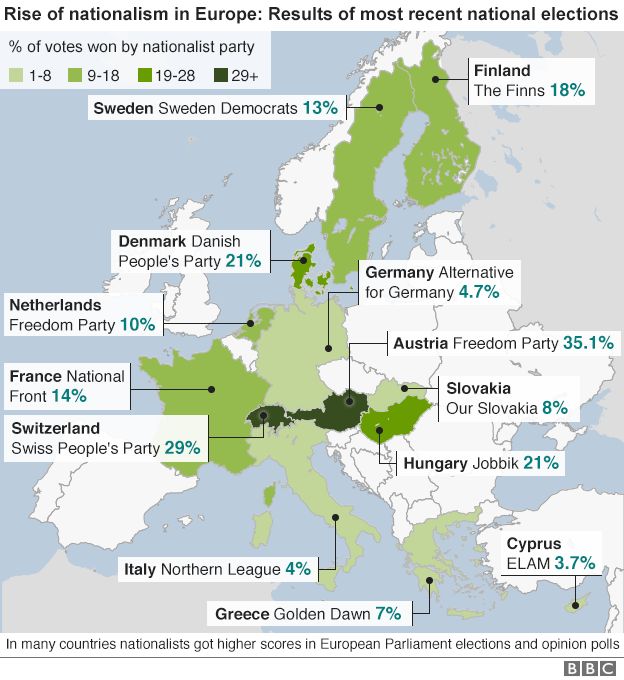
One definite accomplishment of the EU has been to improve the political standing of right-wing nationalist parties all over Europe...
The Law Of Unintended Consequences...
It is a bitch...
The Law Of Unintended Consequences...
It is a bitch...


-
MajGenl.Meade

- Posts: 21522
- Joined: Sun Apr 25, 2010 8:51 am
- Location: Groot Brakrivier
- Contact:
Re: Oh Vienna
About time someone in Europe woke up to the failings of left-liberal maundering, waffling and panty-waisted Munichism
For Christianity, by identifying truth with faith, must teach-and, properly understood, does teach-that any interference with the truth is immoral. A Christian with faith has nothing to fear from the facts
Re: Oh Vienna
Gob wrote:VIENNA (Reuters) - Austria could elect the European Union's first far-right head of state on Sunday, with support for Freedom Party candidate Norbert Hofer buoyed by a migration crisis that has heightened fears about employment and security.
.. "
Could have.
Didn't Hysteria over.
yrs,
rubato
Re: Oh Vienna
So aside from Aspergers boy's stupid "hysteria", many European commentators think this may herald a new rise of the extreme right, as in America.Austrians are now digesting the drama surrounding the election of their new president.
The traditional centre-left and centre-right parties - which have governed Austria in one form or another since 1945 - were decimated during the first round.
And the poll nearly, so very nearly resulted in a head of state from a right-wing populist party.
The rest of Europe watched and gawped.
Could this be a portentous sign of things to come elsewhere in Europe - Italy, France or Denmark for example, where right-wing populists are gaining in strength and influence?
“If you trust in yourself, and believe in your dreams, and follow your star. . . you'll still get beaten by people who spent their time working hard and learning things and weren't so lazy.”

Re: Oh Vienna
Politico isn't quite so hysterical:
http://www.politico.eu/article/5-takeaw ... ht-greens/
Here are five takeaways from the election.
1. Europe’s postwar political establishment is crumbling
Above all, the Austrian result illustrates that the center-right and center-left parties that have dominated the Continent’s politics since World War II are in retreat.
The Social Democratic and People’s Party blocs that have ensured stability for decades across much of the region are quickly losing their appeal. The first round of the election, in which the establishment parties finished at the bottom of the field, amounted to a repudiation of their stewardship.
Austria, like Germany, is governed by a grand coalition, a constellation that if left in place for too long stokes support for the political fringe.
2. Polarization is the new normal
The cozy days of polite political debate in Western Europe are over. The exchanges between Van der Bellen and Hofer were some of the most caustic in recent memory.
Alexander Van der Bellen reacts during an election party after the second round of the Austrian President elections
ALSO ON POLITICO
Austria to get Green president after far-right cedes
MATTHEW KARNITSCHNIG
With candidates outside of the mainstream increasingly joining the political fray — the first presidential round in Austria included six hopefuls — the tone of the debate is getting sharper. Though Eastern Europeans are known to go for the jugular (sometimes literally), politics in Western Europe have for the most part been staid. With the emergence of the Alternative für Deutschland in Germany and the resurgence of the right wing in France, the Netherlands and Scandinavia, that’s changing.
Austria highlights a more troubling aspect of that trend: a widening class divide. While well-educated city dwellers supported Van der Bellen, low-earning rural and working class Austrians backed Hofer. The country hasn’t seen such stark divisions in its electorate since the 1930s, when clashes between rightist and leftist forces almost triggered a civil war.
The results of the close run-off come in | Jan Hetfleisch/Getty Images
The results of the close run-off come in | Jan Hetfleisch/Getty Images
3. The wealthy aren’t immune to the pull of populists
By any objective measure, Austria counts as one of Europe’s, indeed the world’s, richest nations. Unemployment is low, compared to most EU countries, and growth is stable, if not spectacular. That the Freedom Party nonetheless succeeded in upending the country’s politics shows that voters care as much about the future as they do the present. The core of the party’s supporters may not be rich, but they aren’t poor either.
The Freedom Party’s message is that Austria is headed in the wrong direction. Even if Austrians feel comfortable now, Islam, the EU and the forces of globalization threaten to destroy their future, the party warns. With countries across Europe confronting similar societal headwinds, look for the Freedom Party’s playbook to be adopted by parties in other parts of Western Europe.
4. Europe’s liberals may be down, but they’re not out
Van der Bellen’s come-from-behind victory shows that when the chips are down, the Continent’s pro-EU, liberal forces can rally together and carry the day. In the run-off, Van der Bellen won 1.3 million more votes than in the first round, indicating that fear of a Freedom Party victory drove large numbers of conservative voters into his camp. In addition, turnout was high, at 73 percent, with many voters who didn’t turn up for the first round casting a ballot in the second.
5. Sincerity sells
Love them or hate them, a quality both candidates in the race shared was authenticity. Unlike the mainstream parties, which have waffled and reversed course on myriad issues, Van der Bellen and Hofer left little question about where they stood on the key topics of the day.
Van der Bellen was unapologetic about his stance on welcoming refugees, his support for the EU and conviction that the Schengen treaty is a cornerstone of Europe’s stability. Hofer, meanwhile, spoke just as clearly about what he regards as the urgency to secure Austria’s borders and keep the EU from encroaching too much on Austria’s sovereignty.
http://www.politico.eu/article/5-takeaw ... ht-greens/
Here are five takeaways from the election.
1. Europe’s postwar political establishment is crumbling
Above all, the Austrian result illustrates that the center-right and center-left parties that have dominated the Continent’s politics since World War II are in retreat.
The Social Democratic and People’s Party blocs that have ensured stability for decades across much of the region are quickly losing their appeal. The first round of the election, in which the establishment parties finished at the bottom of the field, amounted to a repudiation of their stewardship.
Austria, like Germany, is governed by a grand coalition, a constellation that if left in place for too long stokes support for the political fringe.
2. Polarization is the new normal
The cozy days of polite political debate in Western Europe are over. The exchanges between Van der Bellen and Hofer were some of the most caustic in recent memory.
Alexander Van der Bellen reacts during an election party after the second round of the Austrian President elections
ALSO ON POLITICO
Austria to get Green president after far-right cedes
MATTHEW KARNITSCHNIG
With candidates outside of the mainstream increasingly joining the political fray — the first presidential round in Austria included six hopefuls — the tone of the debate is getting sharper. Though Eastern Europeans are known to go for the jugular (sometimes literally), politics in Western Europe have for the most part been staid. With the emergence of the Alternative für Deutschland in Germany and the resurgence of the right wing in France, the Netherlands and Scandinavia, that’s changing.
Austria highlights a more troubling aspect of that trend: a widening class divide. While well-educated city dwellers supported Van der Bellen, low-earning rural and working class Austrians backed Hofer. The country hasn’t seen such stark divisions in its electorate since the 1930s, when clashes between rightist and leftist forces almost triggered a civil war.
The results of the close run-off come in | Jan Hetfleisch/Getty Images
The results of the close run-off come in | Jan Hetfleisch/Getty Images
3. The wealthy aren’t immune to the pull of populists
By any objective measure, Austria counts as one of Europe’s, indeed the world’s, richest nations. Unemployment is low, compared to most EU countries, and growth is stable, if not spectacular. That the Freedom Party nonetheless succeeded in upending the country’s politics shows that voters care as much about the future as they do the present. The core of the party’s supporters may not be rich, but they aren’t poor either.
The Freedom Party’s message is that Austria is headed in the wrong direction. Even if Austrians feel comfortable now, Islam, the EU and the forces of globalization threaten to destroy their future, the party warns. With countries across Europe confronting similar societal headwinds, look for the Freedom Party’s playbook to be adopted by parties in other parts of Western Europe.
4. Europe’s liberals may be down, but they’re not out
Van der Bellen’s come-from-behind victory shows that when the chips are down, the Continent’s pro-EU, liberal forces can rally together and carry the day. In the run-off, Van der Bellen won 1.3 million more votes than in the first round, indicating that fear of a Freedom Party victory drove large numbers of conservative voters into his camp. In addition, turnout was high, at 73 percent, with many voters who didn’t turn up for the first round casting a ballot in the second.
5. Sincerity sells
Love them or hate them, a quality both candidates in the race shared was authenticity. Unlike the mainstream parties, which have waffled and reversed course on myriad issues, Van der Bellen and Hofer left little question about where they stood on the key topics of the day.
Van der Bellen was unapologetic about his stance on welcoming refugees, his support for the EU and conviction that the Schengen treaty is a cornerstone of Europe’s stability. Hofer, meanwhile, spoke just as clearly about what he regards as the urgency to secure Austria’s borders and keep the EU from encroaching too much on Austria’s sovereignty.
“I ask no favor for my sex. All I ask of our brethren is that they take their feet off our necks.” ~ Ruth Bader Ginsburg, paraphrasing Sarah Moore Grimké

Re: Oh Vienna
It is a beautiful but wacky little country. I love visiting, but I would never live there. I'm glad my ancestors were long gone by the turn of the 20th century.
“I ask no favor for my sex. All I ask of our brethren is that they take their feet off our necks.” ~ Ruth Bader Ginsburg, paraphrasing Sarah Moore Grimké
Re: Oh Vienna
I'm not more frightened than I was before because I already knew these attitudes were there and I knew how widespread they were and are.
The level of nativist racism and xenophobia across Europe has not actually changed; it has only become more visible. People's attitudes have not changed they have just become emboldened to express publicly what they would have concealed before because they were ashamed of it.
It's like developing a photograph, the image was there you just couldn't see it before.
The same is true here. Trump has not changed the attitudes of Republican voters he just invites them to 'be themselves' by reflecting their ideas back at them.
The world will always be vulnerable to this kind of racist primitivism and the only way of reducing it is by education. The hatred and fear of people from different cultures with different languages and different customs is reduced by learning more about them and learning to see that there are underlying similarities, and that there are different virtues in different traditions. Racists attack multicultural education because it is the opposite of xenophobia.
Germany is more morally advanced, and you can see this in their greater acceptance of moral responsibility for the welfare of refugees, because they have had to pay the price and confront directly the seeds of that evil. They undergone a generations-long period of self-examination. Austria has deluded themselves by saying THEY were "victims" of the Nazis and refusing to acknowledge they were Nazis themselves.
yrs,
rubato
The level of nativist racism and xenophobia across Europe has not actually changed; it has only become more visible. People's attitudes have not changed they have just become emboldened to express publicly what they would have concealed before because they were ashamed of it.
It's like developing a photograph, the image was there you just couldn't see it before.
The same is true here. Trump has not changed the attitudes of Republican voters he just invites them to 'be themselves' by reflecting their ideas back at them.
The world will always be vulnerable to this kind of racist primitivism and the only way of reducing it is by education. The hatred and fear of people from different cultures with different languages and different customs is reduced by learning more about them and learning to see that there are underlying similarities, and that there are different virtues in different traditions. Racists attack multicultural education because it is the opposite of xenophobia.
Germany is more morally advanced, and you can see this in their greater acceptance of moral responsibility for the welfare of refugees, because they have had to pay the price and confront directly the seeds of that evil. They undergone a generations-long period of self-examination. Austria has deluded themselves by saying THEY were "victims" of the Nazis and refusing to acknowledge they were Nazis themselves.
yrs,
rubato
-
oldr_n_wsr
- Posts: 10838
- Joined: Sun Apr 18, 2010 1:59 am
Re: Oh Vienna
I don't think they were ashamed of it, I think they were belittled into silence. Not ashamed of their opinion but of the repercussions of speaking out.become emboldened to express publicly what they would have concealed before because they were ashamed of it.
I see it here in the usa, and on this message board.
If one doesn't know that there are more than a few people who hold the same opinions and beliefs they tend to stay silent for fear of ridicule and scorn. When more start speaking up, they get empowered to speak up also.
Re: Oh Vienna
Aspergerish hysteria again from rubato?rubato wrote:I'm not more frightened than I was before because I already knew these attitudes were there and I knew how widespread they were and are.
The level of nativist racism and xenophobia across Europe has not actually changed; it has only become more visible. People's attitudes have not changed they have just become emboldened to express publicly what they would have concealed before because they were ashamed of it.
It's like developing a photograph, the image was there you just couldn't see it before.
The same is true here. Trump has not changed the attitudes of Republican voters he just invites them to 'be themselves' by reflecting their ideas back at them.
The world will always be vulnerable to this kind of racist primitivism and the only way of reducing it is by education. The hatred and fear of people from different cultures with different languages and different customs is reduced by learning more about them and learning to see that there are underlying similarities, and that there are different virtues in different traditions. Racists attack multicultural education because it is the opposite of xenophobia.
Germany is more morally advanced, and you can see this in their greater acceptance of moral responsibility for the welfare of refugees, because they have had to pay the price and confront directly the seeds of that evil. They undergone a generations-long period of self-examination. Austria has deluded themselves by saying THEY were "victims" of the Nazis and refusing to acknowledge they were Nazis themselves.
yrs,
rubato

Where's his new thread?
“If you trust in yourself, and believe in your dreams, and follow your star. . . you'll still get beaten by people who spent their time working hard and learning things and weren't so lazy.”
Re: Oh Vienna
Nothing intelligent to say in response.
typical of you.
All shit.
typical of you.
All shit.
Re: Oh Vienna
“They may be able to describe correctly, in a cognitive and often formalistic fashion, other people’s emotions, expected intentions, and social conventions; yet, they are unable to act on this knowledge in an intuitive and spontaneous fashion, thus losing the tempo of the interaction. Their poor intuition and lack of spontaneous adaptation are accompanied by a marked reliance on formalistic rules of behavior and rigid social conventions. This presentation is largely responsible for the impression of social naiveté and behavioral rigidity that is so forcefully conveyed by these individuals.”
“If you trust in yourself, and believe in your dreams, and follow your star. . . you'll still get beaten by people who spent their time working hard and learning things and weren't so lazy.”
Re: Oh Vienna
Still all shit.
Poor baby.
So scared! So frightened! Such a coward.
yrs,
rubato
Poor baby.
So scared! So frightened! Such a coward.
yrs,
rubato
Re: Oh Vienna
Well said.rubato wrote:Still all shit.
Poor baby.
So scared! So frightened! Such a coward.
yrs,
rubato
“If you trust in yourself, and believe in your dreams, and follow your star. . . you'll still get beaten by people who spent their time working hard and learning things and weren't so lazy.”
Re: Oh Vienna
Mere mindless insults, nothing.
yrs,
rubato
yrs,
rubato

Re: Oh Vienna
rubato wrote:Still all shit.
Poor baby.
So scared! So frightened! Such a coward.
When he's right, he's right...rubato wrote:Mere mindless insults, nothing.
