What happens in 2012?

All the shit that doesn't fit!
If it doesn't go into the other forums, stick it in here.
A general free for all
Post Reply
rubato
Posts: 14245
Joined: Sun May 09, 2010 10:14 pm

What happens in 2012?

Post by rubato »

The world continues to change:

http://www.solarbuzz.com/our-research/r ... 2011-40-yy

World Solar Photovoltaic Market Grew to 27.4 Gigawatts in 2011, Up 40% Y/Y

Incentive Cutbacks in Europe, Falling Prices, Create Major Corporate Challenges in 2012

SANTA CLARA, Calif.—March 19, 2012—Worldwide solar photovoltaic (PV) market installations reached a record high of 27.4 gigawatts (GW) in 2011, up 40% Y/Y, according to the annual PV market report, 2012 Marketbuzz® issued today by NPD Solarbuzz.

Overall market growth in 2011 was boosted by strong second half demand ahead of further deep cuts in solar incentives. This followed a period of over-production in the first half that triggered the sustained price decline through the PV chain that came to characterize 2011. The dominance of Chinese manufacturers in crystalline silicon wafers, cells and modules grew, the share of thin film declined, and demand in Asian markets grew rapidly.

The PV industry generated $93 billion in global revenues in 2011, up 12% Y/Y, while the industry successfully raised more than $8 billion in corporate equity and debt.

Of the more than 100 countries worldwide covered in Marketbuzz, the top five PV markets were Germany, Italy, China, the United States, and France—74% of global demand in 2011. China soared 470% Y/Y, rising from to third place from seventh in 2010.

Image

European countries accounted for 18.7 GW, or 68% of world demand in 2011, down from 82% in 2010. Strong growth in France and Italy, combined with a year-end surge in German demand that held it flat Y/Y, meant that Germany, Italy and France collectively accounted for 82% of the European market.

Figure 1: Major PV Country Markets (GW)

Source: NPD Solarbuzz 2012 Marketbuzz

Worldwide solar cell production reached 29.5 GW in 2011, up from 23.0 GW a year earlier, with thin film production accounting for 11% of total production. Production from China and Taiwan accounted for 74% of global cell production, up from 63% in the prior year.

The Top 10 polysilicon manufacturers had 204K metric tons per annum of capacity in 2011, while the Top 10 wafer manufacturers accounted for 44% of global capacity.

The excess of solar cell production over demand during 1H’11 caused market-weighted average crystalline silicon factory-gate module prices to drop 28% in 2011, significantly more than the 14% drop the previous year. Furthermore, Q4’11 versus Q4’10 prices were down 46%.

Over the next five years, factory-gate module prices are projected to drop between 43% and 53% from 2011 levels. Average c-Si factory-gate prices in 2012 will be at least 29% lower than the 2011 average.

Over the next 12 months, the Rest of World markets are projected to increase to 32% of global demand, from just 20% last year, while Europe loses share, dropping to 53%. By 2016, European market share is projected to fall below 42% as North America and several Asian markets grow rapidly. China is forecast to reach 17% of the world market by 2016.

“Aggressive cuts in incentives in Germany and other European countries have set up the potential for a global market decline in 2012, but ahead of these the rush to install is on, especially in Germany,” said Craig Stevens, President of NPD Solarbuzz. “These cuts in tariffs will force companies to embrace self-sustaining marketing models earlier than they expected. Meanwhile, Chinese policy makers will face a decision whether to stimulate their domestic market even more than planned to support their globally dominant manufacturing base.”

______________________________

yrs,
rubato

User avatar
Timster
Posts: 967
Joined: Sun Apr 18, 2010 3:43 am

Re: What happens in 2012?

Post by Timster »

Question. is this misanthropic little cut and paste job supposed to instill confidence in your punk ass somehow?

Just saying that what you intended to be a tasty morsel in the minds of the inquiring has only left a bad taste in my mouth.

You may argue about a discerning pallete.

And there I would be forced to agree...

Indeed, the World Is changing. Why can't you?
All truth passes through three stages. First, it is ridiculed. Second, it is violently opposed. Third, it is accepted as being self-evident.

Arthur Schopenhauer-

rubato
Posts: 14245
Joined: Sun May 09, 2010 10:14 pm

Re: What happens in 2012?

Post by rubato »

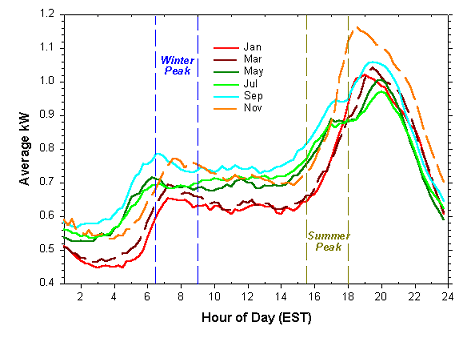
Nuclear power plants produce between 0.5 and 2.0 gigawatts for each reactor (most are closer to the higher number), to give an idea of the scale of 27 Gigawatts/yr. At peak output we are making and installing enough photovoltaic panels to equal 13 new nuclear plants per year in an industry which is in a period of exponential growth.

While it is true that output varies with time of day, so does the usage:


Image


Image

There is considerable overlap between peak production from solar and peak demand.

yrs,
rubato

User avatar
Sue U
Posts: 9087
Joined: Thu Apr 15, 2010 4:59 pm
Location: Eastern Megalopolis, North America (Midtown)

Re: What happens in 2012?

Post by Sue U »

Here's the part I find most interesting:
The excess of solar cell production over demand during 1H’11 caused market-weighted average crystalline silicon factory-gate module prices to drop 28% in 2011, significantly more than the 14% drop the previous year. Furthermore, Q4’11 versus Q4’10 prices were down 46%.

Over the next five years, factory-gate module prices are projected to drop between 43% and 53% from 2011 levels. Average c-Si factory-gate prices in 2012 will be at least 29% lower than the 2011 average.

Over the next 12 months, the Rest of World markets are projected to increase to 32% of global demand, from just 20% last year, while Europe loses share, dropping to 53%. By 2016, European market share is projected to fall below 42% as North America and several Asian markets grow rapidly. China is forecast to reach 17% of the world market by 2016.

“Aggressive cuts in incentives in Germany and other European countries have set up the potential for a global market decline in 2012, but ahead of these the rush to install is on, especially in Germany,” said Craig Stevens, President of NPD Solarbuzz. “These cuts in tariffs will force companies to embrace self-sustaining marketing models earlier than they expected. Meanwhile, Chinese policy makers will face a decision whether to stimulate their domestic market even more than planned to support their globally dominant manufacturing base.”
We put solar panels on our house a bit over two years ago, but with substantial government subsidies (mostly in the form of tax credits) that effectively covered about 35 to 40% of the costs of purchase and installation. Even so, the break-even point in terms of energy savings will be roughly 10 years. (We had initially calculated it at about 6.5 years, but in actual operation the panels are not quite as productive as their official output rating suggests. However, our calculations do not account for inflation or rising costs of energy in excess of inflation rate, so there may be some savings off the estimates.) The problem is, even assuming that reductions in subsidies are offset by falling prices of panels, the up-front cost is still significant and by the time in their lives that most people might even be able to afford it, a 10-year horizon for recouping those costs is undesireable. Under these circumstances, does residential solar installation make economic sense? Or is the more promising path large-scale commercial/indutstrial installation and solar farms?
GAH!

dgs49
Posts: 3458
Joined: Fri Oct 29, 2010 9:13 pm

Re: What happens in 2012?

Post by dgs49 »

Economically, these things will forever remain nothing more than novelty items for most consumers.

The inconvenient fact is that burning of carbon-based fuels is going to be far, far cheaper and infinitely more reliable for at least the next 50 years, and if misguided governments would simply get out of the way, our true energy costs over that time could be declining. New technology is discovering natural gas and oil resources FASTER THAN WE ARE CONSUMING THEM, with the perverse result that the world's known reserves would increase every year, absent government meddling.

Of course if you believe that man-made carbon exhaust is warming the planet to eventual uninhabitability, then maybe you should elect a president who will seek to suppress such activities.

No wait. You already did that.

rubato
Posts: 14245
Joined: Sun May 09, 2010 10:14 pm

Re: What happens in 2012?

Post by rubato »

Economically 'these things' reached grid parity in much of the world in 2011. Nuclear remained the highest-cost option even before calculating the area around Fukushima which will be taken out of agricultural production and depopulated indefinately .

yrs,
rubato

User avatar
Timster
Posts: 967
Joined: Sun Apr 18, 2010 3:43 am

Re: What happens in 2012?

Post by Timster »

Not to put too fine a point on it robusto but shouldn't you be in a home for the epically failed terminallly myopic old and cranky bastards by now? Just saying... :fu

Oh and thanks for the graphs...
All truth passes through three stages. First, it is ridiculed. Second, it is violently opposed. Third, it is accepted as being self-evident.

Arthur Schopenhauer-

User avatar
Timster
Posts: 967
Joined: Sun Apr 18, 2010 3:43 am

Re: What happens in 2012?

Post by Timster »

Okay, although I am not "delusional"; I am giving myself a time out. Lest I become that which I despise.

Later Gators~ :fu 8-) :D
All truth passes through three stages. First, it is ridiculed. Second, it is violently opposed. Third, it is accepted as being self-evident.

Arthur Schopenhauer-

User avatar
The Hen
Posts: 5941
Joined: Tue Apr 06, 2010 8:56 am

Re: What happens in 2012?

Post by The Hen »

Don't be a stranger now.

:D
Bah!

Image

Post Reply