yrs,
rubato



That's a common problem with images here. The work-around is to right-click on the image, then select "Open image in new tab"...and then click open the new tab. (I have to do that pretty often to see larger images, which tend to get cut off on the right edge.)bigskygal wrote:Linky? I can't see the full map or the key.
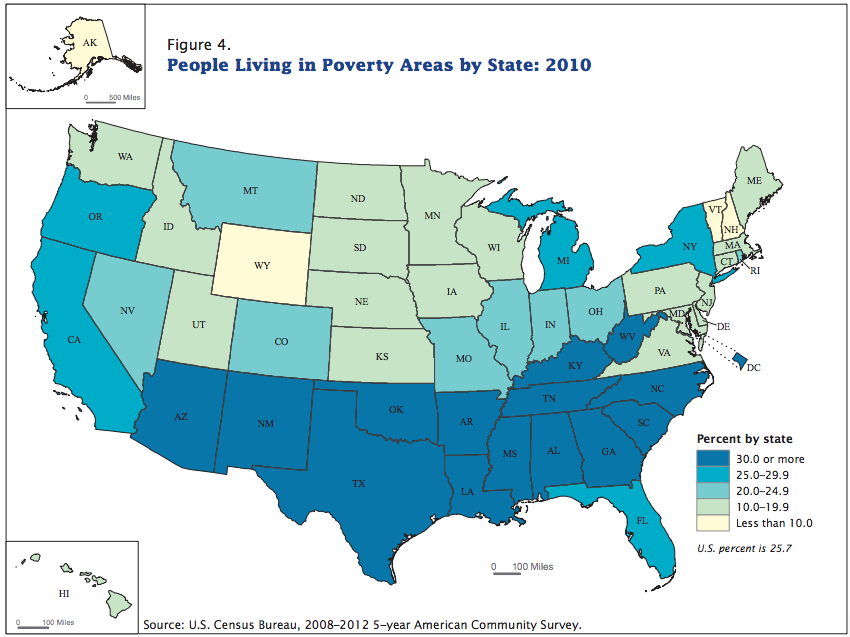
...or that poor people tend to move to (or stay in) warm states, so that they don't have to pay crippling heating bills?Lord Jim wrote:I guess for some reason rube wanted to make the "point" that states with the highest percentages of minority population have higher poverty rates, since that's the most obvious correlation that leaps out from that map...

 Well, yeah, of course...that goes without saying!

That is patently untrue. California, New York, New Jersey, Maryland and Nevada all have higher percentages of minority populations than most of the states in the Deep South poverty belt. In terms of African-Americans alone, Maryland has a higher percentage than all states other than Mississippi, Louisiana and Georgia. Delaware, New York, Illinois and New Jersey all have substantially higher percentages of African-Americans than Texas, Kentucky, Oklahoma and West Virgina.Lord Jim wrote:I guess for some reason rube wanted to make the "point" that states with the highest percentages of minority population have higher poverty rates, since that's the most obvious correlation that leaps out from that map...
http://www.vox.com/2014/6/30/5857074/wh ... ncentratedplaces where more than 20 percent of the population lives under the poverty line, currently around $23,600 for a two-parent family of four, according to a new report from the Census Bureau.
http://www.vox.com/2014/6/30/5857074/wh ... ncentratedAround 15 percent of Americans live in poverty,
http://www.npc.umich.edu/poverty/How many people were poor in 2010?
In 2010, 15.1 percent of all persons lived in poverty.
So on top of the fact that "poverty" is being rated without all these in kind contributions, including the EITC,cash benefits from government assistance programs are included in a family's income when calculating the official poverty measure, benefits received in-kind such as food stamps, Medicare or Medicaid, employer provided health insurance, housing subsidies, and other social services are excluded. Taxes that families pay and tax credits they receive such as the Earned Income Tax Credit (EITC) do not enter into the official poverty determination.
The poverty rate for all persons masks considerable variation between racial/ethnic subgroups. Poverty rates for blacks and Hispanics greatly exceed the national average. In 2010, 27.4 percent of blacks and 26.6 percent of Hispanics were poor, compared to 9.9 percent of non-Hispanic whites and 12.1 percent of Asians.
Poverty rates are highest for families headed by single women, particularly if they are black or Hispanic. In 2010, 31.6 percent of households headed by single women were poor, while 15.8 percent of households headed by single men and 6.2 percent of married-couple households lived in poverty.][Say what you want about Rick Santorum; he's absolutely right when he talks about two parent families and the avoidance of poverty...the numbers don't lie..)
There are also differences between native-born and foreign-born residents. In 2010, 19.9 percent of foreign-born residents lived in poverty, compared to 14.4 percent of residents born in the United States. Foreign-born, non-citizens had an even higher incidence of poverty, at a rate of 26.7 percent.
http://www.npc.umich.edu/poverty/#4
http://www.npc.umich.edu/poverty/In 2010, 31.6 percent of households headed by single women were poor
So, what one would logically expect, is that those states with the highest percentages of those groups with the highest numbers below the poverty line, would be the states with the highest poverty rates overall. That's just logic and basic math, and doesn't have anything to do with how many "poverty areas" there are in a state or how many people live in those "poverty areas".Poverty rates for blacks and Hispanics greatly exceed the national average. In 2010, 27.4 percent of blacks and 26.6 percent of Hispanics were poor, compared to 9.9 percent of non-Hispanic whites and 12.1 percent of Asians.
Poverty rates are highest for families headed by single women, particularly if they are black or Hispanic. In 2010, 31.6 percent of households headed by single women were poor, while 15.8 percent of households headed by single men and 6.2 percent of married-couple households lived in poverty.
In 2010, 19.9 percent of foreign-born residents lived in poverty, compared to 14.4 percent of residents born in the United States. Foreign-born, non-citizens had an even higher incidence of poverty, at a rate of 26.7 percent.