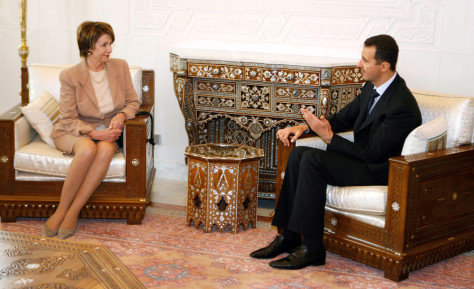
Maybe North Korea can Co-Chair the negociations...
I have mixed feelings about this...
First of all, we can lay the whole hysterical 'traitor" and " this kind of attempt to undercut presidential control over foreign policy is really unprecedented" blah, blah, blah, BS aside; this is
hardly the first time that members of Congress have attempted to interpose themselves in the conduct of foreign policy...
That picture I posted of then House Speaker Nancy Pelosi meeting with Syrian dictator Bashir Al-Assad,is from 2007...
She made that trip at a time when the Bush Administration was involved in intensive efforts to rally international support for increased pressure on the Assad regime. (If you look back over the past 30-40 years, you can find a number of additional examples; from both parties)
Second, I
certainly share the concern that I believe motivated this letter:
Namely, that having seen one foreign policy miscalculation after another, after another,
after another, blow up in their face, (from the "reset button" with Putin to the declaring of ISIS to be a "JV team", and many bad decisions in between) this Administration, (and Obama and Kerry in particular) is so
desperate for a foreign policy "win" that they might well sign off on a deal that doesn't include sufficient safe guards against a "breakout" to prevent Iran from obtaining a nuclear weapon...
I think that's a
very legitimate concern...
But all of that having been said, I really don't think this letter was the best way to address that concern, primarily because of the affect it will have regarding
this point from the article in the OP:
the letter might have undermined Republicans' effort by turning Iran into a partisan issue and making it harder for Democrats to buck Obama on it.
[NYT / Jennifer Steinhauser and Julie Hirschfeld Davis]
I think that's exactly right, and statements made in the Senate earlier this week by Democratic Senators Bill Nelson and Joe Manchin regarding this letter (two Democrats who have expressed public skepticism about a deal with Iran in the past) would seem to underscore that point...
I listened to some of the Senate hearing with Kerry at the Senate Foreign Relations Committee today, (the focus was mainly on the new AUMF being proposed for combating ISIS; I think the proposed resolution gives away
far too much information to the enemy about what we are willing to do and how long we are willing to do it...but that's another discussion...)
But during the hearing, this letter was also discussed...
Rand Paul, (of all people) actually made a good point. While there are a number of errors about Constitutional procedures and prerogatives in the letter, (another reason it was probably ill advised) Paul pointed out, that if the President reaches an agreement which would require the lifting or suspension of
Congressionally authorized sanctions, that would in fact require
Congressional action; that could
not be done simply by an Executive Order....
Even Obama, (who has recently demonstrated a robust and forward leaning interpretation of the purviews of Executive Orders ) seems to realize this. (If he didn't, when he decided to restore diplomatic relations with Cuba, he would have certainly have tried to nullify the Congressionally mandated embargo provisions under the Helms-Burton Act. Apparently even Obama sees that as a bridge too far.)
If the Administration comes back with an inadequate agreement,
that is that battlefield to fight on.
That is the play; refusing to change existing sanctions codified in law, even if the agreement requires that those legally codified sanctions be lifted....
And without this letter, if it comes to that, they would have been making this stand with substantial Democratic support...
They might still get it, but this letter makes it unnecessarily more problematic.